
How to Keep a Conversation Going: 12 Techniques With Examples
By Michael Lee, communication and relationship coach · Last updated
Keeping a conversation going is the skill of sustaining a two-way exchange after the opening of a conversation. Keeping a conversation going depends on three actions: asking questions, sharing details and listening closely. The 12 techniques below work in person, over text and on dates. Each technique belongs to the wider set of conversation skills.
What Does It Mean to Keep a Conversation Going?
Keeping a conversation going means sustaining a two-way exchange after the opening. Both people keep adding new material to a sustained conversation. A conversation that keeps going has a steady back-and-forth. Each turn moves from speaking to listening. Each person then hands the turn back to the other person.
Every conversation moves through 4 stages: opening, sustaining, deepening and closing. Keeping a conversation going is the sustaining stage. The sustaining stage starts after the greeting and the first question. The opening stage belongs to how to start a conversation.
Conversation turns move fast. The average gap between two speakers’ turns is about 200 milliseconds, according to research published in Philosophical Transactions of the Royal Society B (Templeton et al., 2023). A steady rhythm of turns signals that both people are engaged. A sustained conversation gives both people roughly equal talking time.
Why Do Conversations Die?
Conversations die when one person stops giving the other person anything to respond to. The 5 most common causes of a dying conversation are closed questions, one-word answers, interview mode, shift responses and fear of silence.
- Closed questions. A closed question invites a yes-or-no answer. A yes-or-no answer ends the turn without opening a new topic.
- One-word answers. A one-word answer gives the other person no detail to pick up. The other person then has to carry the whole conversation alone.
- Interview mode. Interview mode is a string of questions with no sharing in between. Interview mode makes a conversation feel like an interrogation.
- Shift responses. A shift response turns the topic back to the speaker’s own life. Sociologist Charles Derber named the shift response as the main habit behind conversational narcissism. The opposite of a shift response is a support response. A support response keeps the focus on the other person.
- Fear of silence. Fear of silence pushes people to fill every pause with filler or a sudden topic change. Rushed topic changes break the thread of the conversation.
Phones also shorten conversations. Phone use during meals lowers enjoyment of time with friends and family. Researchers at the University of British Columbia linked that drop to distraction (Dwyer, Kushlev and Dunn, 2018).
What Are the Signs a Conversation Is Dying?
The 5 signs a conversation is dying are shorter answers, no questions back, longer gaps, glances away and closed body language.
- Shorter answers. Each reply gets shorter than the reply before it.
- No questions back. The other person answers without asking anything in return.
- Longer gaps. Pauses between turns grow longer than 2 seconds. Long gaps signal disconnection between strangers (Templeton et al., 2023).
- Glances away. The other person looks at a phone, a watch or the exit.
- Closed body language. Crossed arms, a turned-away torso and feet pointed toward the door signal a wish to leave.
A dying conversation recovers when one person adds new material to it. The 12 techniques below give a conversation that new material.
What Are the 12 Best Techniques to Keep a Conversation Going?
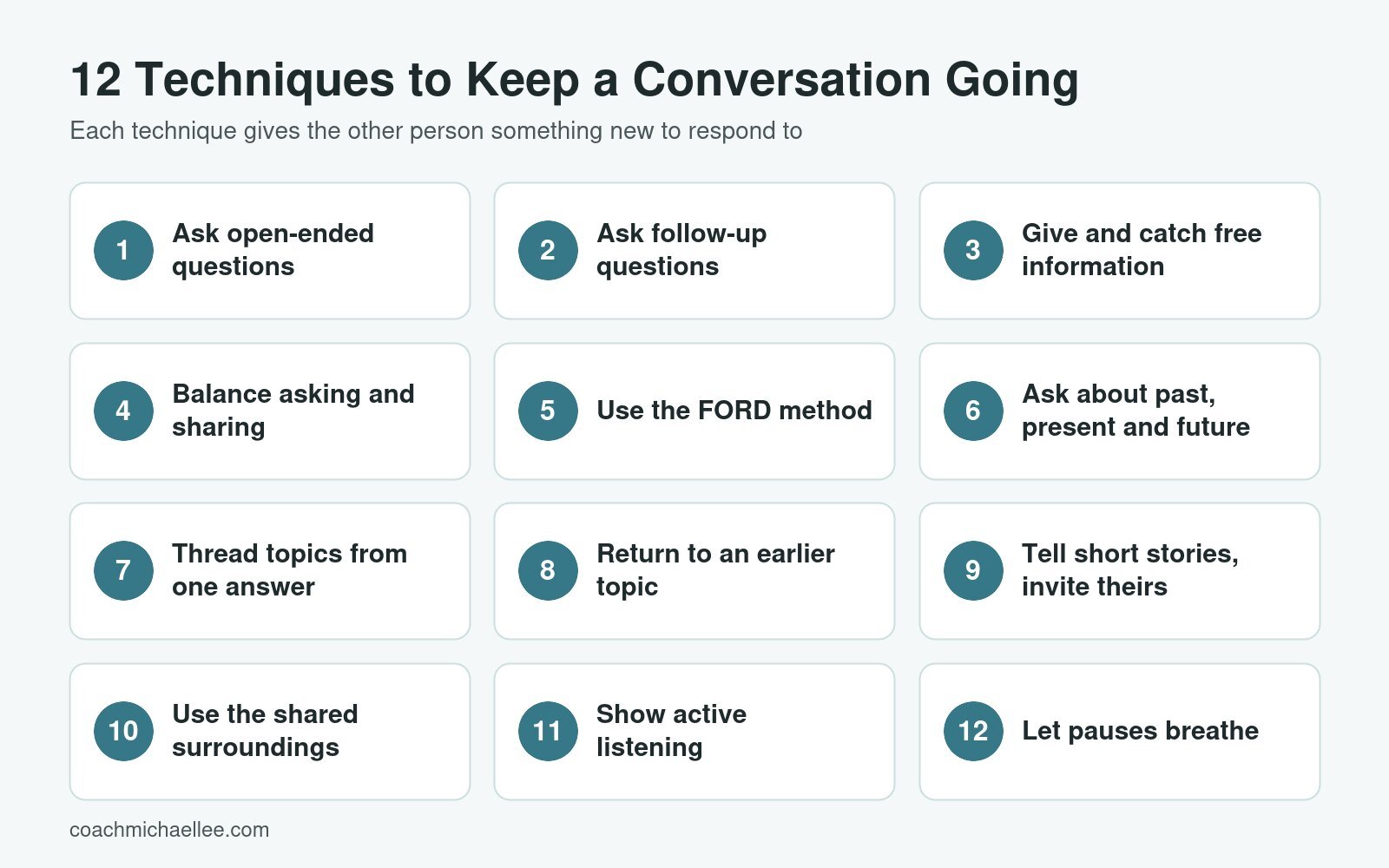
The 12 best techniques to keep a conversation going are below. The 12 techniques are open-ended questions, follow-up questions, free information, balanced sharing, the FORD method, past-present-future questions, topic threading, callbacks, short stories, surroundings, active listening and comfortable pauses. Each technique adds new material to the conversation. Most strong conversations combine 3 or 4 techniques at once.
1. Ask Open-Ended Questions
An open-ended question is a question that cannot be answered with yes or no. Open-ended questions start with words such as what, how, why and “tell me about”. An open-ended question invites a longer answer. A longer answer holds more details to respond to.
An example of a closed question is “Did you like the trip?”. An example of the same question in open-ended form is “What was the best part of the trip?”. The closed version gets one word. The open-ended version gets a story.
Open-ended questions work best after a short shared detail. A full guide to open-ended questions covers the main question types with examples.
2. Ask Follow-Up Questions
A follow-up question is a question about something the other person just said. Follow-up questions prove that the listener heard the last answer. People who ask more follow-up questions are liked more by their conversation partners (Huang et al., 2017, Journal of Personality and Social Psychology). Follow-up questions require responsiveness. Responsiveness signals care.
An example of a follow-up chain starts with the answer “I just moved to Denver.” A first follow-up question is “What brought you to Denver?”. A second follow-up question is “How does it compare to where you lived before?”. Each follow-up question goes one level deeper into the same topic.
Follow-up questions keep the focus on the other person. The dedicated guide to follow-up questions shows how to build longer chains.
3. Give and Catch Free Information
Free information is the extra detail a person adds to an answer beyond the question asked. Debra Fine describes free information in The Fine Art of Small Talk as the raw material of easy conversation. Each piece of free information works as a hook point. A hook point is a detail the other person can ask about.
An example of an answer with no free information is “I’m a nurse.” An example of an answer with 2 hook points is “I’m a nurse in a children’s hospital, and I just started night shifts.” The second answer gives the listener two topics: children’s hospitals and night shifts.
Catching free information matters as much as giving it. A good listener notices each hook point. A good listener then asks about the hook point with the most energy behind it.
4. Balance Asking and Sharing
A balanced conversation alternates between asking questions and sharing personal details. The tennis rule describes the balance. The tennis rule has 3 steps: answer the question, add a detail and return a question.
Self-disclosure drives the balance. Self-disclosure is the act of sharing personal information with another person. Self-disclosure invites reciprocity. Reciprocity means the other person shares a detail of similar depth in return.
An example of the tennis rule is “I grew up near the coast, so I still miss the ocean. Did you grow up near water?”. The answer gives a fact, a feeling and a new question. Too many questions in a row create interview mode. Too much sharing creates a monologue.
5. Use the FORD Method
The FORD method is a memory aid for conversation topics. FORD stands for family, occupation, recreation and dreams. The Harvard Mignone Center for Career Success recommends the FORD method for small talk with new contacts.
The 4 FORD topics each produce one easy question.
- Family: “Do you have family nearby?”
- Occupation: “What does a normal day at work look like for you?”
- Recreation: “What do you do on a free weekend?”
- Dreams: “Is there a trip or project you’re saving up for?”
The FORD method works best as a backup list. A FORD question asked without context sounds robotic. Professional settings with strangers call for occupation and recreation questions before family questions.
6. Ask About the Past, Present and Future
The past-present-future technique turns one topic into 3 questions. The technique treats the other person’s life as a timeline. A question about the past asks how something started. A question about the present asks how it is going now. A question about the future asks where it is heading.
An example of the technique uses the topic of a new job.
- Past: “How did you end up in that field?”
- Present: “What’s the best part of the job right now?”
- Future: “Where do you want the job to take you next?”
The past-present-future technique keeps one topic alive for several minutes. The technique also avoids sudden topic changes.
7. Thread Topics From One Answer
Topic threading is the practice of picking one of several details in an answer and branching from it. Every answer contains several threads. A thread is a detail that can become its own topic.
An example of topic threading starts with the answer “I spent the weekend hiking with my sister in Colorado.” The answer holds 3 threads.
- Hiking: “What’s the best trail you’ve done?”
- The sister: “Are you and your sister close?”
- Colorado: “Have you spent much time in Colorado before?”
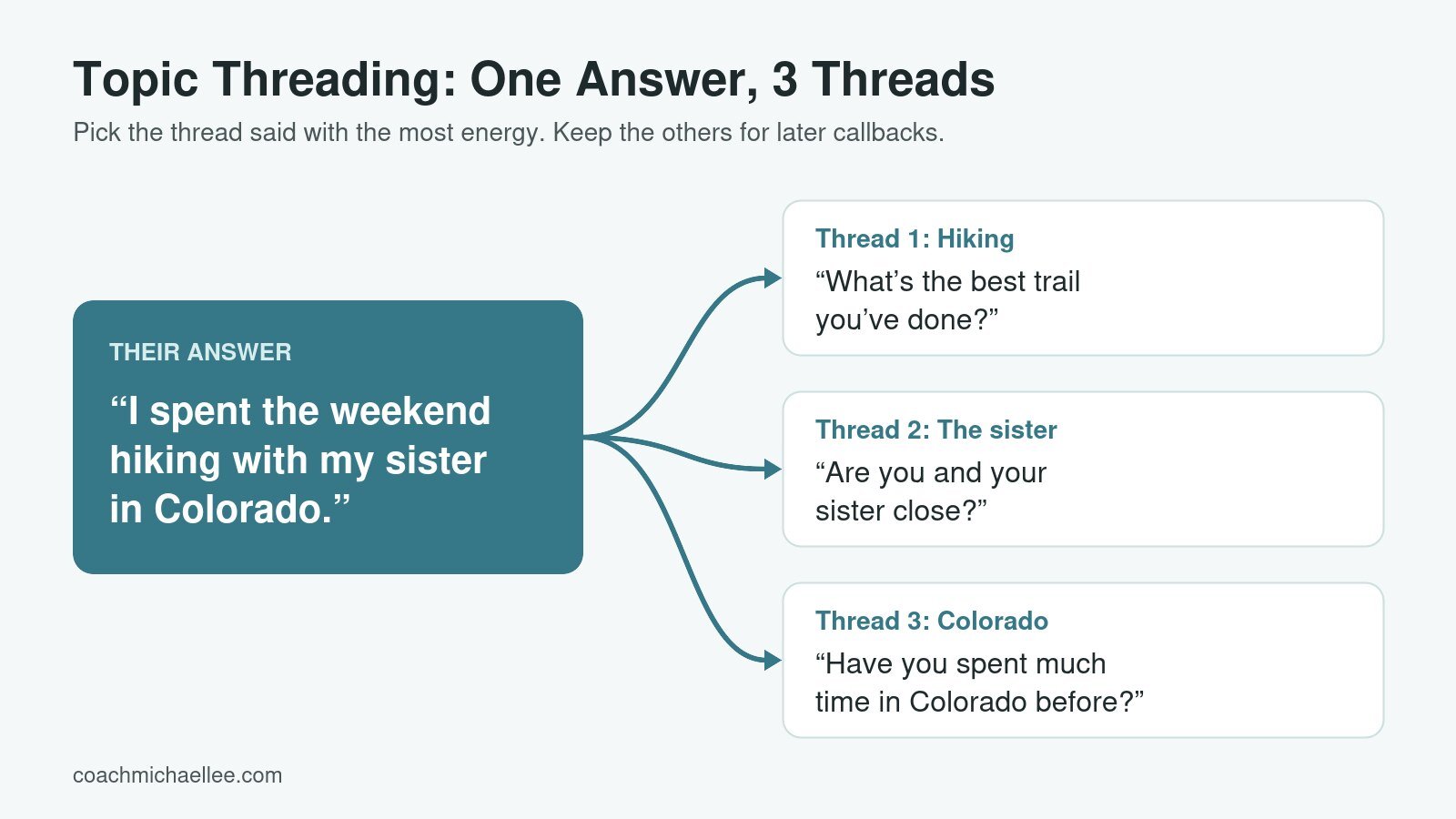
The strongest thread is the detail the other person said with the most energy. Unused threads stay in reserve for later. Topic threading also reveals common ground. Common ground is a shared interest or experience between two people.
8. Return to an Earlier Topic
A callback is a return to a topic from earlier in the conversation. A callback restarts a stalled exchange with material both people already share. A callback also proves that the listener remembered the earlier detail.
An example of a callback is “You mentioned earlier that you’re learning to cook. What have you been making?”. The callback works on a topic the other person already chose to raise. Unused threads from technique 7 make the best callbacks.
Callbacks work well after a pause. A callback feels natural after 5 to 10 minutes of other topics. A callback to an inside joke from earlier in the conversation also builds rapport. Rapport is the sense of mutual understanding between two people.
9. Tell Short Stories and Invite Theirs
A short story is a personal anecdote of about 30 seconds with a clear point. Short stories give the other person far more to respond to than single facts. A story holds people, places, feelings and a turning point.
A strong conversational story has 3 parts: a setup, a moment and an ending. An example of a short story is “Last month I locked myself out at 6 a.m. in running clothes. A neighbor I’d never spoken to let me wait in her kitchen. Now we walk our dogs together every Sunday.”
A story ends with an invitation. An example of an invitation is “Have you ever met a neighbor in a strange way?”. The invitation hands the turn back. Long stories without an invitation turn a conversation into a performance.
10. Use the Shared Surroundings
The shared setting is a reliable source of conversation topics. Both people already share the venue, the event, the food and the weather. A comment on the setting needs no personal question.
The 4 setting topics that work in almost every place are below.
- The venue: “Have you been to this place before?”
- The event: “How do you know the host?”
- The food or drink: “Is that the special? It looks good.”
- The moment: “This band is louder than I expected.”
Comments on the surroundings work best as a bridge. A setting comment restarts a stalled exchange. A follow-up question then moves the conversation back to the other person.
11. Show Active Listening
Active listening is the practice of giving full attention to the speaker and showing that attention. Active listening has a verbal side and a nonverbal side. The nonverbal side includes eye contact, nodding and open body language. The verbal side includes short encouragements and reflection.
Reflection is the act of repeating the core of what the other person said in fresh words. An example of reflection is “So the move was exciting but harder than you expected.” Reflection tells the speaker the message landed. Reflection also invites the speaker to say more.
Active listening makes a speaker feel safe to keep talking. Listening skills also build confidence in conversation. A listener with a plan to understand the speaker feels less pressure to perform.
12. Let Pauses Breathe
A pause is a normal part of a healthy conversation. Silence does not mean a conversation has failed. Long gaps of more than 2 seconds feel awkward between strangers. The same long gaps signal connection between friends (Templeton et al., 2023).
The three-second rule handles most pauses. The three-second rule means waiting about 3 seconds before filling a silence. The other person often uses those seconds to add a thought.
A pause that runs longer calls for a callback, a setting comment or a new thread. A full guide to awkward silence covers what to say when a pause runs long. Comfortable pauses mark a conversation between people who trust each other.
What Does Keeping a Conversation Going Look Like in Practice?
Keeping a conversation going in practice means replying with a detail and a question instead of a single fact. The table below shows 5 common lines, a reply that ends each conversation and a reply that keeps each conversation going.
| What they say | Reply that ends it | Reply that keeps it going | Technique used |
|---|---|---|---|
| “I just got back from Japan.” | “Cool.” | “Japan is on my list. What surprised you most there?” | Open-ended question |
| “Work has been crazy this week.” | “Same here.” | “Crazy busy or crazy chaotic? Mine is a product launch.” | Free information |
| “I’ve started running again.” | “Nice.” | “What got you back into it after the break?” | Follow-up question |
| “I’m from Ohio originally.” | “Okay.” | “What part of Ohio? And what brought you out here?” | Past-present-future |
| “This coffee is terrible.” | “Yeah.” | “It really is. Do you know a better place nearby?” | Surroundings |
The strong replies share 2 features. Each strong reply adds a small personal detail or a reaction. Each strong reply ends with a question that hands the turn back.
What Kills a Conversation?
A conversation dies when one person’s habit leaves the other person with nothing to answer. The 6 conversation killers are interview mode, shift responses, one-word replies, phones, hot-button topics too early and unasked-for advice. The table below pairs each conversation killer with a better move.
| Conversation killer | What it looks like | Better move |
|---|---|---|
| Interview mode | Five questions in a row with no sharing | The tennis rule: an answer, a detail and a returned question |
| Shift responses | “That reminds me of my trip, which was…” | One more question about the other person’s story before a matching story |
| One-word replies | “Yeah.” “Fine.” “Cool.” | One piece of free information in every answer |
| Phones | A phone on the table or a glance at a screen | A phone kept out of sight for the whole conversation |
| Hot-button topics too early | Politics or religion with a new acquaintance | Divisive topics saved for people with established trust |
| Unasked-for advice | “You should just quit that job.” | The question “Do you want ideas, or do you just want to vent?” |
Unasked-for advice kills a conversation by closing the topic. Advice treats the other person’s story as a problem to solve. Most people share a story to feel understood rather than to get a solution.
How Do You Keep a Conversation Going When Someone Gives One-Word Answers?
A conversation with someone who gives one-word answers keeps going through 4 steps: open-ended questions, sharing first, a topic change and a kind close.
- Open-ended questions. A question such as “What was the highlight of the weekend?” asks for more than one word.
- Sharing first. A short personal detail lowers the pressure on a quiet person. An example of sharing first is “I spent Saturday failing at a new bread recipe. Do you cook at all?”.
- A topic change. A one-word answer sometimes signals a topic the other person finds dull. A new topic from the surroundings or the FORD list tests a different direction.
- A kind close. Some people feel tired, shy or busy. A warm close leaves a good impression for the next conversation.
One-word answers often come from nerves rather than a lack of interest. Social nerves affect both sides of a conversation. The guide to feeling nervous talking to people explains where that nervousness comes from.
How Do You Keep a Conversation Going Over Text?
A text conversation keeps going when each message gives the other person something specific to reply to. The 4 texting techniques are a detail plus a question, photos and voice notes, a matched reply pace and a move to a call.
- A detail plus a question. An example of a detail plus a question is “Just tried the new taco place on 5th. The salsa was unreal. Have you been?”. A bare “hey” or “what’s up” gives the other person nothing to answer.
- Photos and voice notes. A photo of a meal, a pet or a view becomes a ready-made topic. A short voice note adds tone of voice to the text.
- A matched reply pace. A reply that arrives at a similar speed and length to the other person’s message feels balanced. Long walls of text in reply to short messages feel one-sided.
- A move to a call. A text thread with lots of back-and-forth works better as a phone call or video call. A call adds voice and timing to the conversation.
Text conversations also need a good first message. The guide to text conversation starters covers openers for friends, crushes and new matches.
How Do You Revive a Text Conversation That Has Died?
A text conversation that has died revives with a callback, a one-line share or a direct question. An example of a callback text is “Did you ever finish that show you were telling me about?”. An example of a one-line share is “Saw this and thought of you” with a photo or link. A revival text skips any complaint about the gap. Guilt about a slow reply makes the other person less likely to answer.
How Do You Keep a Conversation Going With a Crush or on a Date?
A conversation with a crush or a date keeps going through curiosity rather than performance. A date conversation works best when both people feel interesting. The 4 techniques that keep a date conversation going are genuine curiosity, light self-disclosure, playful callbacks and one deeper question.
- Genuine curiosity. Questions about passions, plans and opinions show real interest. Questions about a job title alone feel like a résumé check.
- Light self-disclosure. A personal story of about 30 seconds gives the other person a reason to share in return.
- Playful callbacks. A callback to a joke from earlier in the date builds a sense of shared history.
- One deeper question. An example of a deeper question is “What’s something you’re proud of that most people don’t know about?”.
Deeper questions turn a pleasant date into a memorable one. The guide to deep questions to ask lists questions for dates and close relationships.
How Do You Move a Conversation From Small Talk to Deeper Topics?
A conversation moves from small talk to deeper topics through a staircase of 3 steps: facts, opinions and feelings. Small talk covers facts such as jobs, weather and plans. Opinions cover what a person thinks about those facts. Feelings cover what those facts mean to the person.
An example of the staircase uses the topic of a new job.
- Fact: “Where are you working now?”
- Opinion: “What do you think of the company so far?”
- Feeling: “How does it feel to start over somewhere new?”
Most people stay on the first step for too long. People underestimate how much strangers enjoy deep conversation, according to 12 experiments with more than 1,800 participants (Kardas, Kumar and Epley, Journal of Personality and Social Psychology). Deep conversations with strangers felt less awkward and more connecting than participants predicted.
Small talk still has a job. Small talk is the low-stakes test that shows whether both people want to keep talking. The guide to small talk explains how to make that first step easier.
When Should You Let a Conversation End?
A conversation should end at a high point, before the energy drops. A conversation that ends on a laugh or a shared idea leaves both people wanting another one. A conversation that drags on until silence leaves a flat memory.
The 4 signs a conversation has run its course are repeated topics, shorter answers, glances at the time and body turned toward the exit. A good close names the next step. An example of a good close is “This was great. Let’s grab coffee next week and you can tell me how the move goes.” The close turns one conversation into the start of the next.
The guide to how to end a conversation covers polite exits for parties, work events and phone calls.
How Does Keeping a Conversation Going Build Relationships?
Keeping a conversation going builds relationships by adding up the hours two people spend talking. Friendship forms over time spent together. Acquaintances become casual friends after about 50 hours together, friends after about 90 hours and close friends after more than 200 hours (Jeffrey Hall, University of Kansas, 2018). Each conversation that keeps going adds minutes to that total. The 6 related skills below connect keeping a conversation going to the wider topic of communication. The Roadmap Fundamentals session with Coach Michael Lee trains these skills in live practice.
Why Is Interpersonal Communication the Foundation of Relationships?
Interpersonal communication is the foundation of relationships. Every relationship runs on exchanges between two people. A conversation that keeps going is interpersonal communication in practice. Each exchange builds trust and familiarity. Trust grows when both people share details. Trust also grows when both people listen closely.
Which Interpersonal Skills Keep a Conversation Going?
The 4 interpersonal skills that keep a conversation going are active listening, empathy, self-disclosure and reading nonverbal cues. Active listening shows attention. Empathy shows understanding of the other person’s feelings. Self-disclosure invites the other person to share. Nonverbal cues reveal interest or boredom before words do. The full guide to interpersonal skills covers each skill in depth.
How Does Effective Communication Make Conversations Last Longer?
Effective communication makes conversations last longer by giving the other person clear material to respond to. The 7 Cs of communication are clear, concise, concrete, correct, coherent, complete and courteous. A concrete detail invites a question more easily than a vague one. A courteous tone makes the other person comfortable enough to keep talking. The guide to effective communication explains each of the 7 Cs with examples.
Which Communication Barriers Stop a Conversation From Growing?
The 3 communication barriers that most often stop a conversation from growing are emotional barriers, perceptual barriers and physical distractions. Emotional barriers include nerves, anger and defensiveness. Perceptual barriers include assumptions about the other person. Physical distractions include phones, noise and interruptions. The guide to barriers to communication covers all 9 barrier types and how to overcome them.
Which Communication Exercises Help You Practice Keeping Conversations Going?
The 3 communication exercises that train the skills of keeping a conversation going are Question Chains, Paraphrase Practice and FORD Small Talk Practice. Question Chains train follow-up questions. Paraphrase Practice trains reflection and active listening. FORD Small Talk Practice trains topic choice with new people. The full list of 47 communication exercises includes steps and timing for each exercise.
How Does a Communication Coach Help You Keep Conversations Going?
A communication coach helps people keep conversations going through live practice and direct feedback. A coach spots personal habits such as interview mode or shift responses. A coach then replaces those habits with techniques such as topic threading and callbacks. Communication coaching turns the 12 techniques on this page into automatic habits.