
How to Start a Conversation With Anyone: 7 Steps and 50+ Examples
By Michael Lee, communication and relationship coach · Last updated
Starting a conversation means making the first comment or question that invites another person to talk. Strangers want to talk far more often than people expect, according to research by Nicholas Epley and Juliana Schroeder (2014). A good start follows 7 steps, from reading the room to sharing a personal detail. The first line is the opening stage of strong conversation skills.
What Does It Mean to Start a Conversation?
Starting a conversation means making the first comment or question that invites another person to talk. The first line is the opening stage of a conversation. Every conversation moves through 4 stages: opening, sustaining, deepening and closing. The opening stage lasts only a few exchanges.
A conversation starter is the first line in the opening stage. A good conversation starter is shared, specific, light and easy to answer. An example of a conversation starter is “Have you tried the coffee here? The line says it must be good.” The starter refers to something both people can see. The starter also ends with an easy question.
The goal of a first line is connection rather than information. A first line signals friendly intent. The tone and the smile behind a first line matter more than the exact words.
What Are the Benefits of Starting a Conversation With a Stranger?
The 4 main benefits of starting a conversation with a stranger are a better mood, a sense of belonging, new friendships and new opportunities. Epley and Schroeder tested the mood benefit with train and bus commuters. Commuters told to talk to a stranger reported a more positive commute than commuters told to sit alone (ScienceDaily).
- A better mood. A short chat with a stranger lifts mood more than time spent in silence.
- A sense of belonging. Brief friendly exchanges make a neighborhood, an office or a gym feel more welcoming.
- New friendships. Every close friend was once a stranger in a first conversation.
- New opportunities. Jobs, clients and partners often start with a first conversation at an event.
Why Is Starting a Conversation So Hard?
Starting a conversation feels hard for 3 reasons: fear of rejection, uncertainty about what to say and the liking gap. Fear of rejection makes the first line feel risky. Uncertainty about the first words makes every second of silence feel longer. The liking gap leads people to underestimate the impression they make.
The liking gap is the difference between how much a conversation partner likes a person and how much the person believes the partner likes them. Erica Boothby, Gus Cooney, Gillian Sandstrom and Margaret Clark described the liking gap in Psychological Science in 2018. After 5-minute conversations, participants underestimated how much their partners liked them (CNBC). Shyer participants underestimated their partners’ liking even more. The gap lasted for months among new college dorm mates.
Social nerves add to the difficulty. The guide to feeling nervous talking to people explains where social nervousness comes from.
Do Strangers Want to Talk?
Yes, most strangers want to talk more than people predict. In the Epley and Schroeder research, 64 train commuters estimated the willingness of other commuters to talk. The commuters predicted that only 46.4% of other commuters would be willing to talk. Participants who approached a stranger reported a very different result. Not a single participant reported being rebuffed. The fear of rejection is far larger than the real risk of rejection.
How Do You Start a Conversation?
Starting a conversation takes 7 steps, from reading the room to sharing a personal detail. The 7 steps are reading the room, eye contact and a smile, a shared-context opener, a self-introduction, an open-ended question, a follow-up question and a personal share. The whole sequence takes less than 2 minutes in a live conversation.
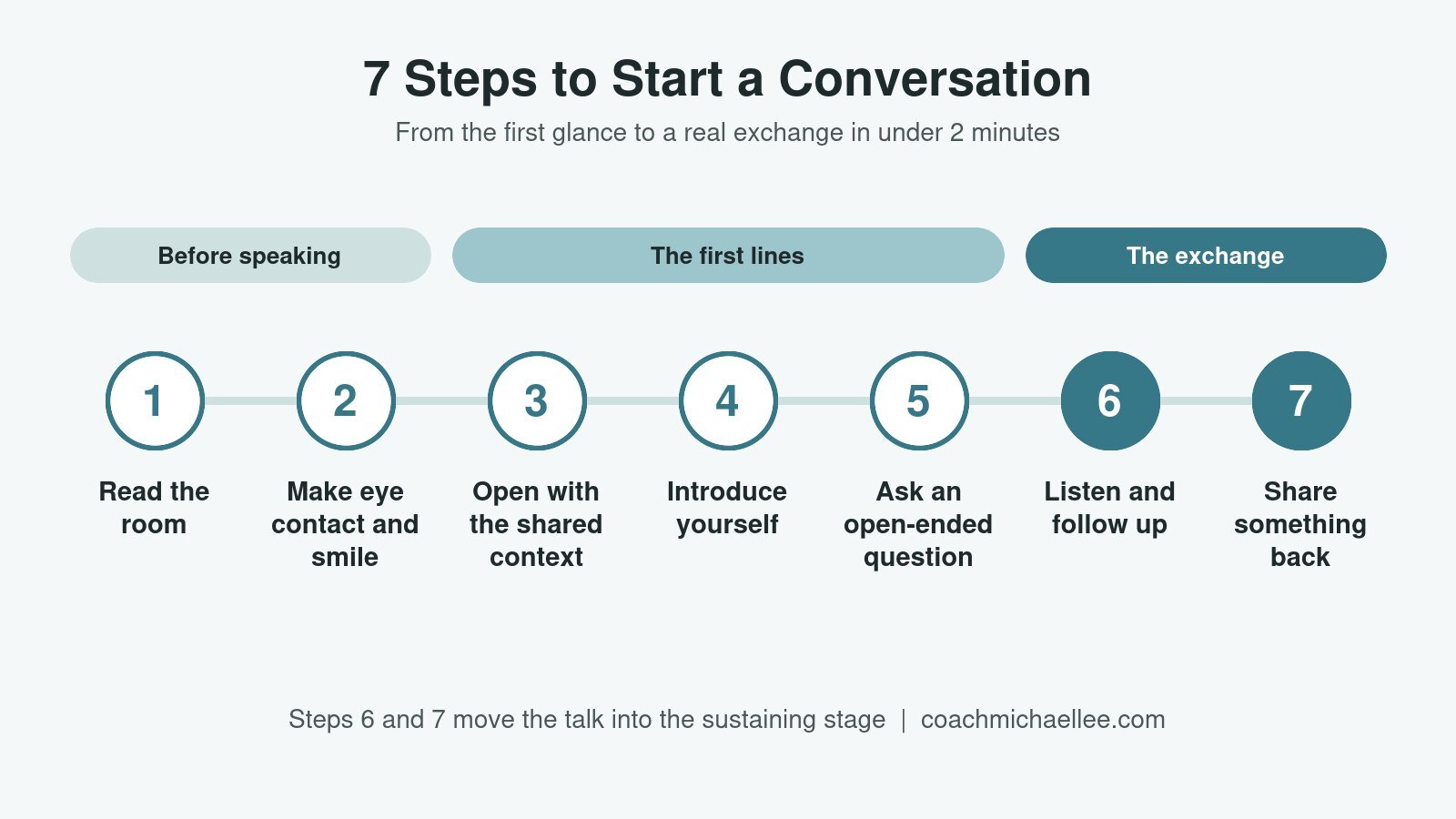
1. Read the Room
Reading the room means checking whether a person is open to talking before speaking. The 3 open signals are returned eye contact, a relaxed posture and free hands. The 3 closed signals are headphones in both ears, a phone call in progress and a body turned away. A person with open signals is the best first choice. A person with closed signals prefers to stay alone.
2. Make Eye Contact and Smile
Eye contact and a smile signal friendly intent before the first word. A brief glance shows interest. A warm smile shows that the approach is friendly. A smile returned by the other person is an invitation to speak. Visible hands and an open posture add to the friendly signal. Crossed arms and a glance at a phone send the opposite signal.
3. Open With the Shared Context
The easiest opener is a comment or question about the shared context. The shared context is the place, the event or the moment both people are in. A shared-context opener needs no clever line. Both people already know the topic.
The 3 kinds of shared-context openers are place, event and moment openers.
- The place: An example of a place opener is “Have you been here before? The menu is huge.”
- The event: An example of an event opener is “How do you know the host?”
- The moment: An example of a moment opener is “That rain came out of nowhere. Did you get caught in it?”
A shared-context opener is also the first step of small talk.
4. Introduce Yourself
A self-introduction gives the other person a name and one detail to respond to. An example of a self-introduction is “I’m Sam, by the way. I just moved here from Ohio.” The detail about Ohio gives the other person an easy question. Repeating the other person’s name on first hearing helps the speaker remember it. An example of name repetition is “Nice to meet you, Priya.”
5. Ask an Open-Ended Question
An open-ended question invites more than a yes or a no. Open-ended questions start with what, how, why or “tell me about”. An example of a closed opener is “Do you like this band?”. An example of the same opener in open-ended form is “How did you get into this band?”. The open-ended version invites a story. The guide to open-ended questions covers the main question forms.
6. Listen and Ask a Follow-Up Question
Listening turns an opener into a real exchange. The first answer always contains at least one detail worth a second question. A follow-up question about that detail proves that the listener heard the answer. An example of a first answer is “I’m here with my sister. She runs the bakery stall.” A good follow-up question is “How long has she been baking?”. Follow-up questions make the asker more likable, according to Huang and colleagues at Harvard (2017).
7. Share Something About Yourself
A personal share balances the exchange. A conversation made only of questions feels like an interview. A short share of similar depth invites the other person to share more. An example of a balanced share is “My brother bakes too. His sourdough is the reason I gained 5 pounds last winter.” The share adds a detail. The share also gives the other person a new hook point.
What Are the 6 Types of Conversation Openers?
The 6 types of conversation openers are observation openers, setting questions, compliments, advice requests, self-introductions and light humor. Each type fits a different setting. The table below gives a definition, an example and the best setting for each type.
| Type | Definition | Example | Best setting |
|---|---|---|---|
| Observation | A comment on something both people see | “This line moves fast for a Monday.” | Lines, waiting rooms, transit |
| Setting question | A question about the place or event | “Is this your first time at this conference?” | Events, venues, classes |
| Compliment | Praise for a choice the person made | “That’s a great jacket. Where did you find it?” | Almost anywhere |
| Advice request | A request for a recommendation | “Any idea which dish is best here?” | Restaurants, shops, new cities |
| Self-introduction | A name plus one detail | “Hi, I’m Sam. I work with the host.” | Parties, networking events |
| Light humor | A gentle joke about the shared moment | “I think the coffee machine has given up on us.” | Offices, lines, delays |
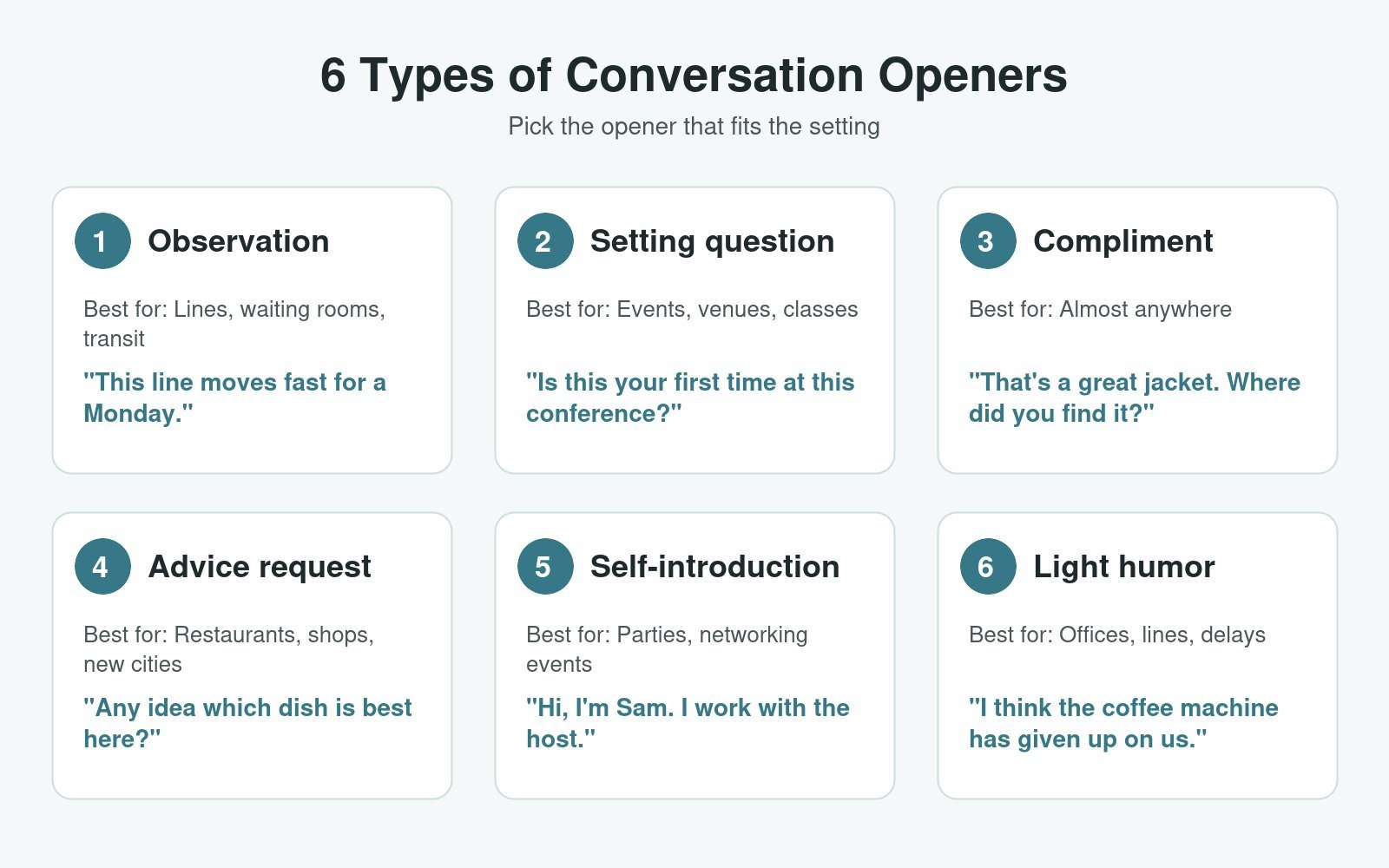
1. Observation Openers
An observation opener is a comment on something both people can see or hear. An example of an observation opener is “This line moves fast for a Monday.” Observation openers work best in lines, waiting rooms and public transit. A short question after the comment hands the turn to the other person.
2. Setting Questions
A setting question is a question about the place or the event. An example of a setting question is “Is this your first time at this conference?”. Setting questions work at events, venues and classes. The answer to a setting question usually reveals how the other person is connected to the place.
3. Compliment Openers
A compliment opener praises a choice the other person made. An example of a compliment opener is “That’s a great jacket. Where did you find it?”. A compliment on a choice feels safe and sincere. A compliment on a body or a face feels too personal from a stranger. A question after the compliment turns praise into a conversation.
4. Advice or Help Requests
An advice request asks the other person for a recommendation or a small piece of help. An example of an advice request is “Any idea which dish is best here?”. Asking for advice makes the asker seem more competent, according to Brooks, Gino and Schweitzer (2015). Advice requests work well in restaurants, shops and new cities.
5. Self-Introductions
A self-introduction opener starts with a name and a short context. An example of a self-introduction opener is “Hi, I’m Sam. I work with the host.” Self-introductions suit parties, networking events and the first day at a new job. A self-introduction invites the other person to share a name and a context in return.
6. Light Humor
A light humor opener is a gentle joke about the shared situation. An example of a light humor opener is “I think the coffee machine has given up on us.” Light humor builds a quick bond through a shared reaction. A joke about a person or a group feels risky with strangers. A joke about the situation keeps the humor safe.
What Are Good Conversation Starters?
Good conversation starters match the situation. The 7 lists below give 56 conversation starters for strangers, parties, work events, coworkers, dates, text messages and dating apps. Each starter is short, light and easy to answer.
Conversation Starters With a Stranger
The 8 conversation starters below suit a stranger in a public place.
- “Have you been here before?”
- “Is this line always this long?”
- “Do you know if this train stops at Main Street?”
- “That’s a great dog. What’s its name?”
- “Any recommendations on what to order?”
- “Is anyone sitting here?”
- “How’s the book? I’ve been looking for a new one.”
- “Do you know a good coffee place around here?”
Stranger starters work best when tied to the place. A follow-up about the answer keeps the exchange going.
Conversation Starters at a Party
The 8 conversation starters below fit a party with friends of friends.
- “How do you know the host?”
- “What’s the best thing you’ve eaten here so far?”
- “Have you been to one of these parties before?”
- “Who picked the music? It’s great.”
- “What’s keeping you busy these days?”
- “Did you come far to get here?”
- “Have you tried the punch yet?”
- “What’s the story behind how you met everyone here?”
The host is the easiest shared topic at a party. Every guest has a story about the host.
Conversation Starters at Work and Networking Events
The 8 conversation starters below fit conferences, meetups and networking events.
- “Which session are you here for?”
- “What brings you to this event?”
- “What did you think of the keynote?”
- “Is this your first time at this conference?”
- “What kind of work do you do?”
- “What’s the most useful thing you’ve heard today?”
- “Are you here with your team?”
- “What projects are keeping you busy right now?”
A prepared answer to “What do you do?” makes networking starters easier. The answer names the role plus one interesting detail.
Conversation Starters With a Coworker
The 8 conversation starters below suit a coworker at the office or on a call.
- “How was your weekend?”
- “How’s the new project going?”
- “Any plans for the holiday?”
- “Have you tried the new place across the street?”
- “How long have you been on this team?”
- “What’s the best part of your role?”
- “Did you catch the game last night?”
- “What are you working on this week?”
Coworker starters build trust over many short exchanges. Politics, salary and health stay out of first conversations at work.
Conversation Starters for a Crush or a Date
The 8 conversation starters below suit a crush or a first date.
- “What’s been the best part of your week?”
- “What do you do for fun on weekends?”
- “What’s something you’re excited about this year?”
- “Have you been to this café before?”
- “What’s the best trip you’ve ever taken?”
- “What are you reading or watching right now?”
- “What’s your favorite spot in this city?”
- “What got you into climbing?”
Curiosity matters more than clever lines with a crush. A date remembers how the conversation felt more than the exact words.
Conversation Starters Over Text
The 8 conversation starters below fit a text to someone new or someone silent for weeks.
- “I just saw a dog that looked exactly like yours.”
- “How did the interview go?”
- “Saw this and thought of you. Have you been?”
- “What are you up to this weekend?”
- “Quick question: any good podcast recommendations?”
- “How was the concert last night?”
- “I’m finally trying that recipe you mentioned. Any tips?”
- “Random question: coffee or tea person?”
Text starters work best when tied to a shared memory or a recent event. A specific text gets a reply faster than a plain “Hey”. The guide to text conversation starters lists more openers for texting.
Conversation Starters on a Dating App
The 8 conversation starters below use details from a dating profile.
- “Your hiking photo looks amazing. Where was that?”
- “You mentioned tacos. Where’s the best taco place in town?”
- “Is that your dog? What’s its name?”
- “Your profile says you love travel. Where’s next?”
- “What’s the story behind your third photo?”
- “I see you play guitar. What are you learning right now?”
- “Beach or mountains for a perfect weekend?”
- “Which book on your list should I read first?”
A dating app starter that names a profile detail shows real interest. The detail proves that the sender read the profile.
How Do You Start a Conversation Without Being Awkward?
Starting a conversation without awkwardness takes 4 habits: prepared openers, low stakes, comfort with short pauses and an early exit when the signals are closed. The 4 habits are below.
- Prepared openers. Three ready openers remove the pressure of thinking on the spot.
- Low stakes. A first line is a small offer, not a test. A short reply costs nothing.
- Comfort with pauses. A 2-second pause is normal in conversation. A calm pause signals ease.
- An early exit. A polite exit after a short reply protects both people. An example of an early exit is “Well, enjoy the rest of the event.”
An awkward moment matters less to the other person than to the speaker. People overestimate how much others notice their mistakes, a bias called the spotlight effect (Gilovich, Medvec and Savitsky, 2000). The guide to handling an awkward silence covers more ways to restart a stalled conversation.
What Should You Avoid When Starting a Conversation?
The 5 habits to avoid when starting a conversation are closed questions, heavy topics, comments on a body, talking only about oneself and rapid-fire questions.
- Closed questions. A yes-or-no opener ends the exchange after 1 word.
- Heavy topics. Politics, religion, money and health feel too personal with a stranger.
- Comments on a body. A remark on weight, height or looks makes a stranger uncomfortable.
- Talking only about oneself. A long story with no question back feels like a monologue.
- Rapid-fire questions. A string of questions with no shares feels like an interview.
What Do You Say After the First Line?
The best move after the first line is a follow-up question about the answer. The follow-up moves the conversation from the opening stage to the sustaining stage. A personal share after the follow-up keeps the exchange balanced. Common ground found in the first minute gives the conversation a topic to grow. The guide on how to keep a conversation going covers 12 techniques for the sustaining stage.
A conversation that fades after the opener needs a warm exit. An example of a warm exit is “It was great to meet you, Sam. Enjoy the rest of the party.” The guide on how to end a conversation covers polite exits for every setting.
How Does Starting Conversations Build Relationships and Communication Skills?
Starting conversations builds relationships by creating the first contact every relationship needs. Every friendship, partnership and career contact begins with a first line. A person who starts conversations meets more people than a person who waits. The 6 related skills below connect starting conversations to the wider topic of communication. The Roadmap Fundamentals session with Coach Michael Lee trains these skills in live practice.
How Does Starting a Conversation Fit Into Conversation Skills?
Starting a conversation is the opening stage of the 4 conversation stages: opening, sustaining, deepening and closing. A strong opening makes the later stages easier. A weak opening ends a conversation before the sustaining stage begins. The full guide to conversation skills explains all 4 stages and the 8 core skills.
What Role Does Starting a Conversation Play in Interpersonal Communication?
The first line sets the relational tone of interpersonal communication. Interpersonal communication is the exchange of messages between two people. A warm first line signals goodwill. A cold first line signals distance. The relational tone of the first line shapes the rest of the exchange.
How Does Confidence Help You Start Conversations?
Confidence makes the first move easier. Confident communicators start conversations without waiting for an invitation. Confident communicators also accept a short reply without taking it personally. The guide to communication with confidence lists 35 ways to speak with confidence.
Which Interpersonal Skills Make Starting a Conversation Easier?
The 3 interpersonal skills that make starting a conversation easier are reading nonverbal cues, warmth and active listening. Reading nonverbal cues finds the open person in a room. Warmth makes the first line feel safe. Active listening finds the hook point in the first answer. The guide to interpersonal skills covers each skill in depth.
Which Communication Exercises Help You Practice Starting Conversations?
The 3 communication exercises that train conversation openers are The Elevator Pitch, FORD Small Talk Practice and The Eye Contact Circle. The Elevator Pitch trains a short self-introduction. FORD Small Talk Practice trains topic choice. The Eye Contact Circle trains the first friendly signal. The full list of 47 communication exercises includes steps and timing for each exercise.
How Does a Communication Coach Help You Start Conversations?
A communication coach helps with starting conversations through live practice and direct feedback. A coach spots habits such as closed openers, a rushed delivery or an avoided first move. A coach then replaces those habits with shared-context openers and confident body language. Communication coaching turns the 7 steps into automatic habits.