
How to End a Conversation Politely: 12 Ways and 66 Exit Lines
By Michael Lee, communication and relationship coach · Last updated
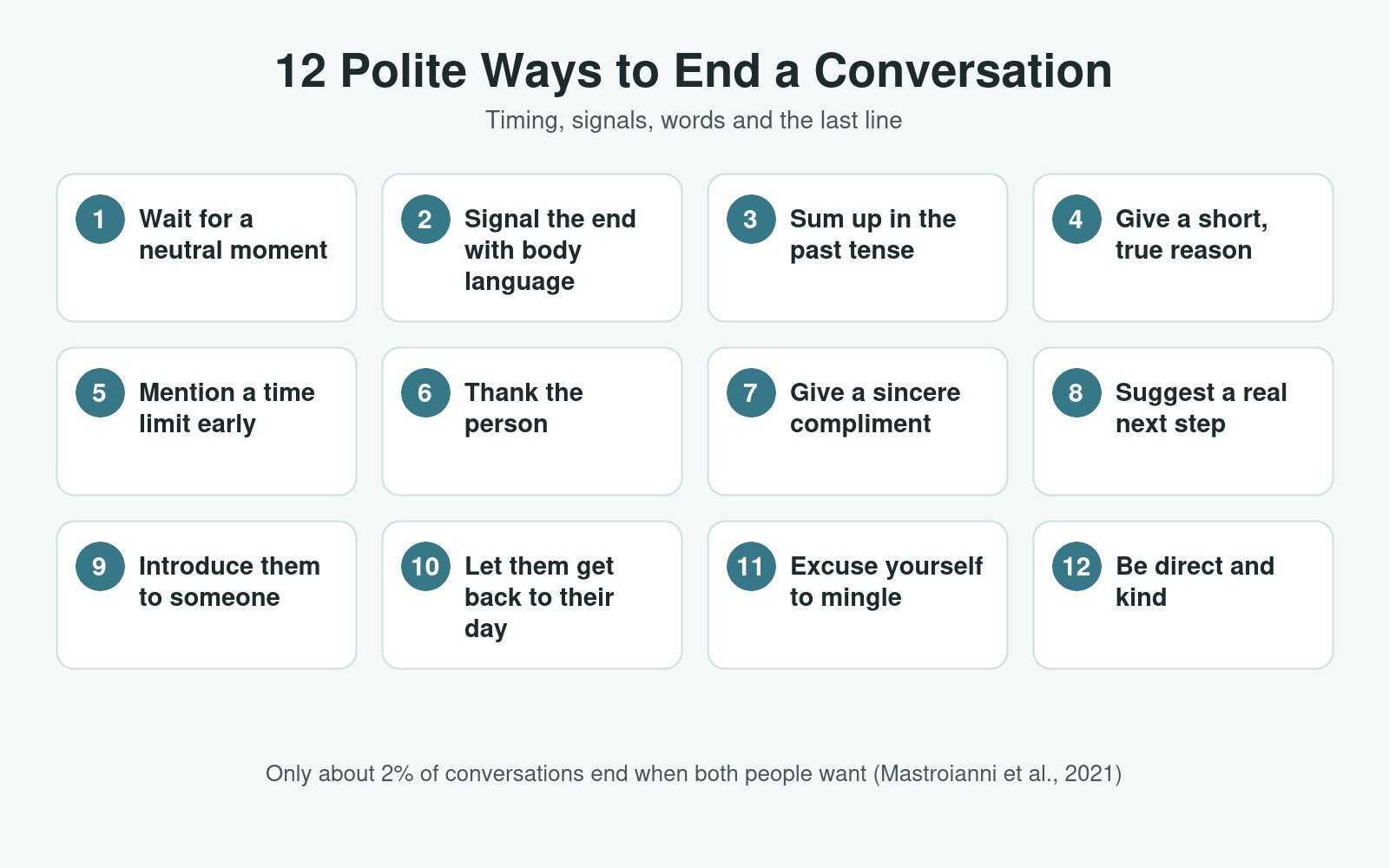
Ending a conversation politely means closing the talk with a clear, kind exit. Only about 2% of conversations end on time for both people, according to a 2021 Harvard study of 932 conversations. A polite exit solves that problem for both people. The first 6 polite ways are a neutral moment, body language, a past-tense summary, a true reason, an early time limit and thanks. The last 6 ways are a compliment, a real next step, an introduction, an “I’ll let you go” line, mingling and a direct goodbye. A good exit is the closing stage of strong conversation skills.
1. Wait for a Neutral Moment
The best moment to end a conversation is a neutral moment just after a high point. A neutral moment is a pause after a light topic, such as weekend plans or a shared hobby. An exit at that moment feels natural. An exit in the middle of a story feels like an interruption. An exit during an emotional topic feels cold. A heavy topic deserves a short lighter moment before the goodbye.
The cleanest exit point comes at the end of the speaker’s own turn. An exit on the speaker’s own turn avoids cutting the other person off. An example of a neutral-moment exit is “Anyway, that’s my weekend. It was great hearing about yours.”
2. Signal the End With Body Language
Body language signals the end of a conversation before any words. The 4 clearest closing signals are a bag or a coat picked up, a small step back, a body turned toward the exit and a handshake. A smile keeps the signals warm. The signals give the other person a few seconds to prepare for the goodbye. Body language without words also works in a group. A spoken exit interrupts the flow of a group talk.
Communication coach Jefferson Fisher recommends turning the body toward the exit during the goodbye line. An example of a body-language exit pairs a small step back with the line “This was lovely.”
3. Sum Up the Conversation in the Past Tense
A past-tense summary marks the conversation as complete. Phrases such as “It was great” and “I really enjoyed” place the conversation in the past. The other person hears the shift. The other person then expects a goodbye. A summary also proves the attention of the listener.
The 2 example lines below sum up a conversation in the past tense.
- “It was great hearing about your new job.”
- “I really enjoyed our chat about the trip.”
4. Give a Short, True Reason
A short, true reason explains the exit without a long story. A real reason feels honest. An invented excuse risks being caught. A reason is optional. A simple goodbye without a reason also works. A long explanation sounds like guilt. One short sentence is enough.
The 2 example lines below give a short, true reason.
- “I promised to check in on my sister.”
- “I have an early start tomorrow, so I’m heading home.”
5. Mention a Time Limit Early
A time limit stated at the start of a conversation makes the end expected. The other person knows the time window from the first minute. The exit then feels like a kept promise instead of a rejection. A time limit also protects busy days at work. A stated limit of “I have 10 minutes” helps a coworker choose the most important topic first. Communication coach Alexander Lyon names a time limit as one of the cleanest ways to end a conversation politely.
The 2 example lines below set a time limit early.
- “I only have 10 minutes, but I’d love to hear how it went.”
- “I need to leave at 3, so let’s make the most of it.”
6. Thank the Person
Gratitude takes the sting out of leaving. Gratitude for the conversation, the help or the time ends the exchange on a warm note. Specific thanks sound more sincere than general thanks. Thanks for a tip, a story or a favor proves the value of the exchange to the listener. A general “thanks for the chat” suits an exchange without a specific highlight.
The 2 example lines below thank the other person.
- “Thanks for the restaurant tip.”
- “Thank you for making time for this.”
7. Give a Sincere Compliment
A sincere compliment before the exit leaves the other person feeling valued. Therapist Renée Zavislak recommends a compliment, then the word “and”, then the exit line, as quoted in Verywell Mind. The word “and” keeps the tone positive. The word “but” makes a compliment sound like a setup for rejection.
The 2 example lines below join a compliment and an exit with “and”.
- “You always have the best book recommendations, and I need to get going.”
- “I love how excited you are about this project, and I have to run.”
8. Suggest a Real Next Step
A real next step turns a goodbye into a pause. A next step is a concrete plan, such as a link to send or a coffee to schedule. Only a real, planned next step belongs in an exit. An empty promise of lunch erodes trust over time. A next step with a day or a time sounds real. A next step without a day sounds like a polite escape.
The 2 example lines below suggest a real next step.
- “I’ll send you that article tonight.”
- “Let’s get coffee next Tuesday.”
9. Introduce Them to Someone Else
An introduction hands the conversation to a new person. The other person gains a new contact instead of standing alone. Introductions work best at parties, conferences and networking events. Succeed Socially lists the introduction as a classic way to leave a conversation smoothly. An example of an introduction exit is “Before I go, you should meet Maya. She works in design too.”
10. Let Them Get Back to Their Day
The phrase “I’ll let you go” frames the exit as a kindness to the other person. The exit becomes a gift of time instead of an escape. The phrase works best on the phone, at work and with busy people. Overuse removes the kindness of the phrase. A rotation with the other 11 ways keeps exits fresh.
The 2 example lines below let the other person get back to their day.
- “I’ll let you get back to your afternoon.”
- “I know you’re busy, so I’ll let you go.”
11. Excuse Yourself to Mingle
Mingling is an expected reason to move on at parties and events. Guests at an event expect short conversations with many people. A friendly line about meeting others ends the exchange without offense. The guide to small talk covers the short conversations at most events.
The 2 example lines below excuse the speaker to mingle.
- “I’m going to circle the room for a bit. Enjoy the event.”
- “I promised myself I’d meet 3 new people tonight. Great talking with you.”
12. Be Direct and Kind
A direct and kind goodbye is the fallback for any situation without a better fit. A short statement of the need to leave is honest and clear. A warm tone keeps a direct exit from sounding rude. Most people respect a clear goodbye more than a long hint. A direct exit fits a long conversation after several ignored hints. A direct exit also fits an uncomfortable conversation.
The 2 example lines below are direct and kind.
- “I need to go now. It was really good to see you.”
- “I’m going to head out. Take care.”
How Do You End a Conversation in Different Situations?
The right exit line depends on the situation. The 11 lists below give 66 exit lines, 6 lines per situation. The situations run from someone new and close family to work, the phone, text and hard conversations. Each line uses at least one of the 12 ways above.
Exit Lines With Someone You Just Met
The 6 exit lines below suit someone new at an event or a gathering.
- “It was really nice meeting you, Priya. Enjoy the rest of the evening.”
- “I’m going to grab another drink. Great talking with you.”
- “I’m glad we got to chat. I hope the move goes smoothly.”
- “I need to find my friend before she leaves. Lovely to meet you.”
- “Have you met Jordan? You both love hiking. Let me introduce you.”
- “I’ll let you get back to your evening. It was a pleasure.”
Exit Lines With Friends and Family
The 6 exit lines below suit friends, parents, siblings and relatives.
- “This was so good. Let’s not wait so long next time.”
- “I need to head home and get some sleep. Love you.”
- “Thanks for having me over. Dinner was amazing.”
- “I’m running low on energy, so I’m going to call it a night.”
- “Send me photos from the trip. I want to see everything.”
- “Same time next week? I’ll bring dessert.”
Exits with close people need warmth more than reasons. A hug or a plan for the next visit says more than an explanation.
Exit Lines at a Party
The 6 exit lines below suit a party with friends of friends.
- “I’m going to say hi to the host before it gets late.”
- “I want to catch a few more people tonight. Great talking with you.”
- “I’m heading to the snack table. Enjoy the party.”
- “I’m so glad we finally met. See you at the next one.”
- “I’ve loved this chat. I need to find my ride now.”
- “You have to meet Alex. Come with me and I’ll introduce you.”
Exit Lines With a Crush or on a Date
The 6 exit lines below end a date or a talk with a crush on a hopeful note.
- “I had a really great time tonight. Can I see you again?”
- “I have an early morning, but I’d love to continue this soon.”
- “This was the best part of my week. Text me when you get home.”
- “I don’t want this to end, but I need to go. Same place next Friday?”
- “Thanks for the great company tonight. Good night.”
- “I’ll let you go for now. Talk tomorrow?”
A date exit works best at a high point. An exit at the peak of enjoyment builds interest in the next meeting.
Exit Lines at Work
The 6 exit lines below suit colleagues, managers and clients at work.
- “I need to get back to the report. Thanks for the update.”
- “Let me think about this and get back to you by Friday.”
- “I have a call in 5 minutes. Can we pick this up at lunch?”
- “Thanks for the help. I’ll let you get back to your work.”
- “Good chat. I’ll send you a summary this afternoon.”
- “I need to focus on a deadline. Can we talk tomorrow morning?”
Exit Lines After a Meeting
The 6 exit lines below close a meeting with clear next steps.
- “I think we’ve covered everything. Thanks, everyone.”
- “I’ll send the notes and next steps by end of day.”
- “Great discussion. Let’s meet again on Thursday.”
- “We’re at time, so let’s wrap here. Thanks for your input.”
- “I’ll follow up with each owner by email.”
- “Thanks for joining. Reach out if any questions come up.”
A meeting exit always names the next action and its owner. A clear close prevents a second meeting about the first one.
Exit Lines at a Networking Event
The 6 exit lines below end a networking conversation with a connection.
- “It was great meeting you. Can I connect with you on LinkedIn?”
- “I want to meet a few more people tonight. Let’s stay in touch.”
- “Here’s my card. I’d love to continue this over coffee.”
- “Who else here should I meet before I go?”
- “Thanks for the advice on pricing. I’ll put it to use.”
- “I’m going to catch the next session. Great talking with you.”
Networking exits work best with a contact detail exchanged. A follow-up message within 2 days turns a short chat into a professional relationship.
Exit Lines on the Phone
The 6 exit lines below end a phone call warmly.
- “I’ll let you go. It was so good to hear your voice.”
- “I have to jump on another call. Talk soon.”
- “Before I go, I’ll email you the details today.”
- “I need to start dinner. Let’s catch up properly this weekend.”
- “Thanks for calling. You made my day.”
- “I’ll let you get back to your afternoon. Bye for now.”
Exit Lines Over Text
The 6 exit lines below end a text conversation without leaving the other person hanging. The guide to text conversation starters covers the opening side of texting.
- “Heading off now. Talk tomorrow.”
- “Love this chat. I need to sleep, though. Good night.”
- “Gotta run. Let’s pick this up later.”
- “Thanks for checking in. Have a good one.”
- “I’m logging off for the night. Text you tomorrow.”
- “Perfect, see you Saturday.”
Exit Lines With Someone Who Talks Too Much
The 6 exit lines below end a conversation with a talkative person firmly and kindly.
- “I want to hear the rest, but I only have 2 minutes. Can we finish another time?”
- “I’m going to stop you there. I need to head out now.”
- “Sorry to cut in. I have to go, but it was good catching up.”
- “Let me jump in before I lose track of time. I need to go.”
- “I’ve got to get moving. Send me the rest over text.”
- “I need to wrap up here. Thanks for sharing all of that.”
A talkative person leaves few pauses. A short interruption with the person’s name is polite in this case. An example of a name-led interruption is “Sam, I’m going to jump in here.”
Exit Lines for a Heated or Uncomfortable Conversation
The 6 exit lines below end a heated or uncomfortable conversation calmly and firmly.
- “I need a break from this topic. Can we come back to it later?”
- “I’m not comfortable with where this is going, so I’m going to step away.”
- “I feel too upset to talk well right now. I’ll call you tomorrow.”
- “Let’s agree to disagree on this one.”
- “I’d rather not discuss this. Let’s talk about something else.”
- “I respect your view. I’m going to end the conversation here.”
How Do You Leave a Group Conversation?
Leaving a group conversation takes less effort than leaving a one-on-one talk. A group keeps talking after the departure of one person. The best moment comes at a natural pause in the group’s topic. A short goodbye to the whole group is enough. An example of a group exit is “I’m going to grab some food. Great talking with you all.” A long speech or a goodbye to each person interrupts the group.
What Are the Signs Someone Wants to End a Conversation?
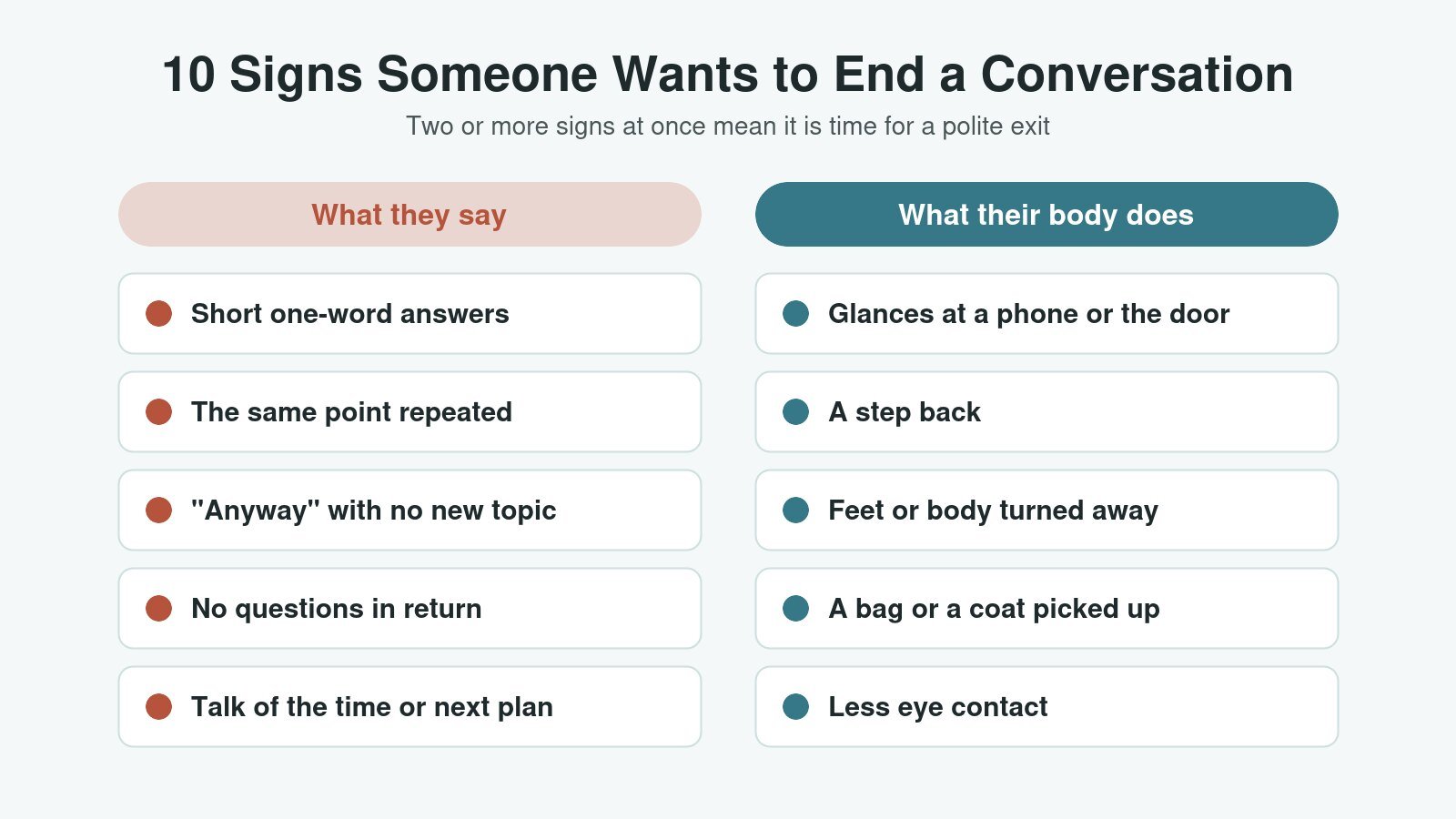
The other person shows a wish to end a conversation through 5 verbal signs and 5 body-language signs. The 5 verbal signs are below.
- Short one-word answers.
- The same point repeated.
- “Anyway” or “so, yeah” with no new topic.
- No questions in return.
- Talk of the time or the next plan.
The 5 body-language signs are below.
- Glances at a phone, a watch or the door.
- A step back.
- Feet or a body turned away.
- A bag or a coat picked up.
- Less eye contact.
Phone and text conversations show the same signs in other forms. Slower replies and shorter messages signal a wish to end a text conversation. Longer pauses and “mm-hm” answers signal the same wish on the phone.
Two or more signs at once signal the right moment for a polite exit. A pause after the signs is the natural place to leave. The guide to handling an awkward silence covers the pauses before an exit.
Why Is Ending a Conversation So Hard?
Ending a conversation feels hard for 2 reasons: fear of seeming rude and uncertainty about the other person’s wishes. Most people hide a wish to leave out of politeness. The other person hides the same wish in many cases. Both people keep talking too long. Psychologists call this pattern a coordination problem.
People pleasers find exits even harder. A strong habit of putting others first makes a personal need to leave feel selfish. A polite exit is a healthy boundary, not a selfish act. Practice with low-stakes conversations makes the habit easier.
Do Conversations End When People Want Them To?
No, very few conversations end on time for both people. Adam Mastroianni, Daniel Gilbert and colleagues studied 932 conversations in a 2021 paper in the Proceedings of the National Academy of Sciences. Only about 2% of the conversations ended on time for both people (Harvard Gazette). Only about 30% ended on time for at least one person. In the lab study of 252 strangers, almost 69% of participants felt ready to end at some point. People misjudged their partner’s preferred conversation length by about 64%.
The finding has a practical meaning. In many conversations, the other person also wants to leave. A polite exit is a kindness to both people, not a rejection.
What Should You Avoid When Ending a Conversation?
The 5 things to avoid in a conversation exit are fake excuses, a trailing “anyway” exit, empty promises, leaving mid-sentence and a long apology.
- Fake excuses. An invented reason risks being caught. A caught excuse feels dishonest.
- A trailing “anyway” exit. A vague “anyway” without a goodbye leaves the other person unsure.
- Empty promises. “Let’s grab lunch soon” with no plan erodes trust.
- Leaving mid-sentence. Cutting off a story feels dismissive.
- A long apology. Over-apologizing turns a normal exit into a big event.
A conversation worth continuing calls for the opposite skill. The guide on how to keep a conversation going covers 12 techniques for the sustaining stage.
How Does Ending Conversations Well Build Relationships and Communication Skills?
Ending conversations well builds relationships by leaving a warm last impression. The final moments of an experience shape the memory of the whole experience, according to the peak-end rule described by psychologist Daniel Kahneman. A kind exit invites the next conversation. The 6 related skills below connect ending a conversation to the wider topic of communication. The Roadmap Fundamentals session with Coach Michael Lee trains these skills in live practice.
How Does Ending a Conversation Fit Into Conversation Skills?
Ending a conversation is the closing stage of the 4 conversation stages: opening, sustaining, deepening and closing. The guide on how to start a conversation covers the opening stage. The guide to deep questions covers the deepening stage. The full guide to conversation skills explains all 4 stages and the 8 core skills.
What Role Does Ending a Conversation Play in Interpersonal Communication?
The exit shapes the memory of an exchange in interpersonal communication. Interpersonal communication is the exchange of messages between two people. A warm exit signals respect for the relationship. A cold exit signals distance.
Which Interpersonal Skills Make Ending a Conversation Easier?
The 3 interpersonal skills behind an easier exit are reading nonverbal cues, assertiveness and warmth. Reading nonverbal cues spots the right moment. Assertiveness states the need to leave. Warmth keeps the exit kind. The guide to interpersonal skills covers each skill in depth.
How Does Confidence Help You End Conversations?
Confidence makes a clear exit easier. Confident communicators end conversations without long excuses. Confident communicators also accept a short pause before the goodbye. The guide to communication with confidence lists 35 ways to speak with confidence.
Which Communication Exercises Help You Practice Ending Conversations?
The 3 communication exercises that train polite exits are Saying No Practice, Timeout and Repair, and Role-Play for Difficult Conversations. Saying No Practice trains a polite, firm refusal. Timeout and Repair trains a calm break in a heated talk. Role-Play for Difficult Conversations trains firm, kind language before a hard talk. The full list of 47 communication exercises includes steps and timing for each exercise.
How Does a Communication Coach Help You End Conversations?
A communication coach helps with ending conversations through live practice and direct feedback. A coach spots habits such as invented excuses, long apologies or a trailing “anyway”. A coach then replaces those habits with the 12 ways in this guide. Communication coaching turns a polite exit into an automatic habit.