
Follow-Up Questions: What They Are, Why They Work and 40+ Examples
By Michael Lee, communication and relationship coach · Last updated
A follow-up question is a question about something the other person just said. Follow-up questions make the asker more likable, according to research from Harvard Business School (Huang and colleagues, 2017). A good follow-up question comes from 5 steps, from listening for a hook point to going one level deeper. Follow-up questions sit at the center of strong conversation skills.
What Is a Follow-Up Question?
A follow-up question is a question that asks the other person to say more about something they just said. A follow-up question stays on the current topic. The question builds on the last answer instead of opening a new subject. Huang and colleagues define a follow-up question as a question about a topic the partner mentioned, usually in the previous turn.
An example of a follow-up exchange starts with the statement “I spent the weekend fixing up an old bike.” A follow-up question to that statement is “What made you pick that bike?”. The follow-up question proves that the listener heard the statement. The follow-up question also invites a longer answer than the first one.
A follow-up question differs from a new question in its target. A new question points at a topic the asker chooses. A follow-up question points at a topic the speaker chose. The speaker’s choice of topic reveals what matters to the speaker. A follow-up question honors that choice.
What Makes a Question a Follow-Up Question?
The 3 attributes of a follow-up question are a link to the last turn, a request for more detail and a position after a statement. A question with all 3 attributes counts as a follow-up question.
- A link to the last turn. A follow-up question refers to a word, a detail or a feeling from the previous answer.
- A request for more detail. A follow-up question asks for a reason, a story or a feeling behind the answer.
- A position after a statement. A follow-up question responds to something the other person shared. A question that only repeats the partner’s question is a mirror question instead.
A question without the link to the last turn is a topic switch. A question without a request for detail is a comment with a question mark.
Why Do Follow-Up Questions Make People Like You More?
Follow-up questions make people like the asker more by signaling responsiveness. Responsiveness is the combination of listening, understanding and care for the other person. Huang, Yeomans, Brooks, Minson and Gino tested question-asking in a 2017 paper in the Journal of Personality and Social Psychology. In the first study, 398 participants chatted online with a stranger for 15 minutes. One partner received an instruction to ask at least 9 questions. The other partner received an instruction to ask at most 4 questions.
Participants who asked more questions were liked more by their partners. Follow-up questions showed the strongest link to liking among all question types. Follow-up questions were also the most common type, at 40.51% of all questions in the chat studies. The Association for Psychological Science reports the researchers’ explanation: follow-up questions require responsiveness from the asker.
Third-party observers rated the same conversations differently. Observers who read the transcripts liked the partners who asked fewer questions. The liking effect belongs to the person receiving the questions. A follow-up question works as a gift to the listener in the conversation.
Responsiveness is the mechanism behind the effect. A topic switch ignores the last answer. A follow-up question rewards the last answer with interest. A follow-up question shows attention in a form the partner can verify.
Do Follow-Up Questions Help on Dates?
Yes, follow-up questions help on dates. The 2017 study followed 110 speed daters across 3 sessions. The researchers analyzed 1,961 four-minute dates. Each dater went on 15 to 19 dates. People who asked more follow-up questions were asked on more second dates. The authors describe the result as correlational.
A follow-up question on a date shows interest in the other person’s answer. A 4-minute date leaves room for only a few questions. Each follow-up question in that window signals attention. An example of a date follow-up is “What got you into rock climbing?” after the statement “I spend most weekends at the climbing gym.”
What Are the 6 Types of Questions in Conversation?
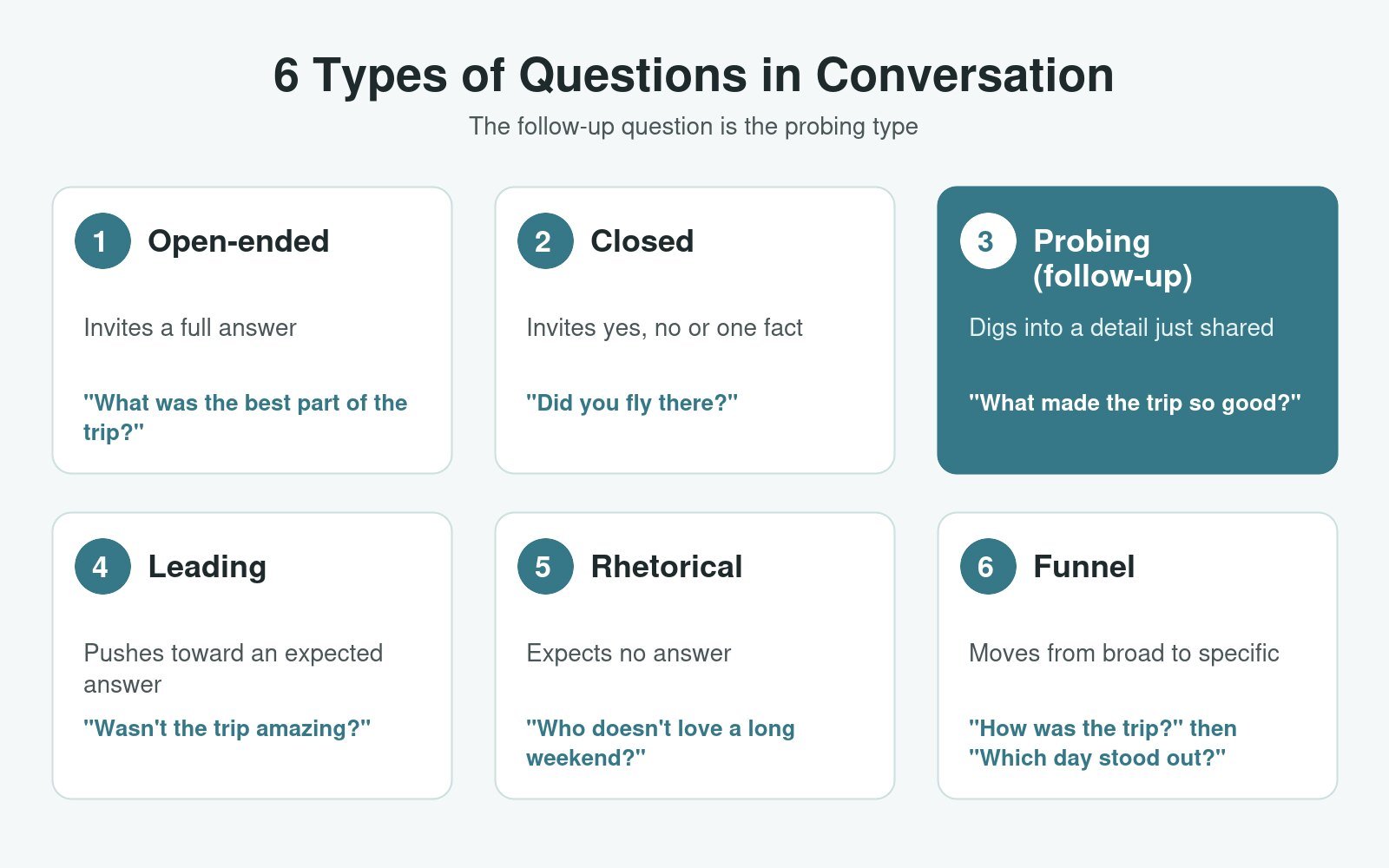
The 6 types of questions in conversation are open-ended, closed, probing (follow-up), leading, rhetorical and funnel questions. The follow-up question is the probing type. Each type serves a different goal in a conversation. The table below gives a definition, an example and the best use of each type.
| Type | Definition | Example | Best use |
|---|---|---|---|
| Open-ended | Invites a full answer | “What was the best part of the trip?” | Starting or deepening a topic |
| Closed | Invites yes, no or one fact | “Did you fly there?” | Confirming a detail |
| Probing (follow-up) | Digs into a detail just shared | “What made the trip so good?” | Showing interest and building connection |
| Leading | Pushes toward an expected answer | “Wasn’t the trip amazing?” | Rarely useful in conversation |
| Rhetorical | Expects no answer | “Who doesn’t love a long weekend?” | Adding emphasis or humor |
| Funnel | Moves from broad to specific | “How was the trip?” then “Which day stood out?” | Exploring one topic step by step |
1. Open-Ended Questions
An open-ended question is a question that invites more than a yes, a no or a single fact. Open-ended questions start with what, how, why or “tell me about”. An example of an open-ended question is “How did the move go?”.
Open-ended describes the form of a question. Follow-up describes the target of a question. The best follow-up questions are open-ended questions aimed at the last answer. The guide to open-ended questions covers the main open-ended forms.
2. Closed Questions
A closed question is a question that invites yes, no or one fact. An example of a closed question is “Did you like the movie?”. Closed questions confirm details quickly. Closed follow-up questions stall a conversation after 1 word. An example of the same follow-up in open-ended form is “What did you think of the ending?”. A long chain of closed questions feels like a form to fill in.
3. Probing (Follow-Up) Questions
A probing question is a question that digs into a detail the other person just shared. The probing question is the conversational name for a follow-up question. An example of a probing question is “What made you decide to switch careers?” after the statement “I left accounting last year.” Probing questions showed the strongest link to liking in the 2017 Harvard study. The 5 steps below explain how to ask a good probing question.
4. Leading Questions
A leading question is a question that pushes the other person toward an expected answer. An example of a leading question is “Don’t you think the meeting ran too long?”. Leading follow-up questions feel like pressure. The other person answers to agree instead of answering honestly. An example of the same question in neutral form is “How did the meeting feel to you?”. Neutral follow-up questions earn honest answers.
5. Rhetorical Questions
A rhetorical question is a question that expects no answer. An example of a rhetorical question is “Isn’t Monday always the longest day?”. Rhetorical questions add emphasis or humor. Rhetorical questions never count as follow-up questions. A rhetorical question asks the listener to agree rather than to share.
6. Funnel Questions
A funnel question is one of a series of questions that moves from broad to specific. A funnel also runs in reverse, from specific to broad. An example of a 3-question funnel is “How was the conference?”, then “Which talk stood out?”, then “What idea from that talk will you use first?”. Each question in a funnel is a follow-up to the last answer. Funnel questions explore one topic in depth without a sudden switch.
How Do You Ask a Good Follow-Up Question?
A good follow-up question comes from 5 steps: listen for a hook point, pick the detail with the most energy, ask an open-ended version, ask one question at a time and go one level deeper each time. Each step takes a few seconds in a live conversation. The 5 steps work in person, on the phone and over text.
1. Listen for a Hook Point
A hook point is a detail in an answer that invites a follow-up question. Debra Fine calls the extra detail in an answer “free information” in The Fine Art of Small Talk. Every answer contains at least one hook point.
An example of an answer with 3 hook points is “I just got back from Denver. My sister had a baby, so I stayed a week.” The 3 hook points in that answer are Denver, the sister and the new baby. Listening for hook points requires full attention. Planning the next comment during the answer hides the hook points from the listener.
2. Pick the Detail With the Most Energy
The best hook point is the detail with the most emotional energy. A speaker signals energy through tone, emphasis and repetition. A detail mentioned twice matters to the speaker. A detail said with a smile or a sigh also carries energy.
An example of an energy signal is a speaker who says “the baby” with a big smile. A follow-up about the baby beats a follow-up about the flight to Denver. The detail with the most energy produces the longest and warmest answer.
3. Ask an Open-Ended Version
An open-ended follow-up question invites a story instead of a single word. Open-ended follow-ups start with what, how or why. An example of a closed follow-up is “Was the baby early?”. An example of an open-ended follow-up on the same hook is “What was it like meeting your niece for the first time?”. The open-ended version gives the speaker room to share feelings and details.
4. Ask One Question at a Time
A good follow-up is a single question. Stacked questions confuse the listener. An example of a stacked question is “How was Denver, did you see the mountains, and how is your sister?”. The listener answers only the last part of a stacked question. A single question gets a full answer. A short pause after the answer gives the speaker space to add more.
5. Go One Level Deeper Each Time
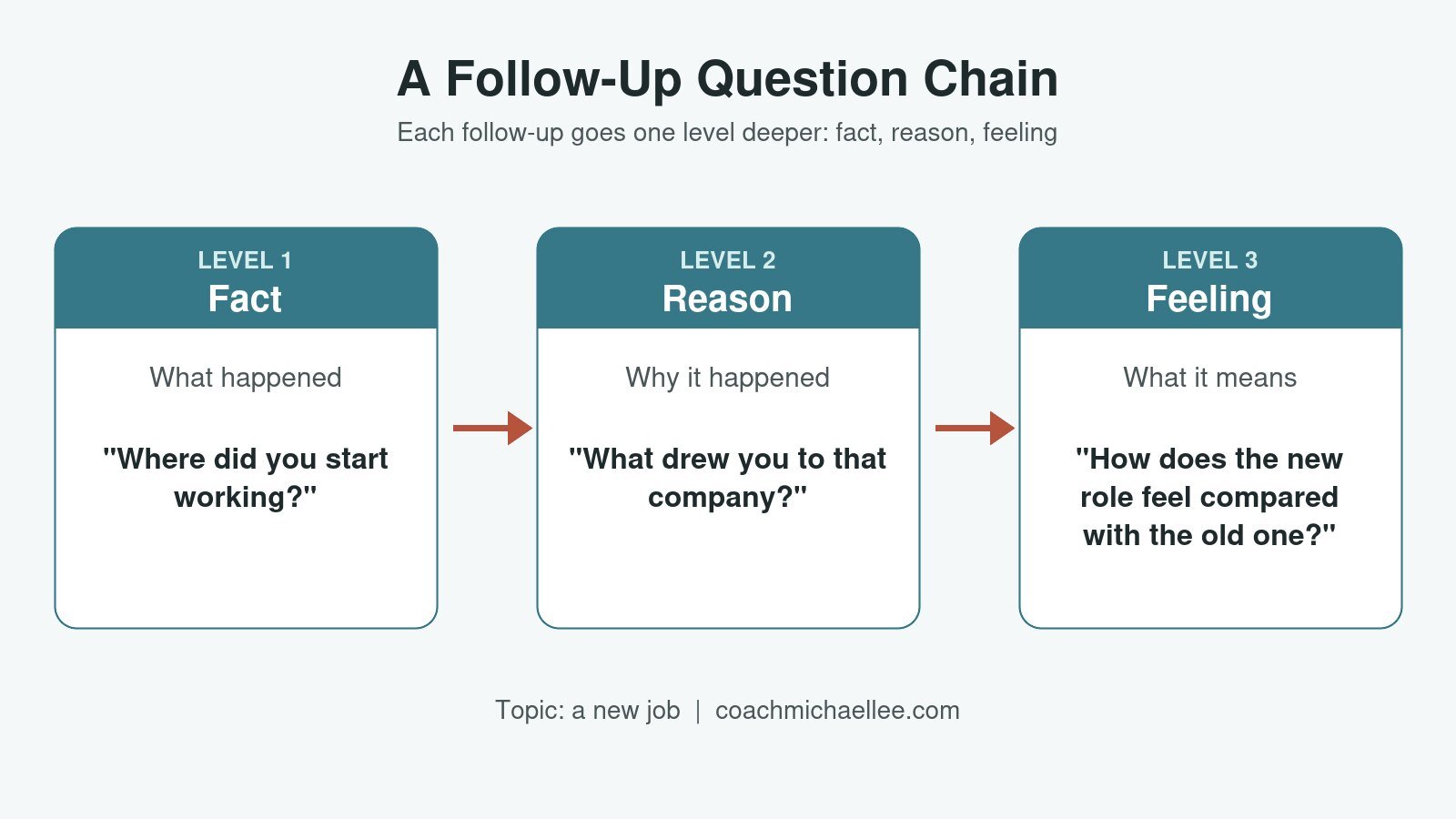
Each follow-up question in a chain goes one level deeper than the last. The 3 levels of a follow-up chain are facts, reasons and feelings. The 3 questions below show a chain on the topic of a new job.
- Fact: “Where did you start working?”
- Reason: “What drew you to that company?”
- Feeling: “How does the new role feel compared with the old one?”
A deeper follow-up fits best after the other person gives longer answers. Personal details offered without a question also signal readiness for depth. The guide to deep questions to ask lists questions for the deepest level.
What Are Good Follow-Up Questions to Ask?
Good follow-up questions match the situation. The 5 lists below give 40 follow-up questions for general conversation, small talk, dates, work and text messages. Each question works best right after a matching answer.
General Follow-Up Questions for Any Topic
The 8 general follow-up questions below work after almost any answer.
- “What happened next?”
- “How did that feel?”
- “What made you decide to do that?”
- “What was the hardest part?”
- “What surprised you most?”
- “How did you get into that?”
- “What would you do differently next time?”
- “Tell me more about that.”
General follow-up questions suit any hook point. A specific follow-up question still beats a general one. A specific question names the detail from the last answer.
Follow-Up Questions for Small Talk
The 8 follow-up questions below fit common small talk topics such as the weekend, travel, work and hobbies.
- “What was the best part of your weekend?”
- “Where are you thinking of going next?”
- “How did you end up in this city?”
- “What got you into that hobby?”
- “What do you like most about living here?”
- “What’s the story behind how you met the host?”
- “What have you watched lately that you’d recommend?”
- “What does a normal day look like in your job?”
Small talk follow-up questions move a conversation from safe facts to personal stories. A good small talk follow-up turns a 1-line answer into a 2-minute exchange.
Follow-Up Questions on a Date
The 8 follow-up questions below suit a date. Each question invites a story about passions, plans or values.
- “What got you excited about that?”
- “What made that trip so memorable?”
- “How did you get into cooking?”
- “What’s the story behind that?”
- “What would the perfect version of that weekend look like?”
- “What part of that plan excites you most?”
- “How has that experience changed you?”
- “Who got you into that?”
Date follow-up questions work best on topics the other person raises first. A follow-up on a passion shows more interest than a question from a prepared list.
Follow-Up Questions at Work
The 8 follow-up questions below suit colleagues, meetings and networking events.
- “What’s the biggest challenge on that project?”
- “How did the team decide on that approach?”
- “What would make that process easier?”
- “What did the client say about it?”
- “How did you move into that role?”
- “What’s keeping your team busy this quarter?”
- “What do you enjoy most about that kind of work?”
- “What would you need from my team to make that work?”
Work follow-up questions build trust with colleagues and clients. A follow-up on a colleague’s project shows respect for the colleague’s work.
Follow-Up Questions Over Text
Text follow-up questions work best when short and specific. The 8 follow-up questions below fit a text conversation.
- “Wait, what happened after that?”
- “How did it go?”
- “Which one did you pick?”
- “What’s the plan after that?”
- “How did it compare to what you expected?”
- “What made you laugh the most?”
- “Who else was there?”
- “What was the highlight?”
A text follow-up question refers to the last message directly. A specific text follow-up gets a reply faster than a general “How are things?”.
What Follow-Up Question Sequences Work Best?
The 3 follow-up question sequences that work best are the time sequence, the why-how-what-if sequence and the tell-me-more chain. Each sequence links 3 follow-up questions on one topic.
- The time sequence. The time sequence moves from the past of a topic to its future. An example of a time sequence is “How did you start running?”, “What does a training week look like now?” and “What race are you aiming for next?”.
- The why-how-what-if sequence. The why-how-what-if sequence moves from a reason to a method to an imagined change. An example of a why-how-what-if sequence is “Why did you choose teaching?”, “How do you keep a class engaged?” and “What would you change about schools if you could?”.
- The tell-me-more chain. The tell-me-more chain repeats an open invitation on the newest detail. An example of a tell-me-more chain is “Tell me more about the trip.”, “Tell me more about the hike.” and “Tell me more about the view at the top.”
A sequence keeps one topic alive for several minutes. A sudden switch to a new topic resets the conversation to the opening stage.
Can You Ask Too Many Follow-Up Questions?
Yes, too many follow-up questions turn a conversation into an interview. The authors of the 2017 study note that a person can ask too many questions. Too many questions annoy the partner. Too many questions also hide information about the asker. Rude or overly repetitive questions also reduce liking, according to the researchers.
A balanced conversation alternates follow-up questions with personal shares. An example of a balanced turn is “I ran my first 10K last spring. My legs hated me. How did your first race go?”. The share adds a detail. The question hands the turn back. The guide on how to keep a conversation going covers 12 techniques for balancing questions and shares.
Two weaker question types replace follow-ups in many conversations. A mirror question repeats the partner’s question back, such as “Good, and you?”. Mirror questions often come from politeness rather than curiosity. A full switch question jumps to an unrelated topic. A full switch question ends the previous topic.
What Follow-Up Question Works When Someone Gives a Short Answer?
A short answer calls for a share first and a specific follow-up second. The share gives the other person material to respond to. An example of a short answer is “Work was fine.” A good share-first reply is “Mine was a mess. A client changed everything at 4 p.m. What was the best part of your day?”. A second short answer signals low interest in the topic. A new topic fits better after 2 short answers.
How Do Follow-Up Questions Build Relationships and Communication Skills?
Follow-up questions build relationships by turning small talk into real connection. Each follow-up question shows that one person values the other person’s words. Repeated follow-ups across many conversations create trust. The 6 related skills below connect follow-up questions to the wider topic of communication. The Roadmap Fundamentals session with Coach Michael Lee trains these skills in live practice.
How Do Follow-Up Questions Fit Into Conversation Skills?
Follow-up questions are one of the 8 core conversation skills. Follow-up questions power the sustaining and deepening stages of a conversation. Strong openers start a conversation. Follow-up questions keep the conversation alive after the opener. The full guide to conversation skills explains all 8 skills and the 4 conversation stages.
What Role Do Follow-Up Questions Play in Interpersonal Communication?
Follow-up questions are the clearest signal of responsiveness in interpersonal communication. Interpersonal communication is the exchange of messages between two people. Responsiveness combines understanding, validation and care. A follow-up question delivers all 3 signals in one sentence.
Which Interpersonal Skills Make Follow-Up Questions Easier?
The 3 interpersonal skills that make follow-up questions easier are active listening, empathy and curiosity. Active listening finds the hook points. Empathy picks the detail with the most feeling. Curiosity turns the detail into a question. The guide to interpersonal skills covers each skill in depth.
How Do Follow-Up Questions Make Communication More Effective?
Follow-up questions make communication more effective by clearing up vague messages. Clarity and correctness are 2 of the 7 Cs of effective communication. A clarifying follow-up question checks meaning before a misunderstanding grows. An example of a clarifying follow-up is “When you say soon, do you mean this week?”.
Which Communication Exercises Train Follow-Up Questions?
The 3 communication exercises that train follow-up questions are Question Chains, Paraphrase Practice and Story Recall. Question Chains train a series of follow-ups on one topic. Paraphrase Practice trains the listening behind a good follow-up. Story Recall trains memory for hook points. The full list of 47 communication exercises includes steps and timing for each exercise.
How Does a Communication Coach Help With Follow-Up Questions?
A communication coach helps with follow-up questions through live practice and direct feedback. A coach spots habits such as mirror questions, stacked questions or interview mode. A coach then replaces those habits with hook-based follow-ups. Communication coaching turns the 5 follow-up steps into automatic habits.