
Types of Interpersonal Communication: 12 Types With Examples
By Michael Lee, communication and relationship coach · Last updated
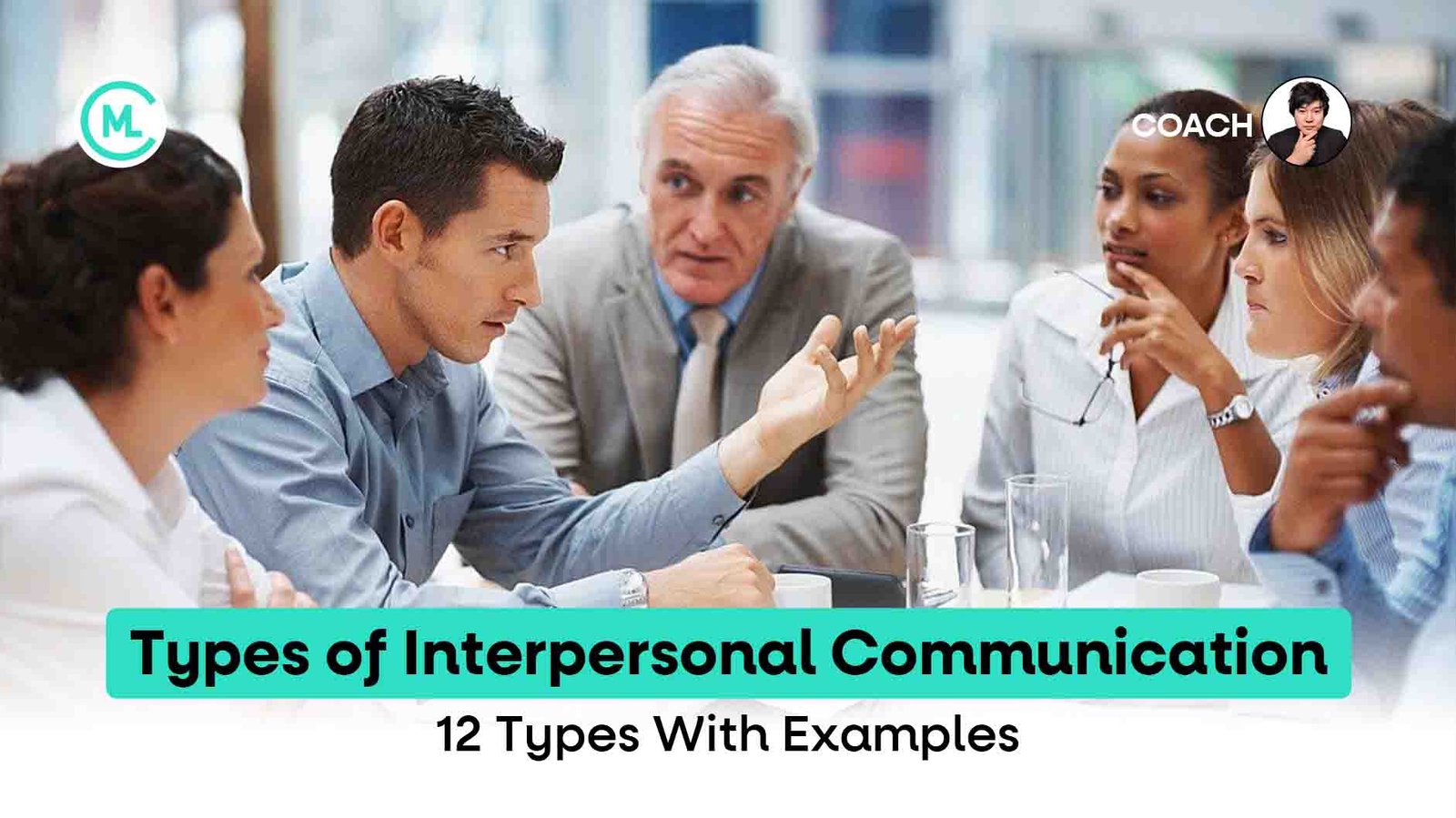
The main types of interpersonal communication are verbal, nonverbal, written, and listening, and interpersonal communication also divides by channel, number of people, and relationship, from face-to-face and dyadic talks to mediated and professional exchanges. Most conversations combine several types of interpersonal communication at once. A video call with a partner, for example, mixes spoken words, tone of voice, facial expressions, a shared screen, and careful listening. The guide below explains the 4 main types, the 5-type version, and a full list of 12 types of interpersonal communication, with an everyday example of each type.
What Are the Types of Interpersonal Communication?
The types of interpersonal communication are the different forms, channels, group sizes, and relationship settings through which 2 or a few people exchange messages. Interpersonal communication is the exchange of information, ideas, and feelings between 2 or more people through verbal and nonverbal messages. Communication scholar Steven McCornack described interpersonal communication in 2010 as a dynamic exchange in which messages shape the thoughts, emotions, behaviors, and relationships of the people involved. Sources count the interpersonal communication types differently, because each source uses different criteria, so published lists range from 4 to 7 types. Interpersonal types also differ from intrapersonal communication, the communication inside 1 person’s mind, such as self-talk before a hard conversation. 4 criteria cover almost every list.
- Form describes how a message travels, such as spoken words, body language, text, or images.
- Channel describes whether 2 people share the same space or connect through technology.
- Number of people describes whether a conversation involves 2 people or a small group.
- Relationship describes whether the exchange happens between friends, partners, and family members or between colleagues and clients.
What Are the 4 Main Types of Interpersonal Communication?
The 4 main types of interpersonal communication are verbal, nonverbal, written, and listening. Almost every textbook and career guide starts with the 4 main types, because the 4 types describe how people send and receive a message. Career guides, training providers, and open textbooks all open with the same 4 types of interpersonal communication. Verbal communication uses spoken words, nonverbal communication uses the body and the voice, written communication uses text, and listening receives and interprets the message. A video call combines spoken words, facial expressions, chat messages, and active listening in a single exchange.
What Are the 5 Types of Interpersonal Communication?
The 5 types of interpersonal communication add tone of voice to the 4 main types, so the list becomes verbal, nonverbal, written, listening, and tone of voice, also called paralanguage. Some sources add visual communication instead of tone of voice as the fifth type. Open textbooks, such as the textbook by Jason Wrench and colleagues, list 5 levels of human communication instead: intrapersonal, interpersonal, small group, public, and mediated communication. Sources count 4, 5, or 7 types, because each source uses a different set of criteria. The full list of 12 types below brings the criteria together.
12 Types of Interpersonal Communication
The 12 types of interpersonal communication fall into 4 groups: 6 types by form, 2 types by channel, 2 types by number of people, and 2 types by relationship. The 4 types that every source lists come first, followed by the less common types. A single conversation belongs to several types at once: a video call with a partner is verbal, nonverbal, mediated, one-on-one, and personal at the same time.
1. Verbal Communication
Verbal interpersonal communication is the use of spoken words to share information, ideas, and feelings with another person. Verbal communication includes word choice, directness, formality, and the structure of each sentence. Career guides often call verbal communication “oral communication,” and a few guides wrongly use “verbal” for written messages, but verbal communication means spoken words. Everyday examples include face-to-face conversations, phone calls, and video calls. A clear verbal message states the main point first, uses words the listener knows, and invites a response, such as “Can we move the meeting to 3 p.m.? What works for you?”
2. Nonverbal Communication
Nonverbal interpersonal communication is the exchange of messages without words, through body language, facial expressions, eye contact, and tone of voice. Researchers divide nonverbal communication into codes. Kinesics covers body movement and gestures, and anthropologist Ray Birdwhistell coined the term in the 1950s. Haptics covers touch, chronemics covers the use of time, and proxemics covers personal space. Edward Hall’s 1966 research on proxemics defined 4 distance zones that communicate closeness: intimate, personal, social, and public distance. Appearance, such as clothing and the background on a video call, also sends nonverbal signals. Psychologist Paul Ekman’s research identified 6 basic emotions whose facial expressions people recognize across cultures: happiness, sadness, fear, anger, surprise, and disgust. A friend who arrives late, avoids eye contact, and keeps arms crossed sends a message before saying a word.
3. Written Communication
Written interpersonal communication is the exchange of personal messages through text, such as text messages, emails, chat messages, and letters. Written messages remove tone of voice and body language, so receivers misread written messages more often than spoken messages. A 2005 study by Justin Kruger and Nicholas Epley in the Journal of Personality and Social Psychology found that email senders overestimated how accurately receivers identified the intended tone of an email. Emojis, punctuation, and response time carry part of the missing tone. A short “ok.” after a long message feels cold to many readers, while “Okay, sounds good!” feels warm.
4. Listening
Listening in interpersonal communication is the active process of receiving, interpreting, and responding to another person’s message. Hearing is the physical perception of sound, while listening involves attention and interpretation. Psychologists Carl Rogers and Richard Farson introduced the term “active listening” in 1957. Kittie Watson, Larry Barker, and James Weaver described 4 listening styles in 1995: people-oriented, action-oriented, content-oriented, and time-oriented. A people-oriented listener focuses on feelings, while a time-oriented listener prefers short, efficient messages. A partner who paraphrases a worry before offering advice shows strong active listening skills.
5. Tone of Voice (Paraverbal Communication)
Paraverbal communication is the vocal side of a message, such as tone, pitch, pace, volume, and pauses, that changes how spoken words land. Linguist George Trager described paralanguage in 1958 as the vocal features that accompany speech. The sentence “That’s great” sounds sincere in a warm tone and sarcastic in a flat tone. A fast pace signals excitement or nerves, and a slow, low voice signals calm. Many textbooks place tone of voice inside nonverbal communication, while newer guides list tone of voice as a separate type because tone carries so much emotional meaning.
6. Visual Communication
Visual communication shares meaning through images, such as photos, drawings, screenshots, and shared screens, during a personal exchange. A photo of a new apartment in a message to a friend, a quick sketch during a 1-on-1 meeting, and a shared screen on a video call all add visual communication to a conversation. GIFs and memes work as visual shortcuts for emotion in group chats. Visual communication makes complex information easier to understand, because a picture shows in seconds what words explain in minutes. Visual communication works best together with words, because an image without context invites different interpretations.
7. Face-to-Face Communication
Face-to-face communication is interpersonal communication in the same physical space, where words, voice, and body language arrive together in real time. Richard Daft and Robert Lengel described media richness theory in 1986 and ranked face-to-face communication as the richest channel, because face-to-face talk carries the most cues and allows instant feedback. Environment, timing, and culture shape every face-to-face conversation, from lighting and noise to the formality of the room. Face to face communication suits sensitive and complex topics, such as bad news, a conflict with a partner, or a first date. Face-to-face talk also builds trust faster than text, because each person sees the other person’s reactions as the conversation unfolds.
8. Digital (Mediated) Communication
Mediated communication is interpersonal communication through technology, such as phone calls, video calls, text messages, and social media. Researchers call text-based exchanges computer-mediated communication, and the comparison of direct vs mediated communication runs through modern interpersonal research. Mediated interpersonal communication includes every exchange that passes through a device, from a 2-minute voice note to a 2-hour video call. Communication researcher Joseph Walther described the hyperpersonal model in 1996: online partners sometimes form more idealized impressions than face-to-face partners, because each person controls the self-image in each message. Digital communication connects friends across distance and supports remote teams. Telehealth visits also use mediated communication between patients and doctors. Heavy reliance on screens reduces nonverbal cues, so digital conversations benefit from clear words and occasional video calls.
9. One-on-One (Dyadic) Communication
Dyadic communication is interpersonal communication between exactly 2 people, the most common and most personal form of interpersonal exchange. Sociologist Georg Simmel described the dyad, a group of 2, and the triad, a group of 3, in 1908. Simmel observed that a dyad depends fully on both people, while a triad survives the departure of 1 member. Examples of dyadic communication include a talk between partners, a coffee with a friend, a performance review, and a doctor’s appointment. Dyadic communication allows the deepest self-disclosure, because only 2 people share the conversation. Charles Berger and Richard Calabrese described uncertainty reduction theory in 1975: strangers ask questions and share small details to reduce uncertainty about the other person, and uncertainty reduction explains the predictable small talk of first conversations.
10. Small Group Communication
Small group communication is interpersonal communication among about 3 to 15 people who interact directly toward a shared goal. Each member of a small group talks directly with every other member, and direct talk among all members keeps the exchange interpersonal. Small groups include project teams, study groups, families at dinner, and friend groups planning a trip. Public communication, such as a speech to an audience, and mass communication, such as television, fall outside interpersonal communication, because the audience rarely responds directly. Small groups work best with clear roles, turn-taking, and space for quieter members to speak.
11. Communication in Personal Relationships
Personal interpersonal communication takes place in close relationships, such as friendships, romantic relationships, and families, and builds intimacy and trust. Psychologists Irwin Altman and Dalmas Taylor described social penetration theory in 1973: relationships deepen as 2 people share more personal information over time. Friendships and romantic relationships grow through reciprocal self-disclosure and shared plans for the future. Parent-child communication shapes a child’s identity, because parents give direct definitions such as “You are so kind” or “You are lazy.” Honest conversations about needs and expectations prevent long-term resentment between partners.
12. Communication at Work
Professional interpersonal communication takes place between colleagues, managers, customers, and clients, and focuses on tasks, roles, and shared results. Common examples include meetings, presentations, 1-on-1s, feedback talks, phone calls with clients, and team chat. Teacher-student communication and patient-provider communication also count as professional interpersonal communication. Workplace communication follows clearer roles and more formal language than personal communication. Respectful disagreement at work leads to better decisions than silent agreement.
What Is the Most Common Type of Interpersonal Communication?
The most common type of interpersonal communication is a face-to-face, one-on-one conversation that combines spoken words, tone of voice, body language, and listening. Communication textbooks describe interpersonal communication as typically dyadic, meaning between 2 people. Everyday conversations with partners, family members, friends, and coworkers make up most interpersonal communication in a normal day. Text messaging ranks as the most common digital type for many people, because texting fits between other activities. A single morning often includes all 4 main types: a chat over breakfast, a text to a friend, a nod to a neighbor, and careful listening in a meeting.
How Do the Types of Interpersonal Communication Work Together?
The types of interpersonal communication work together in almost every conversation, because words, voice, body language, and listening reach the other person at the same time. Nonverbal cues either support or contradict spoken words. Albert Mehrabian’s 1971 research found that listeners rely on tone of voice and facial expressions when a speaker’s words and feelings send inconsistent signals. A partner who says “I’m fine” with a flat tone and crossed arms sends a mixed message, and the listener usually trusts the tone and the body. At work, a manager who praises a report while checking a phone sends the same mixed signal. Consistent types, such as warm words, a warm tone, and steady eye contact, build trust. On a date, a person who asks a curious question, leans in slightly, and listens without checking a phone sends 1 clear message of interest through 4 types at once. In text messages, the same interest shows through a quick reply, a follow-up question, and a friendly emoji.
Which Type of Interpersonal Communication Should You Use?
The right type of interpersonal communication matches the message: face-to-face talk for sensitive or complex topics, and written messages for facts, plans, and records. Media richness theory explains the choice: rich channels suit emotional or unclear messages, and lean channels suit simple facts. The table matches common situations with the best type.
| Situation | Best type | Why |
|---|---|---|
| Sharing bad news | Face-to-face or video call | Tone and body language soften the message |
| Sending a quick fact | Text message or chat | Fast and easy to check later |
| Solving a conflict with a partner | Face-to-face, one-on-one | Full cues and instant repair |
| Confirming a plan with dates | Written message or email | Creates a clear record |
| Following up after a first date | Short text, then a call | Shows interest without pressure |
| Making a team decision | Small group meeting | Every member hears every view |
How Deep Can Interpersonal Communication Go?
Interpersonal communication ranges from impersonal to deeply personal, and philosopher Martin Buber described 3 depths: “I-It,” “I-You,” and “I-Thou”. Buber introduced the “I-Thou” relationship in the 1923 book I and Thou, and Julia Wood’s textbook Interpersonal Communication: Everyday Encounters applies Buber’s ideas to everyday communication.
- “I-It” communication treats another person as an object or a role, such as a form email or a rushed order at a counter.
- “I-You” communication recognizes the other person politely but stays within social roles, such as small talk with a cashier or a classmate.
- “I-Thou” communication fully recognizes the other person as unique, such as a deep conversation with a partner or a close friend.
Most daily exchanges stay at the “I-You” depth, and “I-It” exchanges happen whenever people rush through routine tasks. “I-Thou” moments are rare, and “I-Thou” moments build the strongest relationships.
What Is the Difference Between Formal and Informal Interpersonal Communication?
Formal interpersonal communication follows set roles, polite language, and clear structure, while informal interpersonal communication stays relaxed, spontaneous, and personal. Formal and informal communication differ in language, structure, and the distance between the speakers. A performance review, a job interview, and a meeting with a partner’s parents follow formal patterns. A coffee chat, a text to a friend, and a joke with a teammate follow informal patterns. Formal communication inside organizations also moves in directions: vertical communication runs between managers and employees, horizontal communication runs between peers, and diagonal communication runs across departments and levels. Strong communicators switch smoothly between formal and informal styles as the setting changes. A new employee who writes to a manager in the casual style of messages to friends risks looking unprofessional, while a person who speaks to a partner in formal language sounds distant.
What Is the Difference Between Real-Time and Delayed Communication?
Real-time (synchronous) interpersonal communication happens in the moment, such as a conversation or a call, while delayed (asynchronous) interpersonal communication allows a gap before the reply, such as an email or a text message. Real-time communication gives instant feedback and fast repair of misunderstandings. Delayed communication gives time to think, and the extra time helps with careful replies and busy schedules. Delayed communication also creates waiting, and an unanswered message often causes worry in new relationships and new jobs. Clear expectations about reply times, such as “I’ll answer tonight,” reduce the worry. Synchronous and asynchronous communication work best together: a quick call settles a confusing email thread, and a short written summary after a call records the decisions.
What Is the Purpose of Interpersonal Communication?
The purpose of interpersonal communication falls into 3 goals: instrumental goals that get a task done, relational goals that build or repair a relationship, and identity goals that present a chosen self-image. Daniel Canary, Michael Cody, and Valerie Manusov describe the 3 goals in a goals-based approach to interpersonal communication.
- Instrumental goals complete a task, such as asking a coworker for a file or planning a trip with a friend.
- Relational goals build, keep, or repair a relationship, such as apologizing to a partner or checking in on a friend.
- Identity goals present a chosen self-image, such as appearing competent in an interview or caring on a first date.
Most conversations serve all 3 goals at once, so a simple request also shapes the relationship and the speaker’s image.
Where Do the Types Fit in Interpersonal Communication?
The types of interpersonal communication describe the forms of an exchange, while interpersonal communication skills describe how well each person uses the forms. The guide to interpersonal communication explains the definition, principles, and theories behind every conversation between 2 people. The list of interpersonal communication skills covers 20 skills, from active listening to repairing misunderstandings, that make each type work. Knowledge of the types shows the structure of a conversation, and practice of the skills improves the conversation.
How Is Interpersonal Communication Different From Other Types of Communication?
The types of communication cover every setting, from mass media to public speeches, while the types of interpersonal communication cover exchanges between 2 or a few people. The broader types of communication include verbal, nonverbal, written, and visual communication in any setting. The 5 levels of communication run from intrapersonal to mass communication, and interpersonal communication forms the second level.
Which Skills Make Each Type Work?
Interpersonal skills make each type work, such as clarity for verbal messages, empathy for listening, and self-awareness for nonverbal signals. The broader interpersonal skills add teamwork, patience, and reliability to everyday conversations. The core communication skills cover the abilities for sending and receiving messages in every type.
How Does Each Type Follow the Communication Process?
Every type of interpersonal communication follows the same communication process, from encoding a message to receiving feedback. The communication process moves a message through 5 steps, from the sender’s idea to the receiver’s response. The elements of communication, such as the channel, the noise, and the context, explain why the same message works in 1 type and fails in another.
Why Do Barriers Affect Some Types More Than Others?
Barriers affect written and mediated communication more than face-to-face talk, because text and screens remove tone, facial expressions, and instant feedback. The common barriers to communication include psychological, emotional, perceptual, and language barriers. Effective communication means that the receiver understands the message the way the sender intended, and choosing the right type removes many barriers before a conversation starts.
Why Does Knowing the Types Help People Communicate Better?
Knowing the types of interpersonal communication helps people communicate better, because a person who recognizes each type chooses the right type for each message. The importance of communication shows in trust, teamwork, and well-being at every level. The types of interpersonal communication apply to every part of communication, from a quick text to a deep talk at home. More guides on communication are available in the Knowledge Hub.