
Types of Communication: Verbal, Nonverbal, Written and Visual With Examples
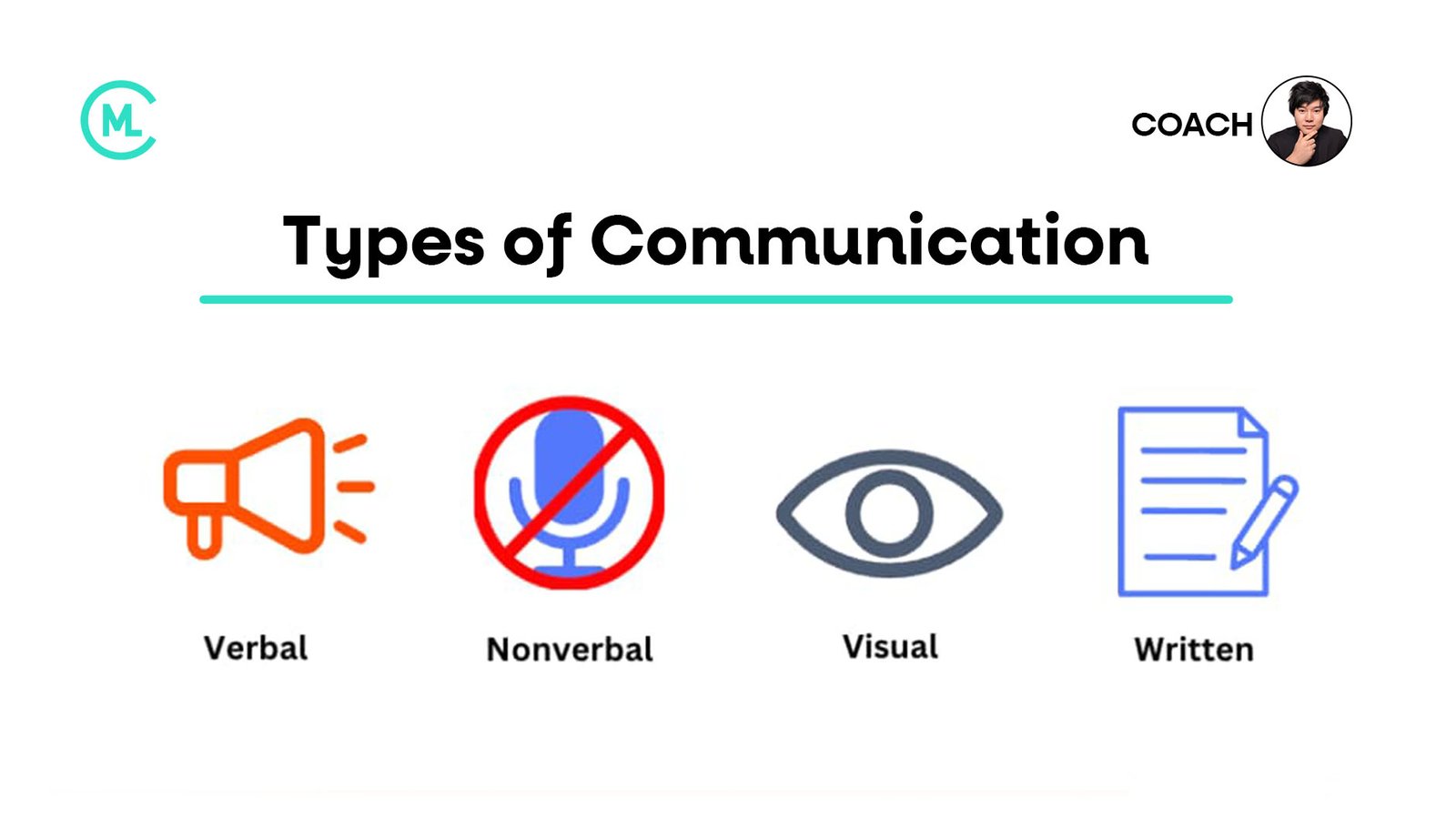
The 4 main types of communication are verbal, nonverbal, written, and visual communication, and listening completes every type as the receiving side of communication. Verbal communication uses spoken words, nonverbal communication uses body language and tone of voice, written communication uses written words, and visual communication uses images, graphics, charts, and symbols. Communication is also classified by formality, by direction, by the number of participants, and by channel. Each type of communication has specific advantages and disadvantages, and the most effective type depends on the message, the audience, and the goal. Most everyday messages combine several types of communication at once.
What Are the Different Types of Communication?
The different types of communication are the ways people exchange information, and the 4 main types are verbal, nonverbal, written, and visual communication. The types of communication are also called the forms of communication or the modes of communication. Each type of communication uses a different channel: spoken words, body signals, written words, or visual elements.
Most messages combine several types of communication at the same time. A video call, for example, combines spoken words, facial expressions, chat messages, and shared slides. The exchange of information succeeds when the different types of communication send the same message. The exchange of information fails when the types send mixed signals, such as friendly words with a cold tone.
How Many Types of Communication Are There?
The number of types of communication ranges from 4 to 6, depending on the source, and the most common answer is 4 main types. The 3 most common counts of the types of communication are below.
- 4 types of communication: The 4 types of communication list is verbal, nonverbal, written, and visual communication, the most common list in career guides and textbooks. Some career guides write the same list as verbal, non-verbal, written, and visual communication.
- 5 types of communication: The 5 types of communication list adds listening, because verbal, nonverbal, written, visual, and listening together cover both sending and receiving.
- 6 types of communication: The 6 types of communication list, used in some business courses, separates oral communication and interpersonal communication into separate types.
The communication framework on coachmichaellee.com uses the 4 main types, with listening as the receiving side of every type.
How Are the Types of Communication Classified?
The types of communication fall into 5 classification criteria: mode, formality, direction, number of participants, and channel. The classification of communication depends on the question: how a sender delivers a message, how official the message sounds, or how many people take part. The 5 ways to classify communication are below.
- Mode: Classification by mode separates verbal, nonverbal, written, and visual communication.
- Formality: Classification by formality asks whether a message is formal or informal, and separates formal communication from informal communication.
- Direction: Classification by direction separates upward, downward, and horizontal communication inside an organization.
- Number of participants: Classification by participants separates intrapersonal communication, interpersonal communication, group communication, public communication, and mass communication.
- Channel: Classification by channel separates face-to-face, digital, and broadcast communication channels.
What Is Verbal Communication?
Verbal communication is the use of spoken words to share information, ideas, and feelings. Verbal communication is also called oral communication. Academic definitions extend verbal communication to any language-based message, including sign language such as American Sign Language (ASL). Verbal communication gives immediate feedback, because the listener responds while the conversation continues. Choice of words, tone of voice, pace, and volume determine how clearly verbal communication carries meaning. Verbal communication fits situations that require quick answers, emotional support, or discussion.
What Are the Types of Verbal Communication?
The 4 main types of verbal communication are face-to-face conversation, phone and video calls, meetings, and presentations. The 4 main types of verbal communication are below.
- Face-to-face conversation: Face-to-face conversation combines spoken words with body language, facial expressions, and eye contact.
- Phone and video calls: Phone calls carry spoken words and tone across distance, and video calls add facial expressions.
- Meetings: Meetings bring several people together to share ideas, make decisions, and coordinate work.
- Presentations: Presentations deliver 1 speaker’s message to an audience, often with visual aids.
What Are Examples of Verbal Communication?
Examples of verbal communication include a job interview, a phone call with a friend, a team meeting, and a wedding toast. A manager who asks a team, “Share your thoughts on the new plan,” uses verbal communication to invite discussion. A person who asks a date, “What was the best part of your week?” uses verbal communication to start a personal conversation. A customer service agent who explains a refund over the phone uses verbal communication to solve a problem. The verbal communication examples above all rely on spoken words and immediate feedback.
What Is Nonverbal Communication?
Nonverbal communication is the exchange of messages without words, through body language, facial expressions, eye contact, and tone of voice. Nonverbal communication, also written as non-verbal communication, runs alongside spoken words and often reveals emotion faster than words. Nonverbal cues either support or contradict verbal messages. Albert Mehrabian’s 1971 research found that listeners rely on tone of voice and facial expressions when a speaker’s words and feelings send inconsistent signals. Nonverbal communication builds trust when body language matches the spoken message.
What Are the Types of Nonverbal Communication?
The 7 main types of nonverbal communication are kinesics, facial expressions, oculesics, proxemics, haptics, paralanguage, and chronemics. The 7 main types of nonverbal communication are below.
- Kinesics: Kinesics covers body language, including gestures, posture, and movement.
- Facial expressions: Facial expressions show emotion, and Paul Ekman’s research identified 6 basic emotions with facial expressions recognized across cultures.
- Oculesics: Oculesics covers eye contact, including gaze direction and gaze duration.
- Proxemics: Proxemics covers personal space, and Edward T. Hall defined 4 distance zones in 1966: intimate, personal, social, and public.
- Haptics: Haptics covers touch, such as handshakes, hugs, and pats.
- Paralanguage: Paralanguage covers the tone, pitch, pace, and volume of the voice.
- Chronemics: Chronemics covers the use of time, such as punctuality and response time.
What Are Examples of Nonverbal Communication?
Examples of nonverbal communication include a firm handshake, a smile, crossed arms, a nod during a conversation, and standing close to a friend. A nod signals attention while another person speaks. Crossed arms and little eye contact signal discomfort or disagreement. Leaning forward on a first date signals interest in the other person. Facial expressions, gestures, and posture send attention, discomfort, and interest without a single spoken word. The nonverbal communication examples above show how much meaning the body adds to every conversation.
What Is Written Communication?
Written communication is the exchange of messages through written words, such as emails, text messages, letters, and reports. Written communication creates a permanent record, so written communication supports accuracy, accountability, and later reference. Written communication removes tone of voice and body language, which increases the risk of misunderstandings. A 2005 study by Justin Kruger and Nicholas Epley in the Journal of Personality and Social Psychology found that email senders overestimated how accurately receivers identified the intended tone of an email. Written communication fits instructions, agreements, records, and complex information that readers review more than once.
What Are the Types of Written Communication?
The 4 main types of written communication are personal, professional, digital, and formal written communication. The 4 main types of written communication are below.
- Personal written communication: Personal written communication includes cards, letters, and messages between friends, partners, and family members.
- Professional written communication: Professional written communication includes emails, memos, and reports between colleagues, clients, and managers.
- Digital written communication: Digital written communication includes text messages, instant messaging, chat apps, and social media posts.
- Formal written communication: Formal written communication includes contracts, policies, job descriptions, and official notices.
What Are Examples of Written Communication?
Examples of written communication include an email to a manager, a text message to a partner, a project report, a handwritten card, and a social media post. A project report shares complex ideas and data in a structured format. A text message confirms dinner plans in a few words. A handwritten thank-you card expresses gratitude in a personal way. Social media posts share news and opinions with a wide audience at once. The written communication examples above show how written words fit both personal and professional life.
What Is Visual Communication?
Visual communication is the use of images, symbols, and graphics to convey a message. Visual communication simplifies complex information, because images, graphics, charts, and diagrams show relationships faster than paragraphs. Road signs use pictographs, so drivers understand the message in a second, even across languages. Visual elements also carry cultural meaning: emojis, colors, and gestures in images mean different things to different people. Visual communication works best as support for verbal or written communication.
What Are the Types of Visual Communication?
The 6 main types of visual communication are charts and graphs, photos and illustrations, infographics, videos, signs and symbols, and emojis. The 6 main types of visual communication are below.
- Charts and graphs: Charts and graphs show numbers, trends, and comparisons.
- Photos and illustrations: Photos and illustrations show people, places, and objects directly.
- Infographics: Infographics combine short text, icons, and data into 1 visual summary.
- Videos: Videos combine moving images, sound, and spoken words.
- Signs and symbols: Signs and symbols deliver instructions quickly, such as traffic signs and safety icons.
- Emojis: Emojis add emotional tone to text messages and instant messaging.
What Are Examples of Visual Communication?
Examples of visual communication include a slide deck, a road sign, a bar chart in a report, an infographic, and an emoji in a text message. A bar chart in a sales report shows quarterly growth at a glance. A slide deck with visual aids helps an audience follow a presentation. A heart emoji at the end of a text message adds warmth to a short note. The visual communication examples above replace or support words with images.
Is Listening a Type of Communication?
Yes, listening is a type of communication, because a message succeeds only when the receiver hears, interprets, and responds to the message. Hearing is the physical perception of sound, while listening involves attention and interpretation. Passive listening receives the message without a response. Active listening confirms understanding through eye contact, paraphrasing, and clarifying questions. Psychologists Carl Rogers and Richard Farson introduced the term “active listening” in 1957. Listening completes verbal, nonverbal, written, and visual communication, because each type needs a receiver who understands the message.
What Is the Difference Between Formal and Informal Communication?
Formal communication follows official rules and channels, while informal communication flows freely through casual conversations and personal networks. The table below compares formal communication and informal communication by 5 features.
| Feature | Formal communication | Informal communication |
|---|---|---|
| Channels | Official emails, memos, reports, and scheduled meetings | Casual conversations, chats, and social events |
| Speed | Slower, because messages follow set steps | Faster, because messages move directly between people |
| Tone | Professional and structured | Relaxed and personal |
| Documentation | Recorded and easy to reference | Rarely recorded |
| Examples | A policy memo or a performance review | A coffee-break chat or a team group chat |
Formal communication supports accuracy and accountability, while informal communication, sometimes called the grapevine, builds relationships and spreads information quickly.
What Are Upward, Downward, and Horizontal Communication?
Upward, downward, and horizontal communication are the 3 directions of communication inside an organization. The 3 directions of communication are below.
- Upward communication: Upward communication moves from employees to managers, such as progress reports, suggestions, and complaints.
- Downward communication: Downward communication moves from managers to employees, such as instructions, goals, and policy updates.
- Horizontal communication: Horizontal communication, also called lateral communication, moves between colleagues at the same level, such as 2 team leads coordinating a project.
Some organizations also use diagonal communication, which moves across departments and levels at the same time. Upward downward horizontal communication, together, keeps every level of an organization informed and aligned.
What Are the Advantages and Disadvantages of Each Type of Communication?
Each type of communication has specific advantages and disadvantages, such as the speed of verbal communication and the permanence of written communication. The table below lists the main advantages and disadvantages of the 5 communication types.
| Type | Advantages | Disadvantages |
|---|---|---|
| Verbal | Immediate feedback, emotional warmth, quick decisions | No permanent record; words are easy to forget |
| Nonverbal | Shows emotion and sincerity; builds trust | Easy to misread; meanings differ across cultures |
| Written | Permanent record; suits complex information | No tone of voice; higher risk of misunderstandings |
| Visual | Simplifies complex ideas; crosses language barriers | Needs context; images can be misinterpreted |
| Listening | Confirms understanding; makes speakers feel heard | Requires full attention; easily disrupted by distractions |
The advantages and disadvantages of types of communication show that the strengths of 1 type often cover the weaknesses of another type.
Which Type of Communication Is Most Effective?
The most effective type of communication depends on the message, the audience, and the goal, and face-to-face verbal communication is the richest type for complex or emotional messages. Richard Daft and Robert Lengel’s media richness theory, developed in the 1980s, ranks face-to-face communication as the richest channel, because face-to-face communication carries the most cues and allows immediate feedback. The table below lists the most effective type of communication for 6 common situations.
| Situation | Most effective type of communication |
|---|---|
| Delivering bad news | Face-to-face verbal communication with supportive nonverbal cues |
| Giving step-by-step instructions | Written communication with visual aids |
| Presenting data | Visual communication, such as charts and graphs |
| Making a first impression | Nonverbal communication, such as eye contact and posture |
| Apologizing to a partner | Face-to-face verbal communication with active listening |
| Sharing a quick update | Written communication, such as a text message or instant messaging |
Effective communication matches the type of communication to the message rather than using 1 type for everything. The audience also shapes the choice: a busy executive prefers a short written summary, while a nervous new employee benefits from a face-to-face conversation. Timing matters too, because urgent problems call for a phone call or a conversation rather than an email that waits in an inbox.
How Do the Types of Communication Work Together?
The types of communication work together because most messages combine words, body language, text, and images at the same time. A job interview combines verbal answers, nonverbal cues such as a firm handshake and eye contact, a written résumé, and active listening. A first date combines conversation, facial expressions, a follow-up text message, and attentive listening. Consistency between types of communication builds trust. Contradiction between types of communication, such as saying “I’m fine” with a flat tone and crossed arms, sends mixed signals and can lead to misunderstandings. Strong communicators align every type of communication with the same core message. A team meeting shows the same pattern at work: the manager explains a goal verbally, shares a chart on screen, sends a written summary afterward, and watches facial expressions to check understanding.
How Can You Improve Communication Skills for Each Type of Communication?
Communication skills for each type of communication improve through a specific habit, such as clear choice of words for verbal communication and open posture for nonverbal communication. The table below lists 1 improvement habit for each of the 5 communication types.
| Type | Improvement habit |
|---|---|
| Verbal | Clear choice of words, a steady pace, and the main point stated first |
| Nonverbal | Open posture, steady eye contact, and facial expressions that match the words |
| Written | Short sentences, a clear subject line, and a final read before sending |
| Visual | 1 idea per visual, clear labels, and visual aids that support the spoken message |
| Listening | Full attention, paraphrasing, and clarifying questions before a response |
The answer to how to improve communication skills differs for each type of communication, and small, consistent habits improve communication skills across personal and professional life.
What Is the Difference Between Types of Communication and Communication Styles?
Types of communication describe the mode of a message, while communication styles describe the way a person behaves when communicating. A person uses verbal, nonverbal, written, and visual communication, and a person also shows 1 communication style across all types. The phrase “types of communication styles” refers to the 4 communication styles, not to the 4 types of communication. The 2 ideas answer different questions: the type of communication answers how a message travels, and the communication style answers how a person treats the other person during the message. A single email can be assertive or passive-aggressive, and a single conversation can be passive or aggressive, so style and type combine in every exchange.
What Are the 4 Communication Styles?
The 4 communication styles are passive, aggressive, passive-aggressive, and assertive. The 4 communication styles are below.
- Passive: The passive style avoids expressing personal needs and opinions.
- Aggressive: The aggressive style expresses personal needs while ignoring other people’s needs.
- Passive-aggressive: The passive-aggressive style expresses disagreement indirectly, through sarcasm or silence.
- Assertive: The assertive style expresses personal needs clearly while respecting other people’s needs.
The assertive style balances honesty and respect, and assertiveness applies to every type of communication.
How Do the Types of Communication Apply to Interpersonal Communication?
Interpersonal communication uses all 4 types of communication at once, plus listening, because both people send and receive messages at the same time. The 4 types of interpersonal communication are verbal, nonverbal, written, and listening. A conversation between partners combines spoken words, facial expressions, and attentive listening. A friendship across distance relies more on text messages and video calls. Intrapersonal communication, meaning self-talk, shapes the words and tone a person chooses before interpersonal communication begins. Intrapersonal communication and interpersonal communication are the first 2 of the 5 levels of communication. Close relationships rely heavily on nonverbal communication, because partners and old friends read small changes in tone and facial expressions quickly.
Which Interpersonal Skills Strengthen Each Type of Communication?
Interpersonal skills strengthen each type of communication, including clarity for verbal communication, nonverbal awareness for body language, and active listening for listening. Empathy strengthens nonverbal communication, because empathy helps people read emotions in facial expressions and tone. Emotional intelligence strengthens written communication, because emotional intelligence helps writers choose a tone that the reader receives as intended. Clear writing and clear speaking both depend on awareness of the audience. Awareness of the audience also sits at the core of effective communication.
How Do the Types of Communication Fit Into the Communication Process?
The types of communication shape the encoding and transmission steps of the communication process, because the sender chooses words, gestures, text, or images as the form of the message. The 5 steps of the communication process are idea formation, encoding, transmission, decoding, and feedback. Verbal communication gives immediate feedback, while written communication often produces delayed feedback. The choice of communication type changes how quickly the receiver responds and how accurately the receiver decodes the message.
Which Elements of Communication Change Between Types?
The channel, the message form, and the type of feedback change between types of communication, while the sender and the receiver stay the same. The 11 elements of communication include communication channels, noise, context, and field of experience. Face-to-face channels carry the most cues, while text-based channels remove tone and body language. Language barriers and cultural differences add noise to every type of communication. The 4 main types of communication, verbal, nonverbal, written, and visual, give people a complete set of tools to share ideas, build trust, and connect with others. More guides on communication are available in the Knowledge Hub.