
Levels of Communication: Intrapersonal, Interpersonal, Group, Public and Mass
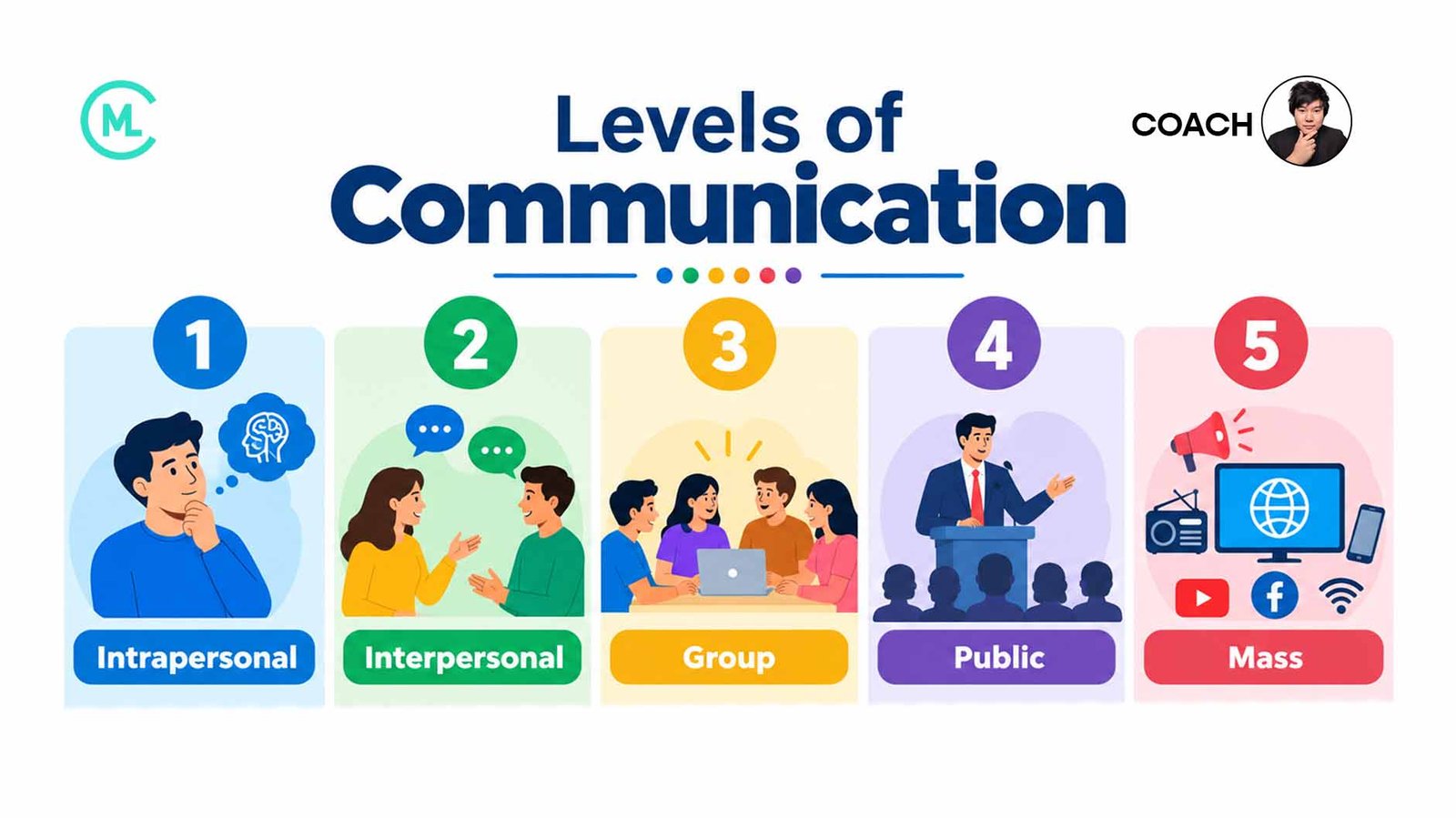
The 5 levels of communication are intrapersonal, interpersonal, group, public, and mass communication, ordered from 1 person to millions of people. Each level of communication adds participants, complexity, and formality, while feedback becomes slower and less personal. Intrapersonal communication happens within 1 person, interpersonal communication happens between people whose lives influence one another, group communication happens among 3 or more people with a shared goal, public communication happens between 1 speaker and an audience, and mass communication reaches large audiences through media. Relationships also use a second set of levels: depth levels that run from small talk to deep emotional sharing.
What Are the Levels of Communication?
The levels of communication are the categories of communication ordered by the number of people involved, from communication within 1 person to communication with millions of people. US communication textbooks also call the levels of communication the forms of communication or the contexts of communication. Each level of communication has a different purpose, a different degree of formality, and a different type of feedback. The sections below explain the levels of communication with examples, from level 1 to level 5.
The levels of communication form a scale. Intrapersonal communication sits at the smallest end of the scale, and mass communication sits at the largest end. Feedback between people is immediate at the interpersonal level and delayed at the mass level. Formality grows as the number of participants grows: a chat between friends feels casual, while a televised speech follows a script.
How Many Levels of Communication Are There?
The most common answer is 5 levels of communication, while extended models list 7 levels and depth models in relationships list 3 to 5 levels. The 3 most common level models are below.
- 5 levels of communication: The 5 levels of communication model lists intrapersonal, interpersonal, group, public, and mass communication. US textbooks call the 5 levels the five main forms of communication.
- 7 levels of communication: The 7 levels of communication model adds dyadic, organizational, and social media or intercultural communication to the core levels.
- Depth levels: Depth models describe how deep a conversation goes. Fr. John Powell’s model lists 5 levels, Dr. Zimmerman’s model lists 4 levels of communication, and a therapy model lists 3 levels of communication.
The communication framework on coachmichaellee.com uses the 5 core levels, with depth levels as a separate model for relationships.
Why Is Communication Divided Into Levels?
Communication divides into levels because the number of participants changes the purpose, formality, and feedback of every message. The hierarchy of communication places each level on top of the level below. Intrapersonal communication happens at every level, because a speaker thinks before speaking to 1 friend or to 1,000 listeners. Interpersonal skills support group communication, and group skills support public communication. The levels of communication help people choose the right channel, the right tone, and the right expectations for each situation.
What Is Intrapersonal Communication?
Intrapersonal communication is communication with oneself, such as self-talk, reflection, and inner dialogue. Intrapersonal communication is level 1 of the 5 levels of communication. Intrapersonal communication takes place inside the mind, through internal vocalization or reflective thinking. An internal or external stimulus triggers intrapersonal communication: the stimulus of hunger triggers the thought “I want to eat,” and a stressful event triggers a calming inner voice. Intrapersonal communication serves several social functions. Talking to oneself helps a person plan a conversation, regulate emotions, and prepare for social situations. A person uses self-talk to calm down before a presentation or to rehearse a difficult conversation with a partner. Intrapersonal communication occurs every waking moment, so intrapersonal communication is the most constant form of communication.
What Are Examples of Intrapersonal Communication?
Examples of intrapersonal communication include self-talk before a job interview, a mental to-do list, journaling, and rehearsing a difficult conversation. A person who repeats “Stay calm and speak slowly” before a presentation uses intrapersonal communication. A person who writes in a journal after an argument uses intrapersonal communication to understand personal feelings. A person who plans the words for a first-date invitation uses intrapersonal communication before interpersonal communication begins. The intrapersonal communication examples above all happen inside 1 mind, without another person present.
What Is Interpersonal Communication?
Interpersonal communication is communication between 2 or more people whose lives mutually influence one another. Interpersonal communication is level 2 of the 5 levels of communication. Interpersonal communication builds, maintains, and ends interpersonal relationships between partners, friends, family members, and colleagues. People spend more time in interpersonal communication than in any other level of communication. Interpersonal communication meets instrumental needs, such as asking a colleague for help, and relational needs, such as showing affection to a partner. Interpersonal communication combines verbal and nonverbal messages and gives immediate feedback in face-to-face conversations.
What Is Dyadic Communication?
Dyadic communication is communication between exactly 2 people. A dyad is a pair, such as 2 friends, 2 colleagues, or a couple. Dyadic communication and interpersonal communication overlap, but the 2 terms are not identical. A conversation between a cashier and a customer is dyadic but impersonal, because the 2 people treat each other as roles. A conversation among 3 close friends is interpersonal but not dyadic, because the group has more than 2 people. Dyadic communication gives the most personal attention and the fastest feedback of any level.
What Are Examples of Interpersonal Communication?
Examples of interpersonal communication include a conversation between partners, a phone call with a friend, a job interview, and a first date. A couple discussing weekend plans over dinner uses interpersonal communication to make a shared decision. A manager giving feedback in a one-on-one meeting uses interpersonal communication to guide an employee. 2 people on a first date use interpersonal communication to build a relationship with someone new. The interpersonal communication examples above all involve people whose words, tone, and body language affect each other directly.
What Is Group Communication?
Group communication is communication among 3 or more people who work toward a shared goal. Group communication is level 3 of the 5 levels of communication. Group communication is more intentional and formal than interpersonal communication. Members of a group are often assigned to the group, such as a project team, rather than choosing each other freely. Group communication is task-focused, because the members work together for an explicit purpose that affects every member. Each member takes on a role, such as leader, note-taker, or questioner, and the roles shape the flow of the conversation.
What Is Small Group Communication?
Small group communication is communication in a group of about 3 to 12 people, where every member takes part actively. Bruce Tuckman described 4 stages of group development in 1965: forming, storming, norming, and performing. Irving Janis introduced the concept of groupthink in 1972, meaning the tendency of a close group to value agreement over careful decision-making. A small group can outvote a single member, while a dyad cannot, so group members often take bigger risks together than pairs do.
What Are Examples of Group Communication?
Examples of group communication include a team meeting, a study group, a family discussion about a holiday plan, and a support group. A project team uses group communication to divide tasks and set deadlines. A family uses group communication to choose a vacation destination. A support group uses group communication to share experiences and encourage each member. The group communication examples above all combine a shared goal with active participation from every member.
What Is Public Communication?
Public communication is communication in which 1 speaker delivers a message to an audience. Public communication is level 4 of the 5 levels of communication. Public communication is sender-focused, more formal, and more prepared than group communication. Public communication serves 3 main purposes: to inform, to persuade, and to entertain. Feedback in public communication comes mostly from nonverbal audience reactions, such as applause, laughter, or silence. Aristotle described 3 modes of persuasion for public speakers in the 4th century BC: ethos (credibility), pathos (emotion), and logos (logic).
What Are Examples of Public Communication?
Examples of public communication include a keynote speech, a lecture, a wedding toast, a sermon, and a town hall meeting. A professor uses public communication to teach a class of 100 students. A best man uses public communication to share a story about the couple at a wedding. A mayor uses public communication to explain a new policy at a town hall meeting. The public communication examples above all place 1 speaker in front of many listeners, where the speaker’s body language and voice carry the message.
What Is Mass Communication?
Mass communication is communication that reaches large, dispersed audiences through media channels, such as television, radio, newspapers, and the internet. Mass communication is level 5 of the 5 levels of communication. Mass communication depends on mass media, meaning the technologies that carry 1 message to millions of people at the same time. Gatekeepers, such as editors and producers, decide which messages reach the audience. Feedback in mass communication arrives late and indirectly, through ratings, comments, and shares. Harold Lasswell described mass communication in 1948 with 5 questions: who says what, in which channel, to whom, and with what effect.
What Are Examples of Mass Communication?
Examples of mass communication include a national news broadcast, a podcast, a newspaper, a streaming series, and a viral social media post. A news network uses mass communication to report an election to millions of viewers. A company uses mass communication to launch a product through television ads. A podcast host uses mass communication to reach listeners in many countries at once. The mass communication examples above all use media channels to reach people the sender never meets.
What Are the Extended Levels of Communication?
The extended levels of communication are organizational, intercultural, and social media communication, which some models add to the 5 core levels. The extended levels overlap the core levels: a team meeting is group communication and organizational communication at the same time. The sections below explain the 3 extended levels of communication.
What Is Organizational Communication?
Organizational communication is communication among people who work together inside a company or institution to achieve shared goals. Organizational communication moves in 4 directions. Upward communication moves from employees to managers. Downward communication moves from managers to employees. Horizontal communication moves between colleagues at the same level. Diagonal communication moves across departments and levels at the same time.
What Is Intercultural Communication?
Intercultural communication is communication between people from different cultural backgrounds. Edward T. Hall described high-context and low-context cultures in the 1976 book Beyond Culture. High-context cultures rely on shared understanding, tone, and nonverbal cues, while low-context cultures rely on direct, explicit words. Couples and colleagues from different cultures build understanding by learning each other’s norms for directness, eye contact, and personal space.
What Is Social Media Communication?
Social media communication is communication through online platforms where users create, share, and respond to content. Social media communication blends several levels in 1 channel. A private message is interpersonal communication, a group chat is group communication, and a public post with thousands of views is close to mass communication. Communication researchers also call social media communication a form of computer-mediated communication.
How Do the Levels of Communication Compare?
The levels of communication differ by number of participants, type of feedback, level of formality, and main example. The levels of communication comparison in the table below covers all 5 core levels.
| Level | Participants | Feedback | Formality | Example |
|---|---|---|---|---|
| Intrapersonal | 1 person | Internal and immediate | Informal | Self-talk before an interview |
| Interpersonal | 2 or more people with a personal connection | Immediate and continuous | Informal to semi-formal | A conversation between partners |
| Group | 3 or more people with a shared goal | Immediate, shared among members | Semi-formal | A team meeting |
| Public | 1 speaker and an audience | Limited, mostly nonverbal | Formal | A keynote speech |
| Mass | 1 source and millions of people | Delayed and indirect | Formal | A national news broadcast |
Intrapersonal, interpersonal, group, public, and mass communication form a scale from the most personal level to the most public level.
What Are the 5 Levels of Communication in Relationships?
The 5 levels of communication in relationships are cliché conversation, reporting facts, sharing ideas and opinions, sharing feelings, and peak communication. Fr. John Powell described the 5 depth levels in the 1969 book Why Am I Afraid to Tell You Who I Am?. The depth levels describe how deep a conversation goes, not how many people take part. The 5 levels of communication in relationships are below, from the shallowest level to the deepest level.
- Cliché conversation: Cliché conversation uses safe, polite phrases, such as “How are you?” and “Nice weather today,” and shares nothing personal.
- Reporting facts: Reporting facts shares information about other people or events, such as “The meeting moved to Friday,” without personal opinion.
- Sharing ideas and opinions: Sharing ideas and opinions reveals personal judgments, such as “I think the plan needs more time,” and brings a first risk of disagreement.
- Sharing feelings: Sharing feelings reveals emotions, such as “I felt hurt when the plans changed,” and builds real trust and intimacy.
- Peak communication: Peak communication is complete openness and mutual understanding between 2 people, a level that close partners and friends reach in rare moments.
Most daily conversations stay at the first 2 depth levels. Close relationships grow when both people reach the levels of shared feelings and peak communication.
What Are Other Models of Communication Depth?
Other models of communication depth include Richard Francisco’s 5 levels, the 3-level model of content, emotions, and beliefs, and the levels based on the Johari window. The 3 other models of communication depth are below.
- Richard Francisco’s 5 levels: Richard Francisco, a lecturer at the Stanford Graduate School of Business, described 5 levels: ritual, extended ritual, content, feelings about the content, and feelings about each other. Each level brings more risk and more potential learning.
- Content, emotions, and beliefs: The 3-level model separates the facts of a situation, the emotions about the situation, and the beliefs behind the emotions. Conversations that stay at the content level feel shallow, while conversations that reach emotions and beliefs build connection.
- The Johari window: The Johari window, created by Joseph Luft and Harrington Ingham in 1955, divides self-knowledge into 4 areas: open, blind, hidden, and unknown. Deeper communication grows the open area through feedback and self-disclosure.
How Do People Move to Deeper Levels of Communication?
People move to deeper levels of communication through gradual self-disclosure, active listening, and trust built over repeated conversations. Irwin Altman and Dalmas Taylor’s social penetration theory, published in 1973, describes relationships as layers that open 1 layer at a time. The 4 steps that move a conversation to deeper levels are below.
- Gradual self-disclosure: Small personal shares, such as a favorite memory or a current worry, invite the other person to share at the same depth.
- Active listening: Active listening shows that a personal share is safe, through eye contact, paraphrasing, and follow-up questions.
- Respect for boundaries: Respect for the other person’s pace keeps trust intact, because forced depth creates discomfort.
- Consistency over time: Repeated honest conversations build the trust that makes feelings and peak communication possible.
Deeper levels of communication turn acquaintances into friends and partners into close companions.
Why Are the Levels of Communication Important?
The levels of communication are important because each level requires different skills, channels, and expectations for feedback. The importance of levels of communication shows in everyday choices, because knowledge of the levels of communication helps people communicate with the right approach in every situation. The 4 main reasons the levels of communication are important are below.
- Choosing the right channel: Knowledge of the levels matches private topics with interpersonal conversation and announcements with public or mass communication.
- Adapting formality: Knowledge of the levels adjusts tone and structure, from a casual chat to a formal speech.
- Setting feedback expectations: Knowledge of the levels prepares a speaker for immediate feedback in a conversation and delayed feedback in mass communication.
- Building deeper relationships: Knowledge of the depth levels shows people how to move past small talk toward trust and intimacy.
How Do the Levels of Communication Connect to the Types of Communication?
The levels of communication describe how many people take part, while the types of communication describe the mode of the message. Every level of communication uses verbal, nonverbal, written, and visual communication. A public speech combines spoken words, gestures, and slides. A group chat combines written words and emojis. The level answers the question “How many people?” and the type answers the question “In which form?” The levels vs types of communication distinction matters, because the same verbal message changes in formality and feedback when the level changes from a private talk to a public speech.
How Does the Communication Process Change Across the Levels?
The communication process keeps the same 5 steps at every level, but feedback becomes slower and less personal as the level grows. The 5 steps are idea formation, encoding, transmission, decoding, and feedback. Intrapersonal communication completes all 5 steps inside 1 mind. Mass communication stretches the feedback step across days or weeks, through ratings and comments. Public communication shortens the feedback step to audience reactions, such as applause, laughter, and facial expressions during a speech.
Which Elements of Communication Change Across the Levels?
The channel, the feedback, and the noise change most across the levels of communication, while the sender and the message stay central. The 11 elements of communication include the channel, feedback, noise, context, and field of experience. Interpersonal communication uses rich face-to-face channels, while mass communication uses media channels with more noise and less direct feedback. The context grows more formal as the audience grows larger. The field of experience shared between sender and receiver also shrinks at larger levels, because a mass audience includes people from many backgrounds. Larger audiences also bring more barriers to communication, such as cultural and language differences.
Why Is Interpersonal Communication the Most Common Level?
Interpersonal communication is the most common level because people spend more time in 1-to-1 and small personal conversations than in any other level of communication. Daily life is full of interpersonal communication: conversations with partners, calls with family members, chats with colleagues, and messages with friends. Interpersonal communication also shapes the quality of every relationship, from a first date to a long marriage.
Which Interpersonal Skills Work at Every Level of Communication?
Active listening, clarity, empathy, and adaptability are the interpersonal skills that work at every level of communication, from self-talk to a public speech. Active listening helps a person understand a partner, a team, or an audience. Clarity helps a message land at every level. Empathy helps a speaker read the emotions of 1 listener or 1,000 listeners. Adaptability helps a communicator adjust tone and formality from 1 level to the next. A person who listens well to a partner also listens better to a team, and a person who speaks clearly in a meeting also speaks more clearly on a stage.
How Do the Levels Fit Into Communication as a Whole?
The 5 levels of communication organize communication as a whole by scale, from 1 person to millions of people. Every conversation, meeting, speech, and broadcast belongs to at least 1 level. Intrapersonal, interpersonal, group, public, and mass communication together describe the full range of human communication, and the depth levels describe how close each conversation feels. The importance of communication shows at every level, from self-talk to mass media. More guides on communication are available in the Knowledge Hub.