
The Communication Process: Types, Steps, Elements and Examples
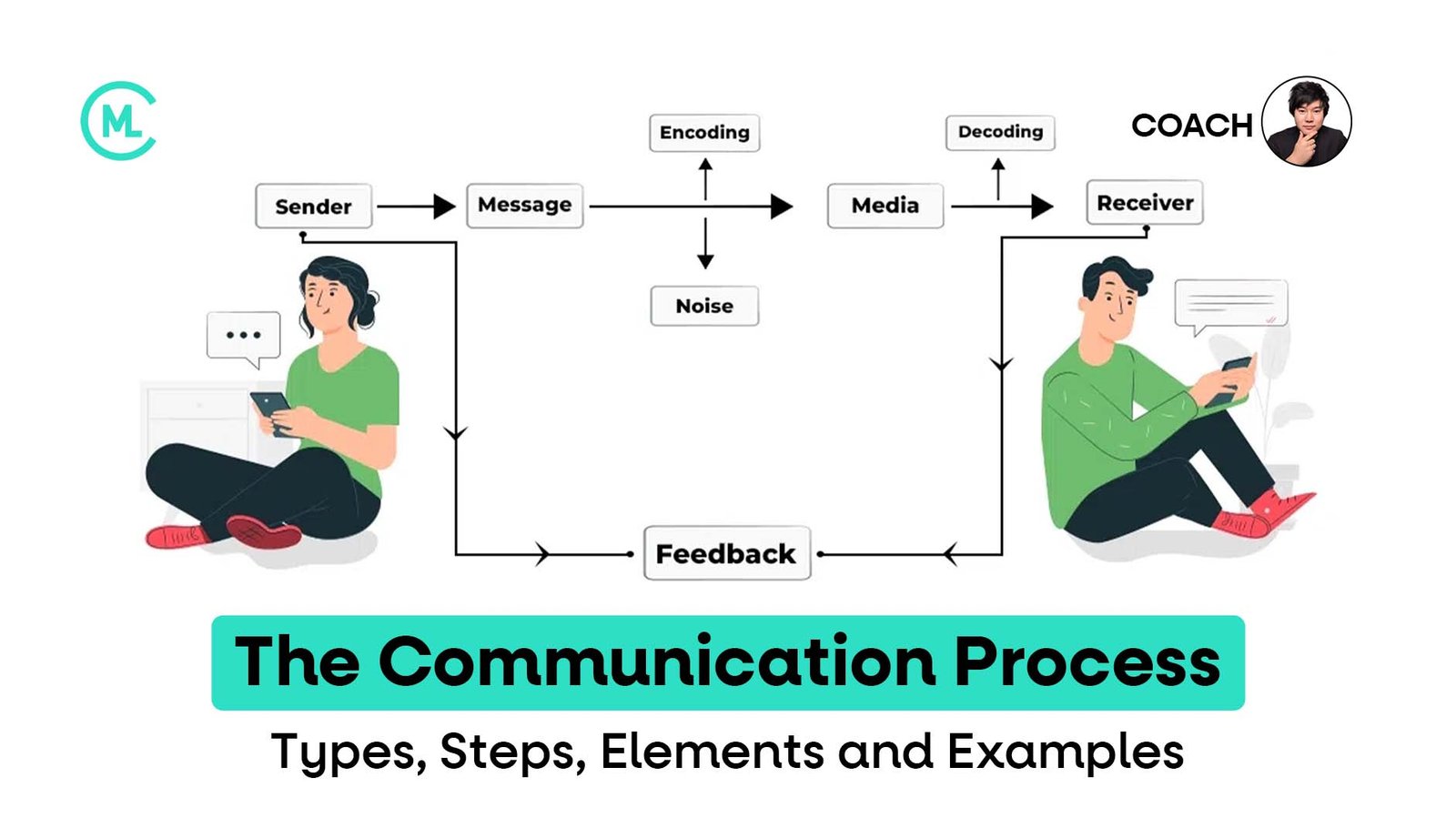
The communication process is the series of steps a message follows from a sender to a receiver, from idea formation to feedback. The communication process has 3 types: the linear, interactive, and transactional communication processes. The communication process moves through 5 steps: idea formation, encoding, transmission, decoding, and feedback. The communication process contains 8 core elements: the sender, message, encoding, channel, receiver, decoding, feedback, and noise. Noise disrupts the communication process at any step, and context shapes how both people interpret the message. The communication process is the core mechanism behind all communication, from a 2-person conversation to mass media.
What Is the Communication Process?
The communication process is the series of steps that transfers a message from a sender to a receiver and creates shared meaning between the sender and the receiver. The sender starts the communication process with 3 steps: idea formation, encoding, and transmission. The receiver completes the communication process with 2 steps: decoding and feedback.
The communication process is cyclical. Feedback turns the receiver into a new sender, and the new message starts the process again. The communication process applies to every level of communication, including conversations between 2 people, team meetings, public speeches, and mass media.
Is the Communication Process the Same as the Communication Cycle?
Yes, the communication cycle is another name for the communication process. The name “communication cycle” emphasizes the feedback loop. The sender sends a message, the receiver responds with feedback, and the feedback becomes a new message that restarts the cycle.
What Are the Types of Communication Process?
The 3 types of communication process are the linear, interactive, and transactional communication processes. Communication theorists describe each type of communication process with a communication model. The 3 types of communication process differ in the direction of the message and the timing of feedback. The sections below explain the 3 types of communication process.
What Is the Linear Communication Process?
The linear communication process is a one-way process in which a sender transmits a message to a receiver without feedback. Claude Shannon described the linear communication process at Bell Labs in 1948, and Warren Weaver co-published an expanded version of the model in 1949. The Shannon-Weaver model introduced the concept of noise, meaning interference that distorts a message between sender and receiver. Harold Lasswell summarized the linear process in 1948 with 5 questions: who says what, in which channel, to whom, and with what effect. Examples of the linear communication process include radio ads, public announcements, and billboards. The linear communication process lacks feedback, so the sender cannot confirm that the receiver understood the message.
What Is the Interactive Communication Process?
The interactive communication process is a two-way process in which the sender and receiver take turns sending messages and feedback. Charles Osgood and Wilbur Schramm described the interactive process in 1954 as a circular exchange between equal participants. Schramm stated that communication succeeds when the “fields of experience” of the sender and receiver overlap, meaning both people share enough knowledge, language, and culture to interpret the message. Examples of the interactive communication process include email exchanges and text conversations. Feedback exists in the interactive communication process, but feedback arrives with a delay.
What Is the Transactional Communication Process?
The transactional communication process is a simultaneous process in which both people send and receive messages at the same time. Dean Barnlund proposed the transactional model in 1970 and described communicators as simultaneous senders and receivers who create shared meaning together. Verbal and nonverbal messages flow in both directions at once: a listener’s nod is feedback while the speaker is still talking. Social, relational, and cultural context shape the meaning of every message in the transactional communication process. The transactional communication process describes face-to-face conversation most accurately, because nonverbal communication runs continuously in both directions.
The table below compares the 3 types of communication process by direction of flow, feedback, and example.
| Type | Direction of flow | Feedback | Example |
|---|---|---|---|
| Linear | One-way | None or delayed | Radio ad, public announcement |
| Interactive | Two-way, in turns | Delayed | Email, text messages |
| Transactional | Simultaneous | Immediate and continuous | Face-to-face conversation, video call |
Each type of communication process fits a different situation, and most daily conversations follow the transactional process.
What Are the 5 Steps of the Communication Process?
The 5 steps of the communication process are idea formation, encoding, transmission, decoding, and feedback. The 5 steps of the communication process are below.
- Idea formation: The sender decides what to communicate.
- Encoding: The sender converts the idea into words, symbols, or gestures.
- Transmission: The sender sends the message through a channel.
- Decoding: The receiver interprets the message.
- Feedback: The receiver responds to the message.
The first 3 steps of the communication process are the sender’s responsibility. The last 2 steps of the communication process are the receiver’s responsibility.
What Happens During Idea Formation?
During idea formation, the sender decides what information, thought, or feeling to communicate and why. Idea formation includes 4 considerations: the purpose of the message, the audience, the timing, and the sender’s mood. A clear purpose at the idea formation step prevents vague messages later in the communication process. For example, an employee who plans to ask a colleague for help with a deadline first defines the exact task, the deadline, and the reason for the request.
What Is Encoding in the Communication Process?
Encoding is the step in which the sender converts an idea into words, symbols, gestures, or images that the receiver can understand. Effective encoding matches the receiver’s language, knowledge, and cultural background. Encoding includes nonverbal choices, such as tone of voice, facial expressions, and body language. A doctor who explains a diagnosis to a patient encodes the message in plain language instead of medical terms, because plain language matches the patient’s knowledge.
How Is a Message Transmitted?
A message is transmitted when the sender sends the encoded message through a communication channel, such as speech, writing, or a video call. Channel choice determines how much meaning reaches the receiver. Rich channels, such as face-to-face conversation, carry words, tone, and body language together. Lean channels, such as text messages, carry words only. The communication channels section below explains the main channel types.
What Is Decoding in the Communication Process?
Decoding is the step in which the receiver interprets the sender’s words, symbols, and signals to understand the message. The receiver’s language, culture, past experiences, emotions, and context shape decoding. Misunderstandings occur most often at the decoding step, because the receiver’s interpretation differs from the sender’s intended meaning. Active listening, a term psychologists Carl Rogers and Richard Farson introduced in 1957, improves decoding through full attention, reflection, and clarifying questions.
What Is Feedback in the Communication Process?
Feedback is the receiver’s response to the message, and feedback tells the sender whether the message was understood as intended. Feedback takes 2 forms: verbal feedback, such as a reply or a question, and nonverbal feedback, such as a nod, a frown, or silence. Immediate feedback occurs in face-to-face conversations and phone calls. Delayed feedback occurs in emails, letters, and text messages. Feedback restarts the communication cycle, because the receiver becomes the new sender.
What Are the Elements of the Communication Process?
The 8 core elements of the communication process are the sender, message, encoding, channel, receiver, decoding, feedback, and noise, all shaped by context. The 8 core elements of the communication process are below.
- Sender: The sender is the person who starts the communication.
- Message: The message is the information, idea, or emotion being shared.
- Encoding: Encoding is the conversion of an idea into words, symbols, or gestures.
- Channel: The channel is the medium that carries the message, such as voice, text, or image.
- Receiver: The receiver is the person who gets the message.
- Decoding: Decoding is the receiver’s translation of signals into meaning.
- Feedback: Feedback is the receiver’s verbal or nonverbal response.
- Noise: Noise is any interference that distorts the message.
Context surrounds all 8 core elements of the communication process. The sections below explain channels, noise, and context in detail.
What Are Communication Channels?
Communication channels are the mediums that carry a message from the sender to the receiver. The 5 main communication channels are below.
- Face-to-face: Face-to-face communication carries words, tone, facial expressions, and body language at the same time.
- Phone and voice: Phone and voice communication carries words and tone without visual cues.
- Written: Written communication, such as letters and reports, carries words and creates a permanent record.
- Digital: Digital communication, such as email, text messages, chat apps, and video calls, carries messages instantly across distance.
- Broadcast media: Broadcast media, such as television and radio, carries 1 message to large audiences.
Richard Daft and Robert Lengel’s media richness theory, developed in the 1980s, ranks face-to-face communication as the richest channel, because face-to-face communication carries the most cues and allows immediate feedback. Complex or emotional messages reach the receiver most accurately through rich channels.
What Is Noise in the Communication Process?
Noise is anything that distorts, blocks, or changes the meaning of a message during the communication process. Shannon and Weaver introduced noise as part of the communication model in 1948 and 1949. The 4 types of noise in communication are below.
- Physical noise: Physical noise is external interference, such as background sound, poor lighting, or a weak phone signal.
- Physiological noise: Physiological noise is interference from the body, such as hunger, tiredness, illness, or hearing loss.
- Psychological noise: Psychological noise is interference from the mind, such as stress, bias, or assumptions.
- Semantic noise: Semantic noise is interference from language, such as jargon, ambiguous words, or unfamiliar terms.
Noise affects every step of the communication process, from encoding to feedback.
What Is Context in the Communication Process?
Context is the setting and circumstances in which communication happens, and context shapes how both people interpret a message. The 5 types of communication context are below.
- Physical context: Physical context is the location and environment, such as a quiet office or a noisy café.
- Social context: Social context is the social rules of the situation, such as a formal meeting or a casual party.
- Relational context: Relational context is the relationship between the people, such as strangers, friends, or partners.
- Cultural context: Cultural context is the shared norms, values, and language of each person’s culture.
- Temporal context: Temporal context is the timing of the message, such as late at night or right after an argument.
The same message carries different meanings in different contexts. The sentence “We need to talk” means one thing from a manager on a Monday morning and another thing from a partner late at night.
What Are Examples of the Communication Process?
Examples of the communication process include a face-to-face conversation, a workplace meeting, a text message, and a first-date invitation. 4 examples of the communication process are below, each shown through the 5 steps.
What Is an Example of the Communication Process in a Conversation?
A friend asking “How was your weekend?” over coffee is an example of the communication process in a face-to-face conversation.
- Idea formation: The friend wants to reconnect and show interest.
- Encoding: The friend chooses a warm question, a smile, and eye contact.
- Transmission: The message travels face to face, carrying words, tone, and body language.
- Decoding: The listener reads genuine interest in the question and the smile.
- Feedback: The listener describes a hiking trip while the friend nods and asks follow-up questions.
The conversation follows the transactional process, because both friends send nonverbal feedback while the other person speaks.
What Is an Example of the Communication Process in the Workplace?
A manager announcing a new deadline in a team meeting is an example of the communication process in the workplace.
- Idea formation: The manager decides the team must finish a report by Friday.
- Encoding: The manager says, “We need the Q3 deliverable EOD Friday.”
- Transmission: The manager delivers the message in person during the meeting.
- Decoding: A new team member does not know the terms “Q3 deliverable” and “EOD,” so semantic noise distorts the message.
- Feedback: The new team member asks, “Which report, and what time on Friday?” The manager clarifies: “The quarterly sales report, by 5 pm Friday.”
The clarifying question repairs the communication process before the misunderstanding causes a missed deadline.
What Is an Example of the Communication Process in a Text Message?
Texting a friend “Dinner Friday?” is an example of the communication process through a written, digital channel.
- Idea formation: The sender wants to make plans with a friend.
- Encoding: The sender writes a short question.
- Transmission: The message travels through a messaging app.
- Decoding: The friend reads the invitation without the sender’s tone of voice.
- Feedback: The friend replies, “Yes, 7 pm?” 2 hours later.
The text exchange follows the interactive process, because feedback arrives in turns and with a delay. Text removes tone of voice, so short texts are easier to misread than spoken invitations.
What Is an Example of the Communication Process in Dating?
Asking someone out for a first date is an example of the communication process in a romantic context.
- Idea formation: The sender decides to ask a person for a date after a good conversation.
- Encoding: The sender chooses clear words, such as “I’d like to take you to dinner on Saturday,” with relaxed posture and steady eye contact.
- Transmission: The sender delivers the invitation in person instead of by text, so tone and body language support the words.
- Decoding: The other person interprets the words, tone, and body language to read interest and intent.
- Feedback: The other person answers with a clear yes, a clear no, or a hesitant “maybe,” and the sender reads the verbal and nonverbal response.
A clear invitation through a rich channel reduces the chance of misreading interest on both sides.
Why Is the Communication Process Important?
The communication process is important because understanding each step shows where messages break down and how to fix broken messages. The 5 main reasons the communication process is important are below.
- Prevents misunderstandings: Knowledge of encoding and decoding helps senders and receivers match meaning.
- Improves feedback: Awareness of the feedback step encourages people to confirm understanding.
- Supports better channel choices: Knowledge of channel richness helps people send sensitive messages face to face.
- Strengthens relationships: Accurate communication builds trust between partners, friends, and family members.
- Improves workplace coordination: Clear steps reduce errors, repeated work, and missed deadlines in teams.
The communication process is the foundation of effective communication in every setting.
Where Does the Communication Process Break Down?
The communication process breaks down when a step fails, most often during encoding, decoding, or feedback. The table below shows how each step of the communication process breaks down, with an example.
| Step | How the step breaks down | Example |
|---|---|---|
| Idea formation | The sender has an unclear purpose | A vague request with no deadline |
| Encoding | The sender uses words the receiver does not understand | Jargon in a message to a new employee |
| Transmission | The sender chooses the wrong channel | Ending a relationship by text message |
| Decoding | The receiver assigns a different meaning to the message | Reading a short text as angry |
| Feedback | The receiver gives no response or an unclear response | Silence after a request for help |
Bypassing is a common cause of breakdown at the decoding step. Bypassing occurs when the sender and receiver attach different meanings to the same word, such as “soon” meaning “today” to one person and “this month” to another. Each breakdown in the communication process is a barrier to communication with a specific fix.
How Can You Improve the Communication Process?
The communication process improves through a clear idea, the right channel, active listening, and regular feedback. 6 ways to improve the communication process are below.
- Clarify the purpose: A clear purpose defines the goal of the message before the sender speaks or writes.
- Encode for the receiver: Plain words matched to the receiver’s language and knowledge improve encoding.
- Choose the richest suitable channel: Face-to-face conversations and video calls carry complex or emotional messages most accurately.
- Reduce noise: A quiet setting, fewer distractions, and plain language reduce noise.
- Listen actively: Active listening gives full attention to the speaker, summarizes the message, and asks clarifying questions.
- Ask for and give feedback: Questions confirm understanding, such as “What did you hear me say?”
Each improvement strengthens one step of the communication process.
How Does the Communication Process Work in Interpersonal Communication?
In interpersonal communication, the communication process works as a transactional exchange between 2 or more people who send and receive messages at the same time. Interpersonal communication is 1 of the 5 levels of communication, alongside intrapersonal, group, public, and mass communication. Interpersonal communication uses all 5 steps of the communication process, but feedback is immediate and continuous. The relationship between the people, the level of trust, and nonverbal cues shape every message in the interpersonal communication process. A partner’s tone, a friend’s facial expression, and a colleague’s posture carry meaning alongside the spoken words.
What Are the Types of Interpersonal Communication?
The 4 types of interpersonal communication are verbal, nonverbal, written, and listening. The 4 types of interpersonal communication are below.
- Verbal: Verbal communication uses spoken words and shapes the encoding step.
- Nonverbal: Nonverbal communication uses body language, facial expressions, and tone, and runs through every step.
- Written: Written communication uses text and relies on a written channel during transmission.
- Listening: Listening is the receiver’s skill that controls the accuracy of the decoding step.
What Is the Difference Between Interpersonal and Intrapersonal Communication?
Interpersonal communication is the exchange of messages between 2 or more people, while intrapersonal communication is communication with oneself. Intrapersonal communication, such as self-talk, shapes the idea formation and encoding steps before a message reaches another person. A person who rehearses a difficult conversation in the mind uses intrapersonal communication to prepare for interpersonal communication.
How Does the Communication Process Lead to Interpersonal Conflict?
The communication process leads to interpersonal conflict when encoding and decoding do not match, so each person attaches a different meaning to the same message. 2 common causes of interpersonal conflict in the communication process are missing feedback and misread nonverbal cues. A partner who hears “I’m fine” in a flat tone decodes anger, while the speaker meant tiredness. Clarifying questions, such as “You seem quiet. Is something wrong?”, repair the communication process before interpersonal conflict escalates. Each mismatch between encoding and decoding is 1 of the barriers to communication that clarifying questions remove.
What Role Do Interpersonal Skills Play in the Communication Process?
Interpersonal skills are the abilities that help people complete each step of the communication process accurately with others. Interpersonal skills include active listening, empathy, clarity, and emotional regulation. Interpersonal skills are learnable skills, and practice with feedback develops interpersonal skills at any age. Interpersonal skills turn the communication process into effective communication.
Which Interpersonal Skills Improve Each Step of the Communication Process?
Each step of the communication process depends on a specific interpersonal skill, from self-awareness in idea formation to active listening in decoding. The table below matches each step of the communication process to the interpersonal skill that improves the step.
| Step | Interpersonal skill | What the skill does |
|---|---|---|
| Idea formation | Self-awareness | Clarifies the purpose and emotion behind the message |
| Encoding | Clarity and empathy | Fits words and tone to the receiver |
| Transmission | Nonverbal awareness | Aligns body language with the spoken words |
| Decoding | Active listening | Interprets the message accurately |
| Feedback | Constructive feedback | Confirms or corrects understanding |
Strong interpersonal skills at every step make the full communication process more accurate.
How Can You Improve Interpersonal Skills for Better Communication?
Interpersonal skills improve through active listening, regular feedback, and attention to nonverbal cues in daily conversations. 3 practical ways to improve interpersonal skills are below.
- Practise active listening: A summary of the other person’s words before a response demonstrates active listening.
- Ask for feedback: Feedback from a trusted friend reveals how messages come across.
- Observe nonverbal cues: Attention to posture, facial expressions, and tone reveals meaning beyond words.
What Is the Difference Between the Communication Process and a Communication Model?
The communication process is the real sequence of steps a message follows, while a communication model is a diagram or theory that describes the communication process. The communication process happens in every conversation. A communication model, such as the Shannon-Weaver model, explains the communication process in a simplified form for study and analysis. Each communication model includes a different combination of the 11 elements of communication, such as the sender, channel, noise, and field of experience.
What Are the Main Models of the Communication Process?
The main models of the communication process are Aristotle’s model, Lasswell’s model, the Shannon-Weaver model, Berlo’s SMCR model, the Osgood-Schramm model, and Barnlund’s transactional model. The table below lists each model by year, type, and key idea.
| Model | Year | Type | Key idea |
|---|---|---|---|
| Aristotle’s model | 4th century BC | Linear | Speaker, speech, and audience; persuasion through ethos, pathos, and logos |
| Lasswell’s model | 1948 | Linear | Who says what, in which channel, to whom, with what effect |
| Shannon-Weaver model | 1948–1949 | Linear | Introduced noise to the communication process |
| Osgood-Schramm model | 1954 | Interactive | Circular communication; overlapping fields of experience |
| Berlo’s SMCR model | 1960 | Linear | Source, message, channel, and receiver |
| Barnlund’s transactional model | 1970 | Transactional | Simultaneous sending and receiving of messages |
The types, steps, elements, and examples of the communication process show how communication moved from one-way transmission to the creation of shared meaning. More guides on communication are available in the Knowledge Hub.