
Small Talk: Meaning, Topics, Examples and How to Make It Easily
By Michael Lee, communication and relationship coach · Last updated
Small talk is light, casual conversation about shared, low-stakes topics. Small talk builds rapport between people who barely know each other. Small talk also opens the door to deeper conversation. Good small talk follows 5 learnable steps. Small talk forms the first stage of strong conversation skills.
What Is Small Talk?
Small talk is light, casual conversation about shared, low-stakes topics such as the weather, the setting or weekend plans. Merriam-Webster defines small talk as “light or casual conversation.” Merriam-Webster lists chitchat as a synonym for small talk. The phrase dates to 1650.
Small talk is the opening stage of a conversation. Every conversation moves through 4 stages: opening, sustaining, deepening and closing. Small talk fills the opening stage. Small talk ends when a conversation deepens or closes.
Small talk differs from deep conversation in its topics. Small talk covers facts that both people share, such as the venue, the event or the season. Deep conversation covers opinions, feelings and personal values.
What Is the Purpose of Small Talk?
The purpose of small talk is to build a social connection rather than to share information. Anthropologist Bronislaw Malinowski called this type of talk “phatic communion” in 1923. A comment about the weather carries almost no information. The comment still signals friendliness and openness.
Small talk serves 3 purposes: signaling goodwill, testing interest and finding common ground. Each exchange shows whether both people want to keep talking. Each answer also reveals a possible shared topic.
Why Is Small Talk Important?
Small talk is important for mood, belonging and relationships. Brief, friendly exchanges raise mood and belonging. Friendly exchanges also grow into relationships. Two studies show the effect clearly.
- Commuters and strangers. Chicago commuters who talked to a stranger reported a more positive commute than commuters who sat alone. The same commuters predicted the opposite result beforehand (Epley and Schroeder, 2014, Journal of Experimental Psychology: General).
- Coffee shop customers. A short, friendly chat with a barista raised positive mood and belonging in coffee shop customers. Customers who skipped the chat felt less connected than chatting customers (Sandstrom and Dunn, 2014, Social Psychological and Personality Science).
Small talk also shapes first impressions. A first impression forms during the opening exchange of a conversation. Networking, job interviews and first dates all begin with small talk. The wider importance of communication starts with these short exchanges.
Why Do Some People Hate Small Talk?
Some people find small talk shallow, scripted or draining. Introverts often find small talk tiring after a long day. Other people fear an awkward silence or a rejection. Many people also see small talk as a waste of time compared with meaningful conversation.
Small talk works best as a doorway rather than a destination. A few minutes of small talk earn the trust needed for a deeper topic. People who skip small talk often jump to personal questions too early. Early personal questions feel intrusive to a new acquaintance.
How Do You Make Small Talk?
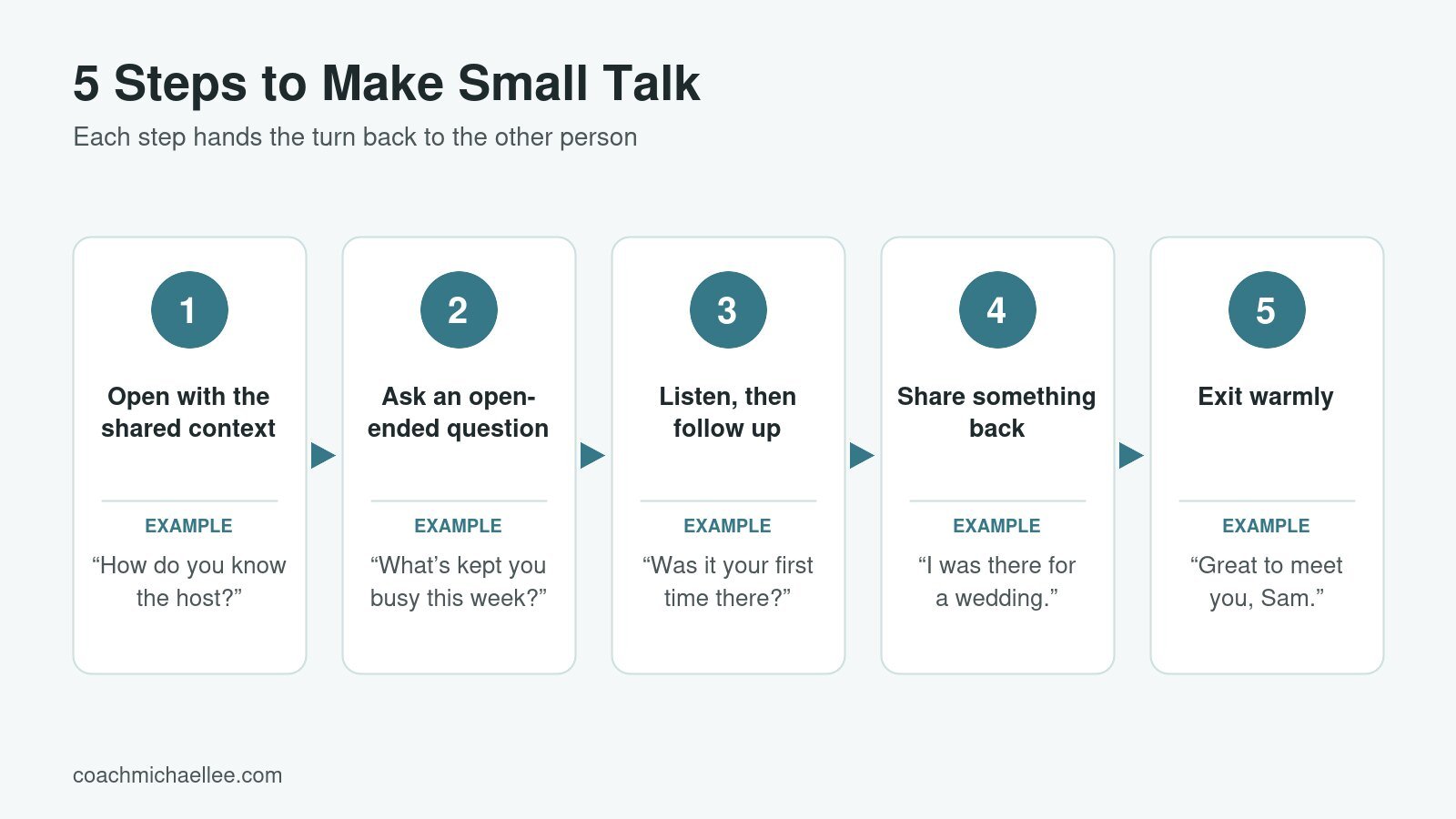
Small talk follows 5 steps in order: open with the shared context, ask an open-ended question, listen and follow up, share something back and exit warmly. Each step hands the turn to the other person. The whole sequence works at parties, at work events, in waiting rooms and on dates.
1. Open With the Shared Context
The best small talk opener is a comment or question about the context both people share. The shared context is the place, the event or the moment. A shared-context opener feels natural. Both people already know the topic. The guide to how to start a conversation covers more openers for different settings.
The 3 strongest types of shared-context openers are below.
- The event: An example of an event opener is “How do you know the host?”
- The place: An example of a place opener is “Have you been here before? The menu looks huge.”
- The moment: An example of a moment opener is “That talk ran long. Did the last speaker convince you?”
A shared-context opener needs no clever line. A friendly tone and a smile matter more than the exact words.
Approaching a stranger works best with a short pause first. A glance and a smile before speaking signal friendly intent. A stranger who smiles back is usually open to talking. A stranger with headphones on, a phone call in progress or a turned-away body signals a wish to stay alone.
2. Ask an Open-Ended Question
An open-ended question is a question that invites more than a yes or no. Open-ended questions start with what, how, why or “tell me about”. A closed question ends small talk quickly. An open-ended question gives the other person room to share details.
An example of a closed question is “Busy week?”. An example of the same question in open-ended form is “What’s been keeping you busy this week?”. The open-ended version invites a story. The guide to open-ended questions explains the main question types.
3. Listen, Then Follow Up
Listening turns small talk into a real exchange. Every answer contains at least one detail worth a second question. A follow-up question about that detail proves that the listener heard the answer.
An example of a follow-up starts with the answer “I just got back from a work trip to Austin.” A good follow-up question is “How was Austin? Was it your first time there?”. The follow-up stays on the other person’s topic. The full guide on how to keep a conversation going covers 12 techniques for the sustaining stage.
4. Share Something Back
Sharing a detail of similar depth keeps small talk balanced. Small talk made only of questions feels like an interview. Small talk made only of personal stories feels like a monologue.
Small talk experts interviewed by Reader’s Digest advise talking about oneself for no more than 3 or 4 minutes at a time. An example of a balanced share is “I was in Austin last spring for a wedding. The food trucks were the highlight. Did you get to try any?”. The share adds a detail. The share then returns a question.
5. Exit Warmly
A warm exit ends small talk on a high point. A good exit line gives a reason to leave and a kind closing word. A warm exit leaves the other person happy to talk again.
The 2 most reliable exit lines are below.
- The reason exit: An example of a reason exit is “I promised to say hi to a friend before she leaves. It was great to meet you, Sam.”
- The next-step exit: An example of a next-step exit is “I’d love to hear how the move goes. Let’s grab coffee next week.”
The guide to how to end a conversation covers polite exits for parties, work events and phone calls.
What Are the Best Small Talk Techniques?
The 6 best small talk techniques are the A-R-E method, the FORD method, free information, listening more than talking, open body language and using names. Each technique makes the 5 steps easier. Most good small talk uses 2 or 3 techniques at once.
The A-R-E Method
The A-R-E method is a 3-part structure for starting small talk: anchor, reveal and encourage. Voice coach Carol Fleming describes the method in It’s the Way You Say It.
- Anchor: An anchor is a comment on the shared context, such as “This line is moving fast.”
- Reveal: A reveal is a small personal detail, such as “I’m here for the new exhibit.”
- Encourage: An encourage step is a question that invites the other person in, such as “Have you seen it yet?”
The A-R-E method works well with strangers in lines, waiting rooms and events.
The FORD Method
The FORD method is a memory aid for small talk topics. FORD stands for family, occupation, recreation and dreams. Each FORD topic produces an easy question.
An example of an occupation question is “What does a normal workday look like for you?”. An example of a recreation question is “What do you do on a free weekend?”. The Harvard Mignone Center for Career Success warns that family questions feel too personal with professional strangers. Occupation and recreation questions suit work events best.
Free Information and Hook Points
Free information is the extra detail a person adds to an answer beyond the question asked. Debra Fine describes free information in The Fine Art of Small Talk as the raw material of small talk. Each detail works as a hook point for the next question.
An example of an answer with no free information is “I work in marketing.” An example of an answer with 2 hook points is “I work in marketing for a pet food brand, so my office is full of dogs.” The second answer gives the listener 2 easy topics: pet food and office dogs.
Listening More Than Talking
Good small talk gives the other person most of the talking time. SocialSelf recommends listening about two-thirds of the time and talking about one-third. Listening shows interest. Interest makes the other person enjoy the conversation.
Active listening signals attention. Short encouragements such as “Really?” and “Then what happened?” keep the speaker going. Reflection repeats the core of the speaker’s point in fresh words.
Open Body Language
Open body language signals that a person is approachable and interested. The 4 signals of open body language are eye contact, a relaxed smile, uncrossed arms and a phone kept out of sight. A body turned toward the other person also shows attention.
Closed body language ends small talk before it starts. Crossed arms, a glance at a screen and feet pointed toward the exit all signal a wish to leave.
Remember and Use Names
A person’s name is the most personal word in small talk. Repeating a name on first hearing helps the listener remember it. An example of name repetition is “Nice to meet you, Priya.” Using the name once more at the exit makes the goodbye feel personal.
What Are Good Small Talk Topics?
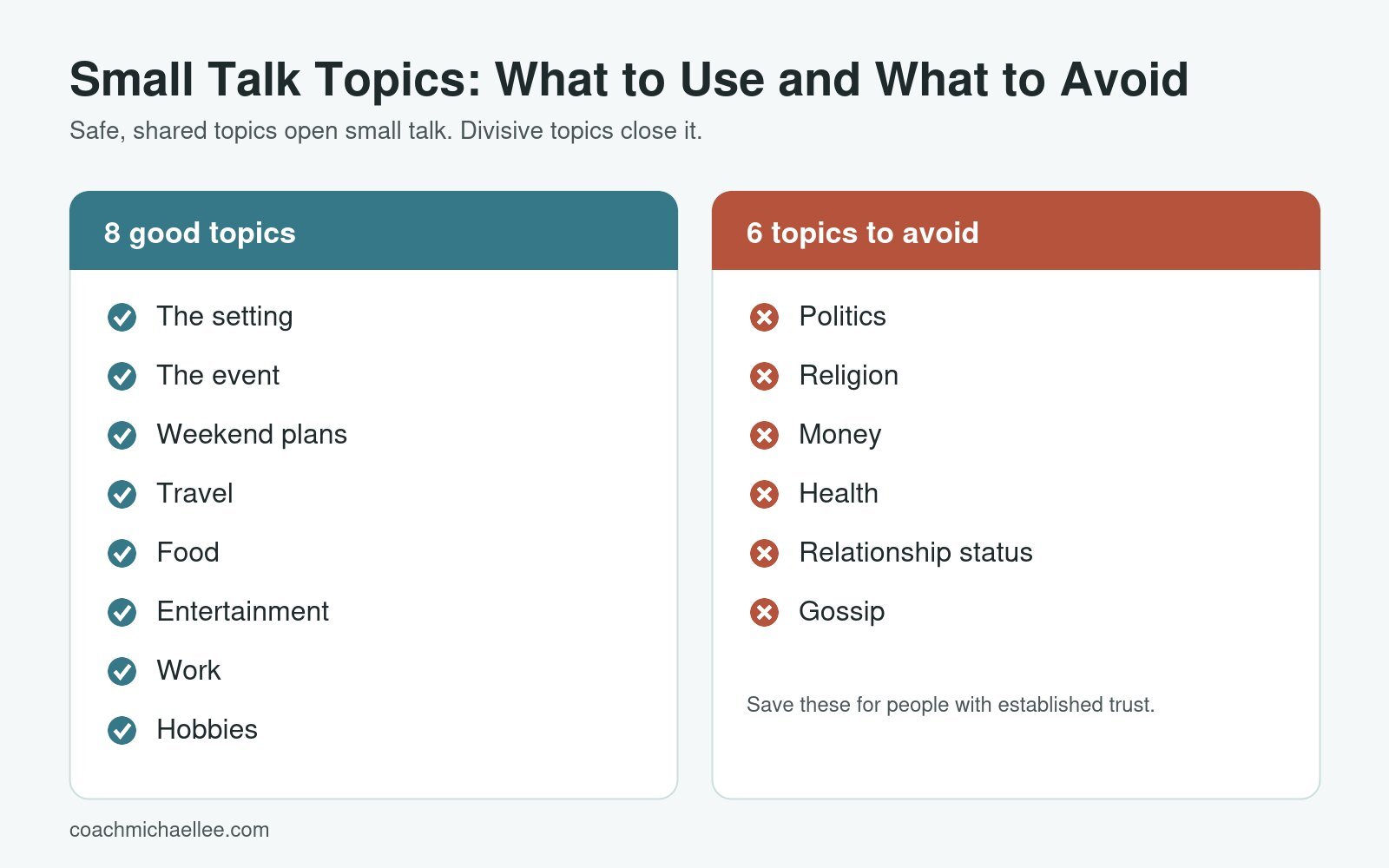
The 8 best small talk topics are the setting, the event, weekend plans, travel, food, entertainment, work and hobbies. Each topic is safe, shared or easy to answer. The table below gives an example line and the best setting for each topic.
| Topic | Example line | Best setting |
|---|---|---|
| The setting | “Have you been to this place before?” | Restaurants, venues, new offices |
| The event | “How do you know the host?” | Parties, weddings, conferences |
| Weekend plans | “Anything fun planned for the weekend?” | Work, the gym, neighbors |
| Travel | “Any trips coming up this year?” | Almost anywhere |
| Food | “Is that the special? It looks good.” | Restaurants, office kitchens |
| Entertainment | “Watched anything good lately?” | Friends of friends, coworkers |
| Work | “What kind of projects keep you busy right now?” | Networking events, conferences |
| Hobbies | “What do you do when you’re not working?” | Dates, parties, new friends |
The weather works as a fallback topic. A weather comment opens small talk. A weather comment rarely keeps small talk going. A weather comment works best when paired with a follow-up about plans, such as “Perfect weather for the weekend. Any plans?”
Current events also work as small talk topics when the event is light. A new local restaurant, a big sports game or a popular new show gives both people something to discuss. Divisive news stories belong outside small talk with new people.
Which Topics Should You Avoid in Small Talk?
The 6 topics to avoid in small talk with new people are politics, religion, money, health, relationship status and gossip. Each topic risks a strong disagreement or an uncomfortable disclosure. Duke University’s career center lists politics, religion, relationship status, health and personal finances as topics to avoid at networking events. Gossip about absent people also makes the speaker seem untrustworthy.
What Does Good Small Talk Look Like?
Good small talk replies to each line with a detail and a question instead of a single word. The table below shows 5 common small talk lines, a reply that stalls and a reply that builds.
| What they say | Reply that stalls | Reply that builds |
|---|---|---|
| “Crazy weather today.” | “Yeah.” | “I know. It wrecked my bike ride. Do you commute far?” |
| “I’m a friend of the bride.” | “Cool.” | “Same here. We met in college. How do you know her?” |
| “I just started at the company.” | “Nice.” | “Welcome. Which team did you join?” |
| “I’m exhausted this week.” | “Same.” | “Busy at work or busy at home? Mine is a product launch.” |
| “I’m from Seattle.” | “Okay.” | “I’ve always wanted to visit. What should a first-timer see?” |
The building replies share 2 features. Each building reply adds a small personal detail. Each building reply ends with a question that hands the turn back.
How Do You Make Small Talk at Work and Networking Events?
Small talk at work and networking events works best with 3 kinds of preparation. The 3 kinds of preparation are a short answer to “What do you do?”, an event-based opener and light homework on the people attending. Each preparation step removes the hardest part of starting.
- A prepared answer. A strong answer to “What do you do?” names the role. The answer then adds one interesting detail. An example of a prepared answer is “I run customer research for a fintech app. Right now I’m interviewing people about how they budget.”
- An event-based opener. The event gives every attendee a shared topic. An example of an event-based opener is “Which session are you here for?”
- Light homework. A quick look at a speaker list or a LinkedIn profile gives 1 or 2 ready topics.
Workplace small talk also follows the topics-to-avoid list. Politics, salary and health stay out of small talk with coworkers and clients. Strong small talk at work grows from the same core communication skills as every other workplace conversation.
Small talk at a networking event also needs a follow-up. A short message within 2 days keeps the new connection alive. An example of a follow-up message is “Great to meet you at the product meetup, Dana. I enjoyed hearing about your budgeting research. Coffee next month?” The follow-up message turns a 5-minute chat into a professional relationship.
How Do You Join a Group Conversation?
Joining a group conversation takes 3 steps: approach, listen and enter at a pause. A newcomer stands at the edge of the group. The newcomer makes brief eye contact with the speaker. The newcomer listens to the current topic for a minute. The newcomer then adds a comment related to that topic at a natural pause. An example of a group entry line is “Sorry to jump in. Are you talking about the keynote? I had the same question.”
How Can Introverts Get Better at Small Talk?
Introverts get better at small talk through preparation, small goals and planned recovery time. Introversion describes where a person gets energy, not a lack of social skill. The 4 small talk strategies that suit introverts are below.
- Prepared topics. Three ready topics remove the pressure of thinking on the spot.
- A small goal. A goal of 2 real conversations per event replaces the pressure to meet everyone.
- Questions that share the load. Open-ended questions let the other person do most of the talking.
- Planned recovery. A quiet break after a social event restores energy.
Introverts often listen well. Strong listening is one of the most valued small talk skills. Social nerves feel different from introversion. The guide to feeling nervous talking to people explains where social nervousness comes from.
An example of a prepared topic list for an introvert at a conference is the keynote speaker, the city hosting the event and one current project at work. Each topic leads to an open-ended question. A prepared list turns small talk from improvisation into a simple plan.
How Do You Make Small Talk on a Date?
Small talk on a date moves from the shared context to light personal topics within the first few minutes. Date small talk works best as a warm-up rather than the whole conversation. The 3 stages of small talk on a date are below.
- The shared context: An example of a shared-context line on a date is “Have you been to this café before?”
- Light personal topics: An example of a light personal question is “What’s been the best part of your week?”
- One deeper question: An example of a deeper question is “What’s something you’re excited about this year?”
Curiosity matters more than clever lines on a date. A date remembers how the conversation felt more than the exact words.
Date small talk also has topics to skip. Past relationships, salary and a long list of complaints about work make a first date feel heavy. Light topics such as favorite places, recent trips and weekend plans keep the mood easy.
How Do You Move From Small Talk to a Deeper Conversation?
A conversation moves from small talk to deeper topics through a staircase of 3 steps: facts, opinions and feelings. Small talk covers facts such as jobs, plans and places. Opinions cover what a person thinks about those facts. Feelings cover what those facts mean to the person.
An example of the staircase uses the topic of travel.
- Fact: “Where did you go on your last trip?”
- Opinion: “What did you think of the city?”
- Feeling: “Did the trip change how you see home?”
Most people stay on the first step for too long. People underestimate how much strangers enjoy deep conversation, according to 12 experiments with more than 1,800 participants (Kardas, Kumar and Epley, Journal of Personality and Social Psychology). Deep conversations with strangers felt less awkward and more connecting than participants predicted. The guide to deep questions to ask lists questions for each stage of a relationship.
The other person signals readiness for a deeper topic in 3 ways: longer answers, personal details offered without a question and questions asked in return. A deeper question fits best after those signals appear. A deeper question without those signals feels intrusive.
How Does Small Talk Build Relationships and Communication Skills?
Small talk builds relationships by starting the conversations that friendships, partnerships and careers grow from. Every close friend was once a stranger in a small talk exchange. Acquaintances become casual friends after about 50 hours together (Jeffrey Hall, University of Kansas, 2018). Small talk starts the clock on those hours. The 6 related skills below connect small talk to the wider topic of communication. The Roadmap Fundamentals session with Coach Michael Lee trains these skills in live practice.
How Does Small Talk Fit Into Conversation Skills?
Small talk is the opening stage of the 4 conversation stages: opening, sustaining, deepening and closing. Strong small talk makes the later stages easier. Weak small talk ends a conversation before the sustaining stage begins. The full guide to conversation skills explains all 4 stages and the 8 core skills.
What Role Does Small Talk Play in Interpersonal Communication?
Small talk is the most common form of interpersonal communication between strangers. Interpersonal communication is the exchange of messages between two people. Small talk carries more relational meaning than factual meaning. Each exchange signals goodwill and interest.
Which Interpersonal Skills Make Small Talk Easier?
The 4 interpersonal skills that make small talk easier are active listening, empathy, self-disclosure and reading nonverbal cues. Active listening shows attention. Empathy shows understanding. Self-disclosure invites a matching share. Nonverbal cues reveal interest or boredom. The guide to interpersonal skills covers each skill in depth.
How Does Confidence Change Small Talk?
Confidence changes small talk by making the first move easier. Confident communicators open conversations first. Confident communicators also tolerate short pauses without rushing to fill them. The guide to communication with confidence lists 35 ways to speak with confidence.
Which Communication Exercises Help You Practice Small Talk?
The 3 communication exercises that train small talk are FORD Small Talk Practice, Question Chains and Two Truths and a Lie. FORD Small Talk Practice trains topic choice. Question Chains train follow-up questions. Two Truths and a Lie trains light self-disclosure. The full list of 47 communication exercises includes steps and timing for each exercise.
How Does a Communication Coach Help With Small Talk?
A communication coach helps with small talk through live practice and direct feedback. A coach spots habits such as one-word answers or interview mode. A coach then replaces those habits with openers, follow-ups and warm exits. Communication coaching turns the 5 small talk steps into automatic habits.