
Effective Communication: Definition, 7 Cs, Skills and Examples
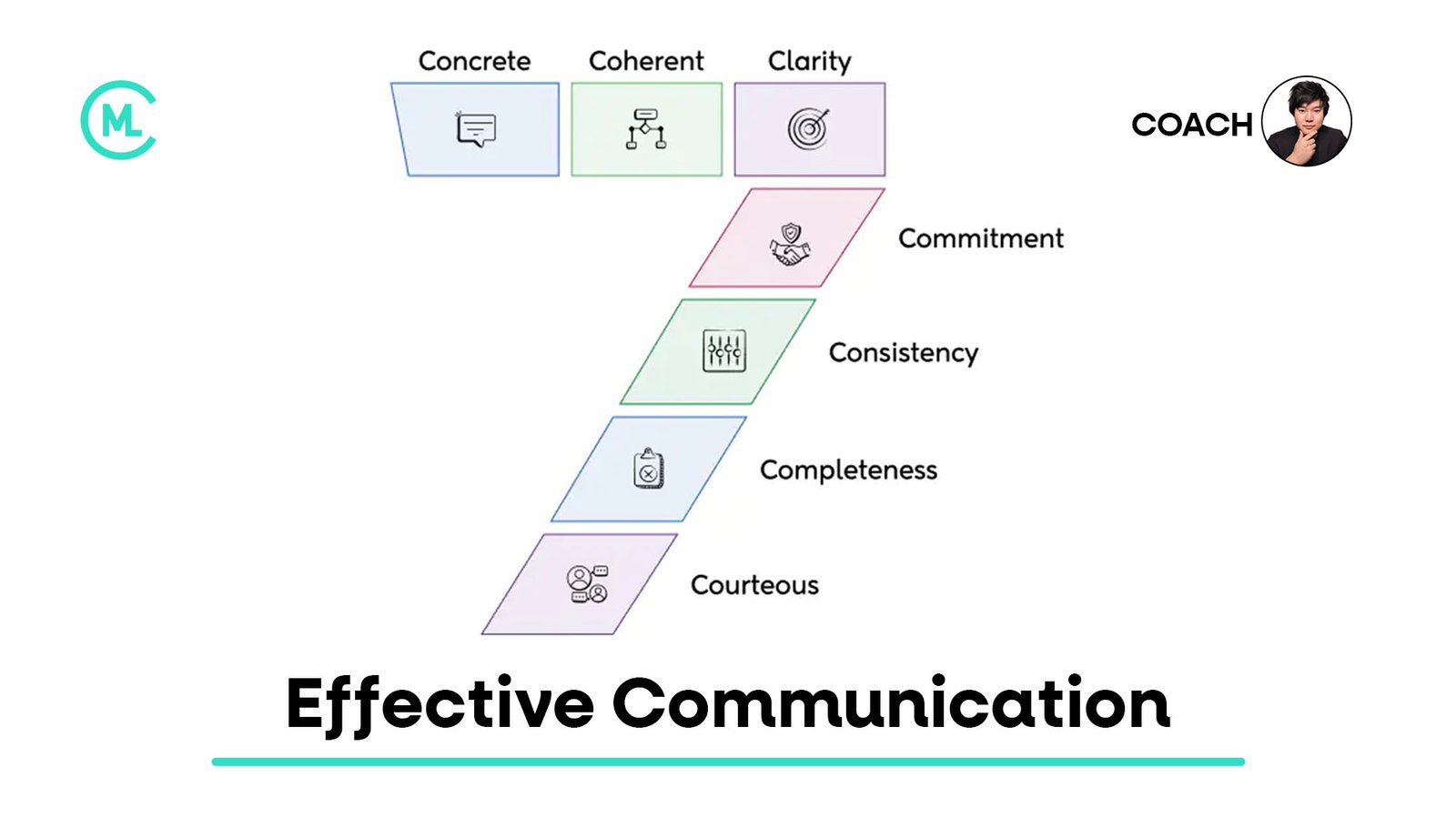
Effective communication is the exchange of information, ideas, and feelings in which the receiver understands the message the way the sender intended. The 7 C’s of communication, clear, concise, concrete, correct, coherent, complete, and courteous, turn any message into effective communication. Effective communication depends on 5 key skills: active listening, nonverbal awareness, stress management, assertiveness, and emotional intelligence. Effective communication builds trust at work, keeps relationships close, and prevents the misunderstandings that damage both. Effective communication skills are learnable skills, and deliberate practice improves effective communication at any age.
What Is Effective Communication?
Effective communication is the exchange of information, ideas, and feelings in which the receiver understands the message the way the sender intended. The definition of effective communication goes beyond the exchange of information. Effective communication also carries the emotion and intention behind the information, so the other person feels heard and understood.
Effective communication works in 2 directions. The sender expresses an idea clearly, and the receiver listens closely enough to understand and respond. A message that reaches the receiver but leaves the receiver confused is ineffective, even when every word is correct. Effective communication succeeds when both people leave the exchange with the same understanding.
What Makes Communication Effective?
Communication becomes effective through 5 key characteristics: clarity, active listening, 2-way exchange, nonverbal alignment, and emotional awareness. The 5 characteristics of effective communication are below.
- Clarity: Clarity gives each message 1 main idea and 1 purpose.
- Active listening: Active listening confirms that the receiver understood the message before a response.
- 2-way exchange: Two-way communication invites questions and feedback instead of a single announcement.
- Nonverbal alignment: Nonverbal alignment matches body language, facial expressions, and tone of voice with the spoken words.
- Emotional awareness: Emotional awareness recognizes personal emotions and the emotions of the other person during the exchange.
What Is the Difference Between Effective and Ineffective Communication?
Effective communication creates shared understanding, while ineffective communication leaves the receiver confused, misinformed, or hurt. The effective vs ineffective communication comparison in the table below covers 6 features.
| Feature | Effective communication | Ineffective communication |
|---|---|---|
| Purpose | 1 clear purpose | Vague or mixed purposes |
| Listening | Active listening and clarifying questions | Interrupting and planning a reply |
| Direction | Two-way communication | One-way communication |
| Tone | Respectful and calm | Harsh, sarcastic, or passive-aggressive |
| Feedback | Regular checks for understanding | No check for understanding |
| Result | Shared understanding and trust | Misunderstandings and conflict |
Effective communication and ineffective communication often use the same words, and the difference lies in clarity, listening, and tone.
The 7 C's of Communication
The 7 C’s of communication are clear, concise, concrete, correct, coherent, complete, and courteous, and the 7 C’s work as principles of effective communication. The 7 Cs of effective communication also appear in noun form: clarity, conciseness, concreteness, correctness, coherence, completeness, and courtesy. The sections below explain the 7 C’s of communication, as the 7 Cs of communication with examples of a weak message and a strong message.
1. Clear
Clear communication states 1 main idea and 1 purpose, so the receiver knows exactly what the message means. Clear communication uses simple words, short sentences, and 1 idea per sentence. A clear message answers the question “What does the sender want?” within the first sentence.
- Weak example: The sender writes, “Can we talk about the thing later?”
- Strong example: The sender writes, “Can we review the Q3 budget at 3 pm today?”
The strong example names the topic, the time, and the request, so the receiver understands the message and responds without guessing.
2. Concise
Concise communication delivers the message in the fewest necessary words, without filler or repetition. Concise communication respects the receiver’s time and keeps attention on the main point. Filler words, long introductions, and repeated apologies hide the message inside extra text.
- Weak example: The sender writes, “I just wanted to reach out and let you know that, unfortunately, due to a number of different factors, the report is going to be a little bit later than originally planned.”
- Strong example: The sender writes, “The report arrives Friday at noon.”
The strong example keeps the key fact and removes 30 words of filler.
3. Concrete
Concrete communication uses specific facts and figures, examples, and details instead of vague statements. Concrete communication gives the receiver a clear picture and leaves no room for doubt. Vague words, such as “a lot,” “soon,” and “great,” mean different things to different people.
- Weak example: The sender writes, “Sales went up a lot this quarter.”
- Strong example: The sender writes, “Sales rose 25% this quarter, from $80,000 to $100,000.”
The strong example replaces an opinion with numbers that every receiver reads the same way.
4. Correct
Correct communication contains accurate facts, correct grammar, and language that fits the audience. Correct communication builds credibility, because a single wrong date or misspelled name reduces trust in the whole message. Correct language also matches the receiver’s level of knowledge, without unexplained technical terms. The right language and tone show respect for the receiver’s background.
- Weak example: The sender writes, “The launch event is on March 31st,” although the event takes place on April 1st.
- Strong example: The sender writes, “The launch event is on Tuesday, April 1, at 6 pm in the main hall.”
The strong example gives verified details, so the receiver acts on accurate information.
5. Coherent
Coherent communication presents ideas in a logical order, so the message flows logically from 1 point to the next. Coherent communication connects every sentence to the main topic. A coherent email follows a simple structure: context, request, and deadline.
- Weak example: The sender writes an email that jumps from a budget question to a holiday party and back to the budget.
- Strong example: The sender writes, “The Q3 budget is $5,000 over plan. A review of travel costs closes the gap. A decision by Friday keeps the project on schedule.”
The strong example moves from the problem to the solution to the deadline in 3 linked sentences.
6. Complete
Complete communication includes every piece of necessary information the receiver needs to understand and respond. A complete message answers the 5 Ws and 1 H: who, what, when, where, why, and how. An incomplete message creates follow-up questions, delays, and mistakes.
- Weak example: The sender writes, “Meeting tomorrow.”
- Strong example: The sender writes, “The product team meets tomorrow at 11 am in Room 3 to finalize the launch plan.”
The strong example names the people, the time, the place, and the purpose, so no follow-up message is necessary.
7. Courteous
Courteous communication is open and honest, respectful, and considerate of the receiver’s feelings and perspective. Courteous communication avoids hidden insults, sarcasm, and passive-aggressive phrasing. Courtesy keeps relationships strong even when the message contains criticism or bad news.
- Weak example: The sender writes, “Fix this now.”
- Strong example: The sender writes, “The team is under pressure this week, and a fix by Friday keeps the launch on track. Thank you for the help.”
The strong example states the same request with respect for the receiver’s workload.
Who Created the 7 Cs of Communication?
Communication textbooks commonly trace the 7 Cs of communication to Scott Cutlip and Allen Center’s 1952 book Effective Public Relations. Cutlip and Center’s original 7 Cs formed a public-relations list: credibility, context, content, clarity, continuity and consistency, channels, and capability of the audience. Business writers later adapted the idea into the modern 7 Cs of business communication: clear, concise, concrete, correct, coherent, complete, and courteous. Some versions replace coherent with consideration. A shorter model, the 5 Cs of communication, keeps 5 of the principles, such as clarity, conciseness, correctness, completeness, and courtesy.
How Do the 7 Cs Work as a Communication Checklist?
The 7 Cs work as a communication checklist because each C turns into 1 question a sender answers before sending a message. The table below lists the checklist question for each of the 7 C’s of communication.
| C | Checklist question |
|---|---|
| Clear | What is the 1 main idea of the message? |
| Concise | Which words add nothing to the message? |
| Concrete | Which vague words need a fact, number, or example? |
| Correct | Is every name, date, and figure accurate? |
| Coherent | Does each sentence follow logically from the sentence before? |
| Complete | Does the message answer who, what, when, where, why, and how? |
| Courteous | Does the tone respect the receiver’s feelings and time? |
A 30-second review with the 7 Cs checklist catches most problems in written communication and spoken communication before the message leaves the sender.
What Are the Key Skills for Effective Communication?
The key skills for effective communication are active listening, nonverbal awareness, stress management, assertiveness, and emotional intelligence. Effective communication skills are learnable skills, not fixed personality traits. Emotional intelligence connects the other 4 skills, because emotional intelligence helps a person notice emotions, stay calm, and choose the right words. The 4 sections below explain how each core skill supports effective communication.
How Does Active Listening Support Effective Communication?
Active listening supports effective communication by making the speaker feel heard and understood through full attention, paraphrasing, and clarifying questions. Psychologists Carl Rogers and Richard Farson introduced the term “active listening” in 1957. Active listening focuses on the speaker’s message instead of the listener’s next reply. Listeners who ask for clarification, such as “What do you mean by ‘soon’?”, replace guesses with facts. Paraphrasing, such as “So the deadline moved to Friday,” confirms that the message arrived intact. Active listening reduces misunderstandings faster than any other single skill.
How Does Nonverbal Communication Support Effective Communication?
Nonverbal communication supports effective communication when body language, facial expressions, and tone of voice match the spoken words. Open body language, such as uncrossed arms, steady eye contact, and a relaxed posture, signals interest and honesty. Negative body language, such as crossed arms, a turned-away body, or a phone in hand, signals disinterest even when the words sound friendly. Albert Mehrabian’s 1971 research found that listeners rely on tone of voice and facial expressions when a speaker’s words and feelings send inconsistent signals. Consistent verbal and nonverbal messages build trust.
How Does Managing Stress Support Effective Communication?
Managing stress supports effective communication because a calm mind thinks clearly, reads others accurately, and chooses words with care. Stress narrows attention and pushes a person toward defensive or aggressive replies. A short pause before responding, a slow breath, or a request for a moment to think keeps a conversation calm under pressure. John Gottman’s research found that partners in a heated argument benefit from a break of at least 20 minutes before the conversation continues. Calm communicators resolve conflict faster and with less damage to the relationship.
How Does Assertiveness Support Effective Communication?
Assertiveness supports effective communication by expressing needs and opinions clearly while respecting the needs of other people. The 4 communication styles are passive, aggressive, passive-aggressive, and assertive. The passive style hides needs, the aggressive style ignores other people’s needs, and the passive-aggressive style expresses disagreement indirectly. The assertive style is the most effective communication style, because assertive communication balances honesty and respect. An assertive request, such as “I need the draft by Thursday to meet the Friday deadline,” states a need, a reason, and a clear time.
What Are Examples of Effective Communication?
Examples of effective communication include a clear meeting request, a specific compliment, a calm apology, and a first-date question that shows real interest. The table below compares an ineffective version and an effective version of 6 common messages.
| Situation | Ineffective version | Effective version |
|---|---|---|
| Workplace email | “Need that thing ASAP.” | “Please send the Q3 sales report by 3 pm today for the board meeting.” |
| Feedback | “Good job.” | “The chart on slide 4 made the budget easy to understand.” |
| Apology to a partner | “Sorry if you got upset.” | “I’m sorry I was late. I know dinner mattered to you, and next time I’ll text early.” |
| First date | “So, what do you do?” | “What’s something you’re excited about this month?” |
| Team meeting | A 45-minute update with no agenda | A 20-minute meeting with 3 agenda items and clear next steps |
| Text message | “Fine.” | “That works for me. See you at 7!” |
Every effective version adds clarity, specific detail, or warmth, and every ineffective version leaves the receiver guessing.
What Is Effective Communication in the Workplace?
Effective communication in the workplace is the clear, 2-way exchange of information that keeps teams aligned, productive, and trusting. Workplace communication succeeds when every employee knows the goals, the tasks, and the deadlines. The 6 main practices of effective communication in the workplace are below.
- The right channel: Chat suits quick updates, email suits records, and conversations suit complex or sensitive topics.
- Face-to-face for complex topics: Face-to-face conversations and video calls carry tone and body language that text removes.
- Two-way communication: Questions and feedback from employees reveal confusion early.
- Facts, not stories: Specific facts replace assumptions about colleagues’ motives.
- Clarification: A short summary at the end of a meeting confirms that everyone shares the same understanding.
- Regular check-ins: Weekly team meetings and one-on-ones keep information flowing.
Amy Edmondson’s research on psychological safety, published in 1999, showed that teams learn more when members feel safe to speak up, and psychological safety makes every practice above more effective.
What Are the Benefits of Effective Communication in the Workplace?
The benefits of effective communication in the workplace are clearer goals, stronger teamwork, better decisions, fewer mistakes, and higher trust. The 5 main benefits of effective communication in the workplace are below.
- Clearer goals: Clear communication puts every employee on the same page about priorities and expectations.
- Stronger teamwork: Open communication promotes collaboration and cooperation across teams.
- Better decisions: Shared information and perspectives lead to better-informed decisions.
- Fewer mistakes: Complete and correct messages prevent rework, delays, and missed deadlines.
- Higher trust: Consistent, honest communication builds trust between employees and managers.
What Is Effective Communication in Relationships?
Effective communication in relationships is the honest, respectful exchange of thoughts and feelings that helps partners feel understood and close. Effective communication in relationships focuses on understanding the other person, not on winning an argument. John Gottman’s research at the University of Washington found that stable couples maintain about 5 positive interactions for every 1 negative interaction during conflict. “I” statements, such as “I feel lonely when we skip our evening walks,” share feelings without blame. Active listening helps a partner feel heard before a solution appears. Effective communication helps people connect with others in every close relationship, from a first date to a long marriage.
Why Is Effective Communication Important?
Effective communication is important because effective communication builds trust, prevents misunderstandings, resolves conflict, and supports wellbeing at work and at home. The importance of effective communication shows in every relationship and every team. Communication is essential, because people depend on shared understanding to cooperate. Ineffective communication can lead to misunderstandings, missed deadlines, and hurt feelings. The 5 main reasons effective communication is important are below.
- Trust: Honest, consistent communication builds trust between partners, friends, and colleagues.
- Fewer misunderstandings: Clear and complete messages prevent confusion and repeated explanations.
- Conflict resolution: Calm, respectful communication resolves disagreements before the disagreements grow.
- Productivity: Clear goals and feedback help teams work faster with fewer mistakes.
- Wellbeing: Feeling heard and understood reduces stress in work and personal life.
How Can You Improve Your Effective Communication Skills?
Effective communication skills improve through deliberate practice, honest feedback, and regular use of the 7 Cs in daily messages. The answer to how to improve communication skills is practice: better communication skills grow from small habits repeated every day. The 6 main methods to improve effective communication skills are below.
- A 7 Cs review before sending: A short check of each important message against the 7 Cs catches unclear, incomplete, or harsh wording.
- A communication journal: A daily note about 1 conversation that went well and 1 conversation that went badly reveals personal patterns.
- Active listening practice: Conversations without phones or multitasking build attention and accuracy.
- Feedback from trusted people: Friends, partners, and managers point out blind spots in tone and clarity.
- Recorded practice: A recording of a presentation or a practice conversation shows filler words, pace, and body language.
- Coaching and courses: Communication coaching, workshops, and courses provide structure and personal feedback.
The most useful effective communication tips share 1 idea: small, consistent habits change communication more than occasional big efforts.
How Do Barriers Block Effective Communication?
Barriers block effective communication by distorting the message at any step, and each of the 7 Cs removes a specific barrier. The barriers to communication include physical, emotional, language, and cultural barriers. Clear communication removes language barriers, such as jargon. Courteous communication reduces emotional barriers, such as defensiveness. Complete communication closes information gaps. Concise communication prevents information overload. Barriers to effective communication also include lack of focus, which active listening corrects. Cultural barriers require the courteous C most of all, because directness, silence, and eye contact carry different meanings in different cultures. A message that passes the 7 Cs checklist still meets barriers, so feedback from the receiver remains the final test of effective communication. Effective communication turns the importance of communication into real results at work and at home.
How Does the Communication Process Support Effective Communication?
The communication process supports effective communication when every 1 of the 5 steps works, from idea formation to feedback. The 5 steps are idea formation, encoding, transmission, decoding, and feedback. Clear and concrete messages strengthen encoding. Active listening strengthens decoding. Two-way communication strengthens feedback, which confirms that the message arrived as intended. Effective communicators treat feedback as part of the message, not as an afterthought, because the feedback step reveals any failure in the earlier 4 steps.
Which Elements of Communication Make a Message Effective?
The sender, message, channel, and feedback make a message effective when the 4 elements align with the receiver’s field of experience. The 11 elements of communication include 8 core elements and 3 situational components: context, environment, and field of experience. A message that matches the receiver’s knowledge, language, and culture reaches understanding faster. Noise, such as distractions and stress, reduces the effect of even a well-written message. Context also shapes effectiveness: a joke that works in a relaxed setting fails in a tense meeting.
Which Types of Communication Are Most Effective?
Face-to-face verbal communication is the most effective type of communication for complex or emotional messages, while written communication is most effective for detailed instructions. The 4 main types of communication are verbal, nonverbal, written, and visual communication. Visual communication, such as charts and diagrams, makes data easy to understand. Effective communicators combine several types, such as a conversation followed by a written summary. Nonverbal communication supports every other type, because tone and body language confirm the sincerity of the words.
How Does Effective Communication Change Across the Levels of Communication?
Effective communication changes across the levels of communication because each level needs a different balance of clarity, formality, and feedback. Interpersonal communication depends on active listening and immediate feedback. Group communication depends on clear agendas and shared goals. Public communication depends on structure, a strong opening, and attention to audience reactions. Mass communication depends on simple language and a single clear message, because feedback arrives late.
Which Interpersonal Skills Make Communication Effective?
Active listening, empathy, clarity, and emotional intelligence are the interpersonal skills that make communication effective in every relationship. The 10 essential communication skills build the habits behind every effective message. Empathy helps a speaker understand the emotions behind a message. Emotional intelligence keeps reactions calm during difficult conversations. Interpersonal communication improves when both people use the 7 Cs and listen with full attention. The definition, 7 Cs, skills, and examples of effective communication apply to every part of communication, at work and at home. More guides on communication are available in the Knowledge Hub.