
Deep Questions to Ask: 120 Questions for Real Connection
By Michael Lee, communication and relationship coach · Last updated
A deep question is a question that invites a person to share values, feelings, memories or beliefs instead of surface facts. Deep conversations with strangers feel less awkward and more connecting than people expect, according to 12 experiments by Michael Kardas, Amit Kumar and Nicholas Epley (2021). The 120 deep questions below cover 8 relationships, from someone new to the self. Deep questions belong to the deepening stage of strong conversation skills.
What Are Deep Questions?
A deep question is a question that invites a person to share values, feelings, memories or beliefs instead of surface facts. A shallow question asks what a person does. A deep question asks why it matters to that person. An example of a shallow question is “What do you do for work?”. An example of the same topic as a deep question is “What part of your work feels most meaningful to you?”.
Deep questions open the deepening stage of a conversation. The 4 stages of a conversation are opening, sustaining, deepening and closing. Small talk fills the first 2 stages. Deep questions move a conversation from the facts of a life to the meaning inside it.
A deep question differs from an intrusive question in its timing and its tone. A deep question arrives after trust exists. An intrusive question demands private information before trust exists. An example of an intrusive question on a first meeting is “How much money do you make?”. An example of a deep question on the same theme is “What does financial security mean to you?”. The deep version asks about meaning. The intrusive version asks about a private number.
What Makes a Question Deep?
The 5 attributes of a deep question are a personal focus, an open form, feelings or values, room for a story and a safe pass. A question with all 5 attributes invites real self-disclosure.
- A personal focus. A deep question asks about the other person’s own life, not about the news or the weather.
- An open-ended form. A deep question invites a full answer instead of a yes or a no. The guide to open-ended questions explains the main open-ended forms.
- Feelings or values. A deep question asks what an experience meant, not only what happened.
- Room for a story. A deep question gives the other person space to explain a moment in full.
- A safe pass. A deep question leaves the other person free to skip it without awkwardness.
What Topics Do Deep Questions Cover?
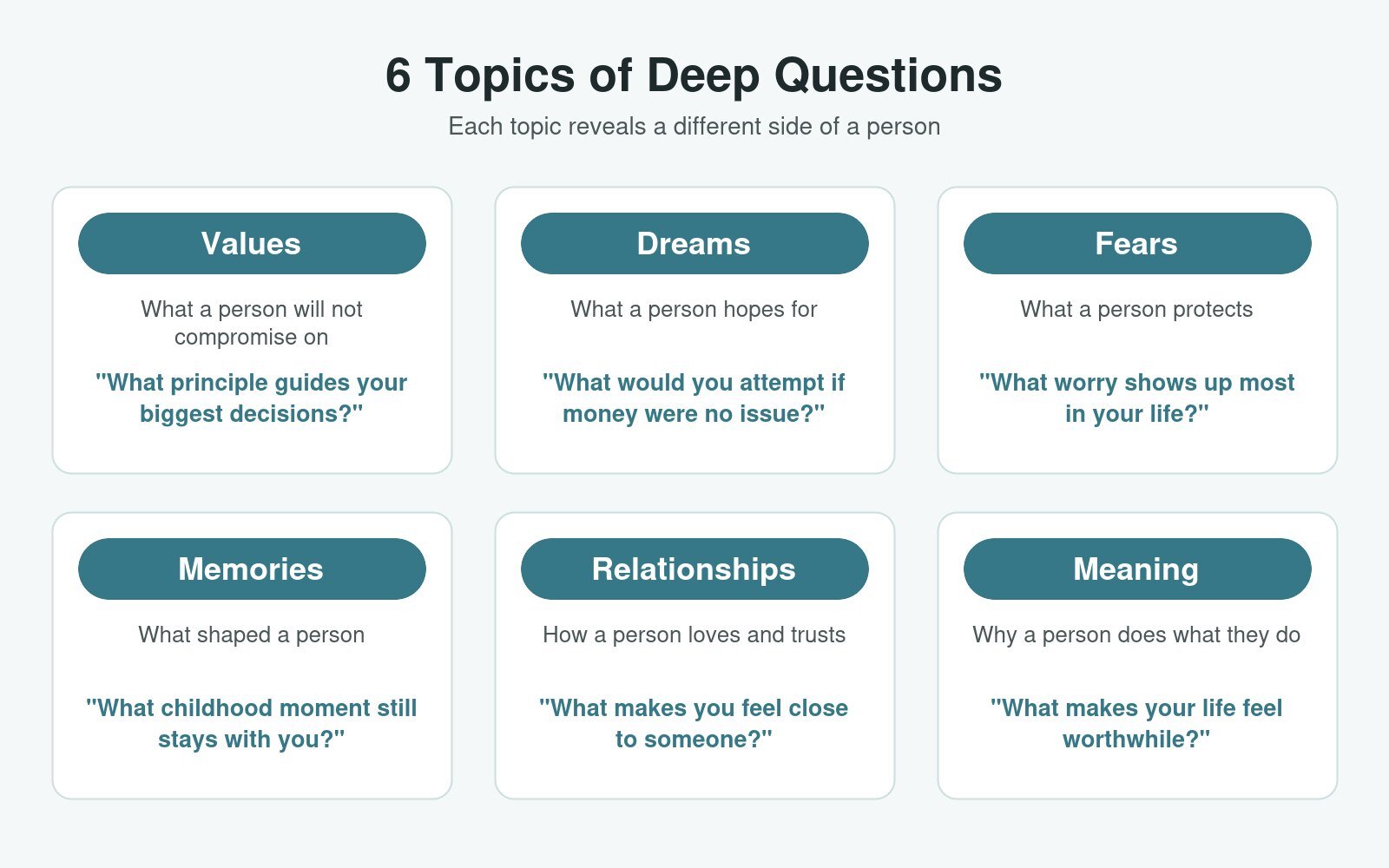
Deep questions cover 6 main topics: values, dreams, fears, memories, relationships, and meaning and purpose. Each topic reveals a different side of a person. The table below gives what each topic reveals and an example question for each topic.
| Topic | What it reveals | Example question |
|---|---|---|
| Values | What a person will not compromise on | “What principle guides your biggest decisions?” |
| Dreams | What a person hopes for | “What would you attempt if money were no issue?” |
| Fears | What a person protects | “What worry shows up most in your life?” |
| Memories | What shaped a person | “What childhood moment still stays with you?” |
| Relationships | How a person loves and trusts | “What makes you feel close to someone?” |
| Meaning and purpose | Why a person does what they do | “What makes your life feel worthwhile?” |
Why Do Deep Questions Bring People Closer?
Deep questions bring people closer through self-disclosure. Self-disclosure is the sharing of personal thoughts, feelings and experiences. Each honest answer builds trust. Trust invites a deeper answer in return.
Michael Kardas, Amit Kumar and Nicholas Epley tested deep conversations in the Journal of Personality and Social Psychology in 2021. The researchers ran 12 experiments with more than 1,800 participants. Pairs of strangers answered deep questions or shallow questions. An example of a deep question from the study is “Can you describe a time you cried in front of another person?”. Deep conversations felt less awkward than participants expected (ScienceDaily). Deep conversations also created more connection and enjoyment than participants predicted. Participants underestimated how interested their partners would be in learning about them.
Deep conversation also links to happiness. Matthias Mehl and colleagues recorded the daily conversations of volunteers for 4 days in a 2010 study in Psychological Science. The happiest participants had about 2 times as many substantive conversations as the unhappiest participants. The happiest participants also had about one-third as much small talk.
What Are the 36 Questions That Build Closeness?
The 36 questions are a set of questions designed to build closeness between 2 people in about 45 minutes. Psychologist Arthur Aron and colleagues published the 36 questions in Personality and Social Psychology Bulletin in 1997. The questions come in 3 sets of 12. Each set is more personal than the last. Both people take turns answering each question.
Pairs of strangers who asked the 36 questions reported more closeness than pairs who asked 36 small talk questions. The closeness of those pairs matched the average closeness other participants reported in their closest relationships (Greater Good in Action). The 3 example questions below come from the first 2 sets.
- Set I: “Given the choice of anyone in the world, whom would you want as a dinner guest?”
- Set I: “For what in your life do you feel most grateful?”
- Set II: “What is the greatest accomplishment of your life?”
The 36 questions work best with a few simple rules. Both people set aside about 45 minutes. Each set gets about 15 minutes. The pair moves to the next set when the time runs out, even with questions left. Either person can skip a question that feels too personal.
What Are Good Deep Questions to Ask?
Good deep questions match the relationship. The 8 lists below give 120 deep questions, from someone new to the self. Each list holds 15 questions. The lists start with lighter depth for new people and grow deeper for close relationships.
Deep Questions to Get to Know Someone
The 15 deep questions below help a new acquaintance move past small talk. The guide on how to start a conversation covers the first line before these questions.
- “What has shaped who you are the most?”
- “What’s a belief you held strongly that you’ve changed your mind about?”
- “What does a meaningful life look like to you?”
- “What’s a moment that changed the direction of your life?”
- “Who has influenced you more than anyone else?”
- “What are you most proud of that few people know about?”
- “What’s something you’re still trying to figure out?”
- “What do you value most in the people close to you?”
- “What would you do if you knew you could not fail?”
- “What’s a lesson you learned the hard way?”
- “When do you feel most like yourself?”
- “What’s a dream you’ve quietly kept for years?”
- “What does home mean to you?”
- “What’s something you wish more people asked you about?”
- “How do you want to be remembered?”
Questions for a new acquaintance work best after a few minutes of light talk. One deep question per conversation is enough for a new acquaintance.
Deep Questions for a First Date or a Crush
The 15 deep questions below stay one level lighter, to fit an early stage of trust.
- “What’s something you’re really passionate about right now?”
- “What does a perfect ordinary day look like for you?”
- “What’s a small thing that always makes you happy?”
- “What’s the best decision you’ve made in the last year?”
- “What’s a place that feels like yours?”
- “What’s a value you won’t compromise on?”
- “What made you laugh hardest recently?”
- “Who’s someone you really look up to?”
- “What’s something you’ve always wanted to learn?”
- “What do you love most about your life right now?”
- “What’s a goal you’re excited about this year?”
- “What kind of people do you feel most yourself around?”
- “What’s a memory that always makes you smile?”
- “What would your best friend say is your best quality?”
- “What does a good relationship look like to you?”
First date questions reveal values without pressure. A shared laugh after a light answer prepares the ground for a deeper question later.
Deep Questions to Ask a Girl
The 15 deep questions below invite a girl or a woman to share her strengths, values and dreams.
- “What’s a moment you felt truly brave?”
- “Who taught you the most about being strong?”
- “What do you wish people noticed about you first?”
- “What’s a dream you’ve had since you were a kid?”
- “What makes you feel safe with someone?”
- “What’s something you’ve learned to love about yourself?”
- “What’s a belief your family gave you that you still hold?”
- “When do you feel most confident?”
- “What’s a goal that scares you a little?”
- “What kind of friend are you when someone is struggling?”
- “What does success mean to you personally?”
- “What’s a book, song or film that changed how you see things?”
- “What’s something you’ve never stopped caring about?”
- “What would you do with a year off and no money worries?”
- “What do you need to feel appreciated?”
The best questions for a girl or a guy are the same as the best questions for anyone: personal, open-ended and asked with real curiosity.
Deep Questions to Ask a Guy
The 15 deep questions below invite a guy or a man to share the pressures, values and dreams he rarely shows.
- “What’s something you rarely admit you’re proud of?”
- “Who showed you what it means to be a good man?”
- “What pressure do you feel that most people don’t see?”
- “What’s a time you surprised yourself?”
- “What does respect look like to you?”
- “What’s a dream you put on hold?”
- “How do you handle a really bad day?”
- “What’s a lesson a mentor or a parent taught you?”
- “When do you feel most at ease?”
- “What do you want your life to stand for?”
- “What’s a friendship that shaped you?”
- “What’s a fear you’ve overcome?”
- “What does a supportive partner do for you?”
- “What would you change about how you were raised?”
- “What makes a day feel meaningful to you?”
Deep Questions to Ask Your Partner
The 15 deep questions below help partners in a long-term relationship keep learning about each other.
- “What makes you feel most loved by me?”
- “When did you first feel we were a real team?”
- “What’s one thing you need more of from me right now?”
- “What does a happy life together look like to you in 10 years?”
- “What’s a worry about us you’ve never said out loud?”
- “Which moment with me do you replay most often?”
- “How has being with me changed you?”
- “What’s something I do that means more to you than I realize?”
- “How do you like to be comforted when you’re stressed?”
- “What’s a dream you want us to chase together?”
- “What part of your past do you want me to understand better?”
- “What does trust look like to you day to day?”
- “When do you feel closest to me?”
- “What’s one thing we should never stop doing?”
- “How can we handle disagreements better?”
Partner questions work best in a calm moment, such as a walk or a quiet dinner. A busy evening or a tense moment makes a deep question feel like a test.
Deep Questions to Ask Your Friends
The 15 deep questions below turn a casual friendship into a close one.
- “What’s a moment our friendship really mattered to you?”
- “How do you think I’ve changed since we met?”
- “What’s something you’ve been carrying alone lately?”
- “What do you need from friends that you don’t always get?”
- “What’s a risk you’re glad you took?”
- “What does a good friend mean to you?”
- “What’s a goal you haven’t told many people about?”
- “When was the last time you felt truly proud of yourself?”
- “What’s a memory with me you’d want to live again?”
- “What would you tell your younger self?”
- “Which friendship in your life taught you the most?”
- “What makes you feel most at peace?”
- “What’s a part of your life you rarely talk about?”
- “How can I be a better friend to you?”
- “What do you hope our friendship looks like in 20 years?”
Friendship questions deepen a bond built on shared fun. A long drive or a late conversation gives friends the time these questions need.
Deep Questions to Ask Your Family
The 15 deep questions below help family members learn the stories behind each other’s lives.
- “What got you through the hardest year of your life?”
- “What do you remember most about your own parents?”
- “What’s a family story that should never be forgotten?”
- “What did you want for your life when you were my age?”
- “What’s something you wish you had asked your parents?”
- “Which tradition from our family do you love most?”
- “What are you most proud of in our family?”
- “What’s a lesson you hope we pass on?”
- “What was your biggest dream growing up?”
- “What surprised you most about becoming an adult?”
- “What’s something about you that might surprise us?”
- “What did your childhood home feel like?”
- “When did you feel most loved as a child?”
- “What do you wish we talked about more as a family?”
- “What do you hope we remember about you?”
Family questions preserve stories that disappear when they go unasked. A recorded answer from a grandparent becomes a gift for the whole family.
Deep Questions to Ask Yourself
The 15 deep questions below work for self-reflection or journaling.
- “What am I avoiding right now?”
- “What do I want my life to look like in 5 years?”
- “Which of my habits hold me back?”
- “What am I most grateful for today?”
- “When did I last feel fully alive?”
- “What do I need to forgive myself for?”
- “What would I do if no one were judging me?”
- “Which relationships give me energy?”
- “What does a good day look like for me?”
- “What am I pretending not to know?”
- “What do I value that I’m not living by?”
- “What fear is making my decisions for me?”
- “What advice would I give a friend in my situation?”
- “What small step could I take toward my biggest goal?”
- “What do I want people to feel after time with me?”
Self-reflection questions work best in writing. A journal entry of 5 minutes per question turns a vague feeling into a clear thought.
How Do You Ask Deep Questions Without Being Awkward?
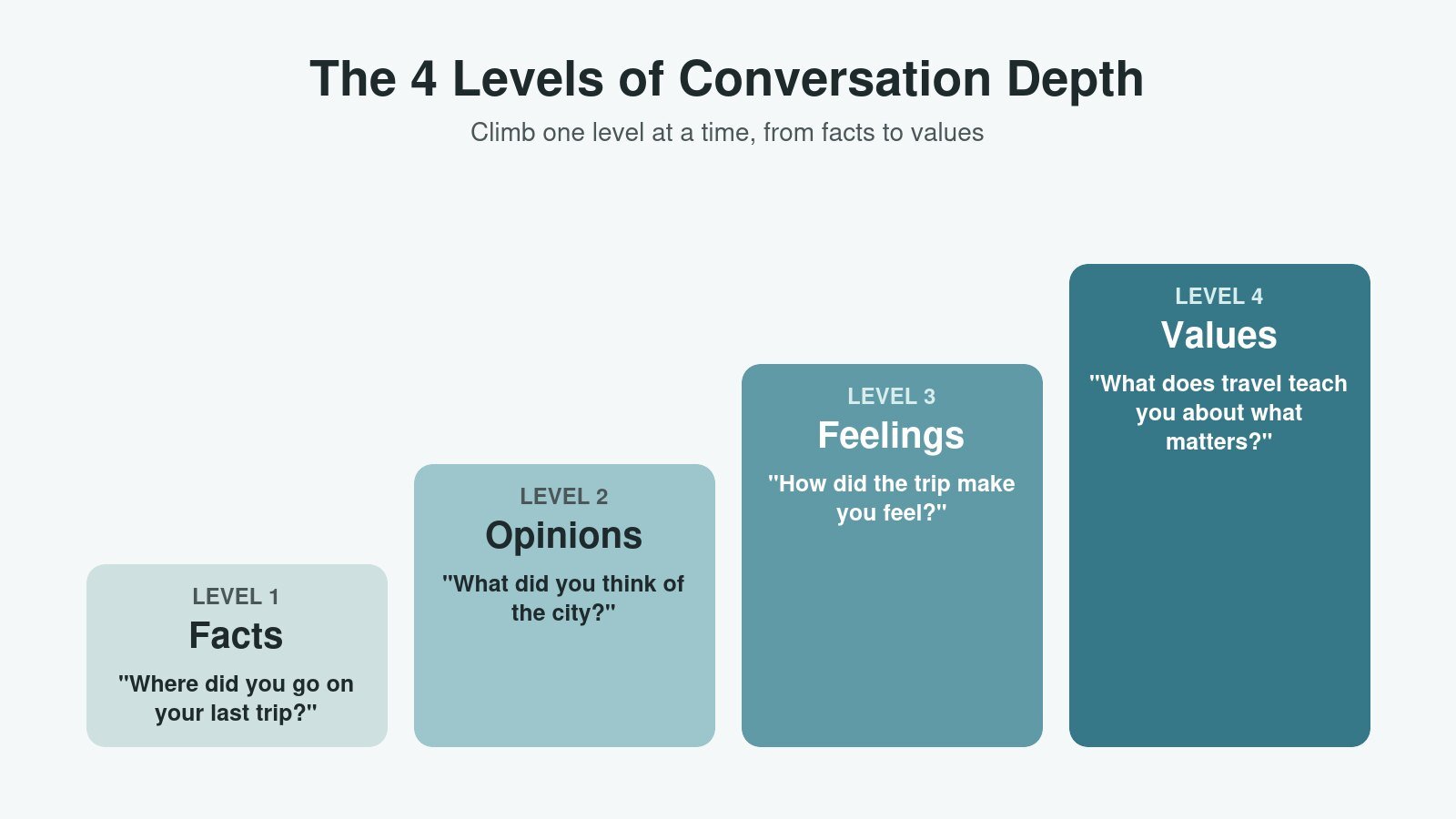
Asking deep questions without awkwardness takes 5 steps: small talk first, attention to readiness signals, one level deeper at a time, a matching answer and judgment-free listening. Each step protects trust. The staircase below shows the 4 levels of conversation depth.
1. Start With Small Talk
Small talk builds the trust that deep questions need. A deep question from a stranger in the first minute feels intrusive. A few minutes of light talk about the setting, plans or hobbies makes a deeper question feel natural. Small talk is the warm-up stage of every deep conversation.
2. Watch for Readiness Signals
The other person signals readiness for a deep question in 3 ways: longer answers, personal details offered without a question and questions asked in return. A deep question fits best after those signals appear. Short answers and a glance at a phone signal that the moment is not right. A lighter topic fits better at that moment.
3. Go One Level Deeper at a Time
Conversation depth has 4 levels: facts, opinions, feelings and values. Each follow-up question moves one level deeper than the last. The 4 questions below show a staircase on the topic of travel.
- Fact: “Where did you go on your last trip?”
- Opinion: “What did you think of the city?”
- Feeling: “How did the trip make you feel?”
- Value: “What does travel teach you about what matters?”
A jump from facts straight to values feels abrupt. A gradual climb feels natural.
4. Answer Your Own Question Too
A deep conversation works best as an exchange. A person who asks a deep question also shares a matching answer. A turn-taking rhythm keeps the conversation balanced. Partners take turns answering each question in the 36 questions method. A matching answer shows that the asker is willing to be vulnerable too.
5. Listen Without Judging
A deep answer needs a safe listener. Judgment-free listening means attention, reflection and no rush to advice. An example of a reflective response is “That sounds like it really shaped you.” Advice in response to a feeling makes the speaker feel unheard. Gratitude for an honest answer makes the next answer easier.
Which Deep Questions Should You Avoid?
The 5 kinds of deep questions to avoid are early trauma or grief, money or sex with new people, loaded “why” questions, rapid-fire depth and judging questions.
- Trauma or grief too early. Painful memories belong to established trust. A new acquaintance has no reason to share them.
- Money or sex with new people. Income, debt and intimacy feel too private for a first conversation.
- Loaded “why” questions. “Why are you still single?” sounds like criticism instead of curiosity.
- Rapid-fire depth. Five deep questions in a row feel like an interview.
- Questions used to judge. A deep question asked to test or score an answer breaks trust.
A balanced deep conversation alternates questions with personal shares. The guide on how to keep a conversation going covers 12 techniques for balancing questions and shares.
What If Someone Does Not Want to Answer?
A person who does not want to answer a deep question deserves an easy way out. The best response accepts the pass without pressure. An example of a graceful response is “Totally fair. That’s a big one.” A personal share on a lighter topic restarts the exchange. A short pause after a skipped question is normal. The guide to handling an awkward silence covers ways to restart a stalled conversation.
How Do Deep Questions Build Relationships and Communication Skills?
Deep questions build relationships by turning acquaintances into close friends, partners and family. Every close relationship grows from a series of honest answers. Deep questions invite those answers. The 6 related skills below connect deep questions to the wider topic of communication. The Roadmap Fundamentals session with Coach Michael Lee trains these skills in live practice.
How Do Deep Questions Fit Into Conversation Skills?
Deep questions power the deepening stage of the 4 conversation stages: opening, sustaining, deepening and closing. Small talk opens a conversation. Follow-up questions sustain the conversation. Deep questions take the conversation to the level of values and feelings. The full guide to conversation skills explains all 4 stages and the 8 core skills.
What Role Do Deep Questions Play in Interpersonal Communication?
Deep questions invite self-disclosure, the core of closeness in interpersonal communication. Interpersonal communication is the exchange of messages between two people. Self-disclosure builds trust in small steps. A deep question asks for the next step.
Which Interpersonal Skills Make Deep Questions Work?
The 3 interpersonal skills that make deep questions work are empathy, active listening and trustworthiness. Empathy picks the right moment for depth. Active listening honors the answer. Trustworthiness keeps the answer private. The guide to interpersonal skills covers each skill in depth.
How Does Confidence Help You Ask Deep Questions?
Confidence makes the vulnerability of a deep question easier. Confident communicators ask the first deep question. Confident communicators also share a matching answer without fear of judgment. The guide to communication with confidence lists 35 ways to speak with confidence.
Which Communication Exercises Use Deep Questions?
The 3 communication exercises that use deep questions are The 36 Questions, Highs and Lows and The Fireside Chat. The 36 Questions builds closeness through increasingly personal questions. Highs and Lows trains the daily sharing of the best and the hardest moments. The Fireside Chat trains calm talk about feelings and plans between partners. The full list of 47 communication exercises includes steps and timing for each exercise.
How Does a Communication Coach Help With Deep Conversations?
A communication coach helps with deep conversations through live practice and direct feedback. A coach spots habits such as a jump to depth too fast, interview mode or advice instead of listening. A coach then replaces those habits with readiness checks and the staircase method. Communication coaching turns the 5 steps into automatic habits.