
Open-Ended Questions: Meaning, Examples and How to Ask Them
By Michael Lee, communication and relationship coach · Last updated
An open-ended question is a question that invites an answer in the other person’s own words, beyond a yes, a no or a single fact. Open-ended questions draw out about 4 times as many details as direct questions, according to interview research by Michael Lamb and colleagues (2009). A good open-ended question follows 5 steps, from an open starter to a follow-up. Open-ended questions are one of the core conversation skills.
What Is an Open-Ended Question?
An open-ended question is a question that invites an answer in the other person’s own words, beyond a yes, a no or a single fact. The other person chooses the length and the direction of the answer. An open-ended question has no single correct answer.
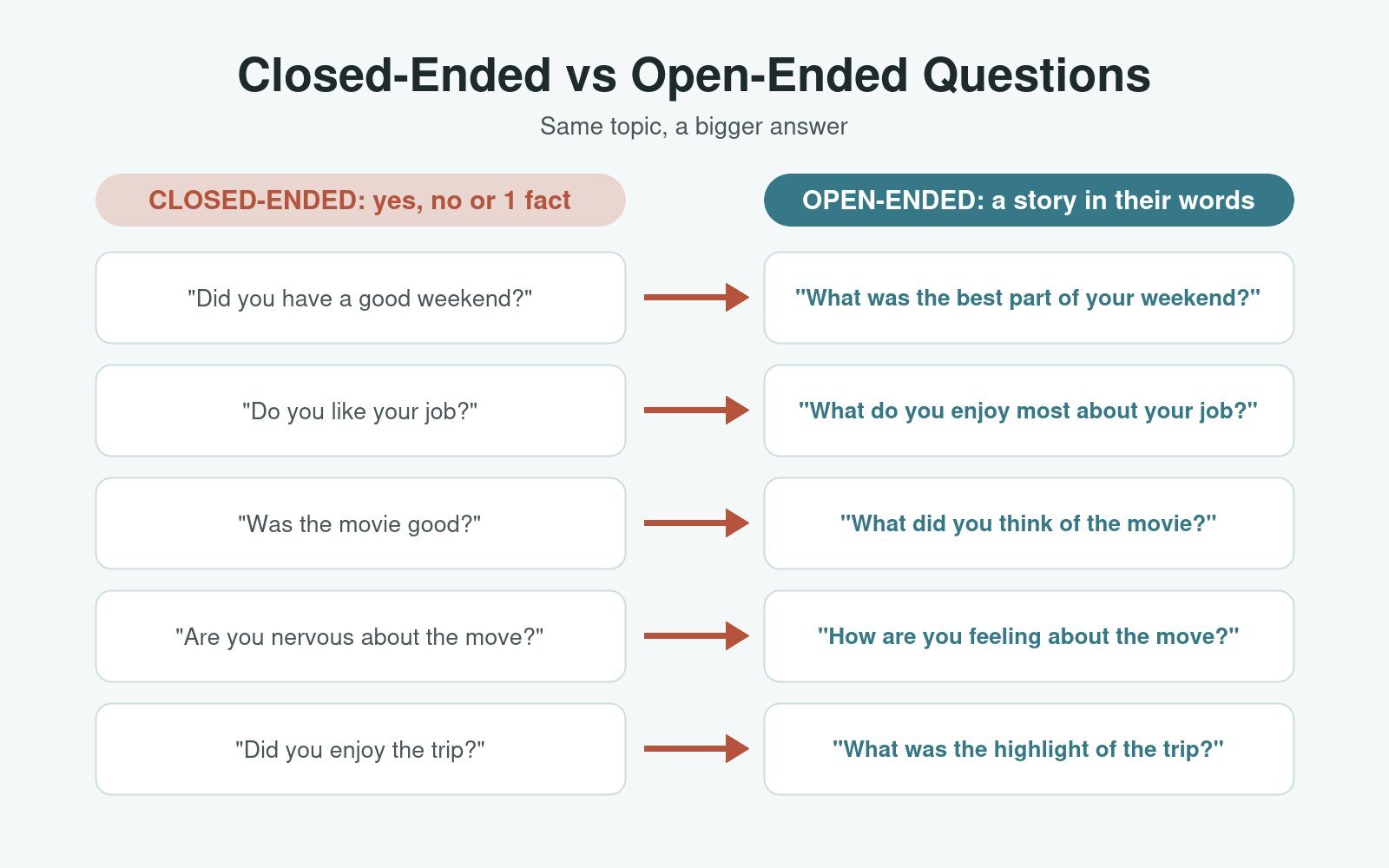
An example of a closed question is “Did you have a good weekend?”. An example of the same question in open-ended form is “What was the best part of your weekend?”. The closed version invites 1 word. The open-ended version invites a story.
Open-ended questions appear in conversations, interviews, classrooms, surveys and coaching sessions. In conversation, an open-ended question gives the other person room to share what matters to them. The shared detail becomes the topic of the next question.
What Words Start an Open-Ended Question?
The 6 most common open-ended question starters are what, how, why, “tell me about”, describe and “walk me through”. Each starter asks for a story, an opinion or a feeling.
- What: An example of a what question is “What made you choose that job?”
- How: An example of a how question is “How did the move go?”
- Why: An example of a why question is “Why did that trip matter so much?”
- Tell me about: An example of a tell-me-about prompt is “Tell me about the new project.”
- Describe: An example of a describe prompt is “Describe a perfect Saturday.”
- Walk me through: An example of a walk-me-through prompt is “Walk me through a normal workday.”
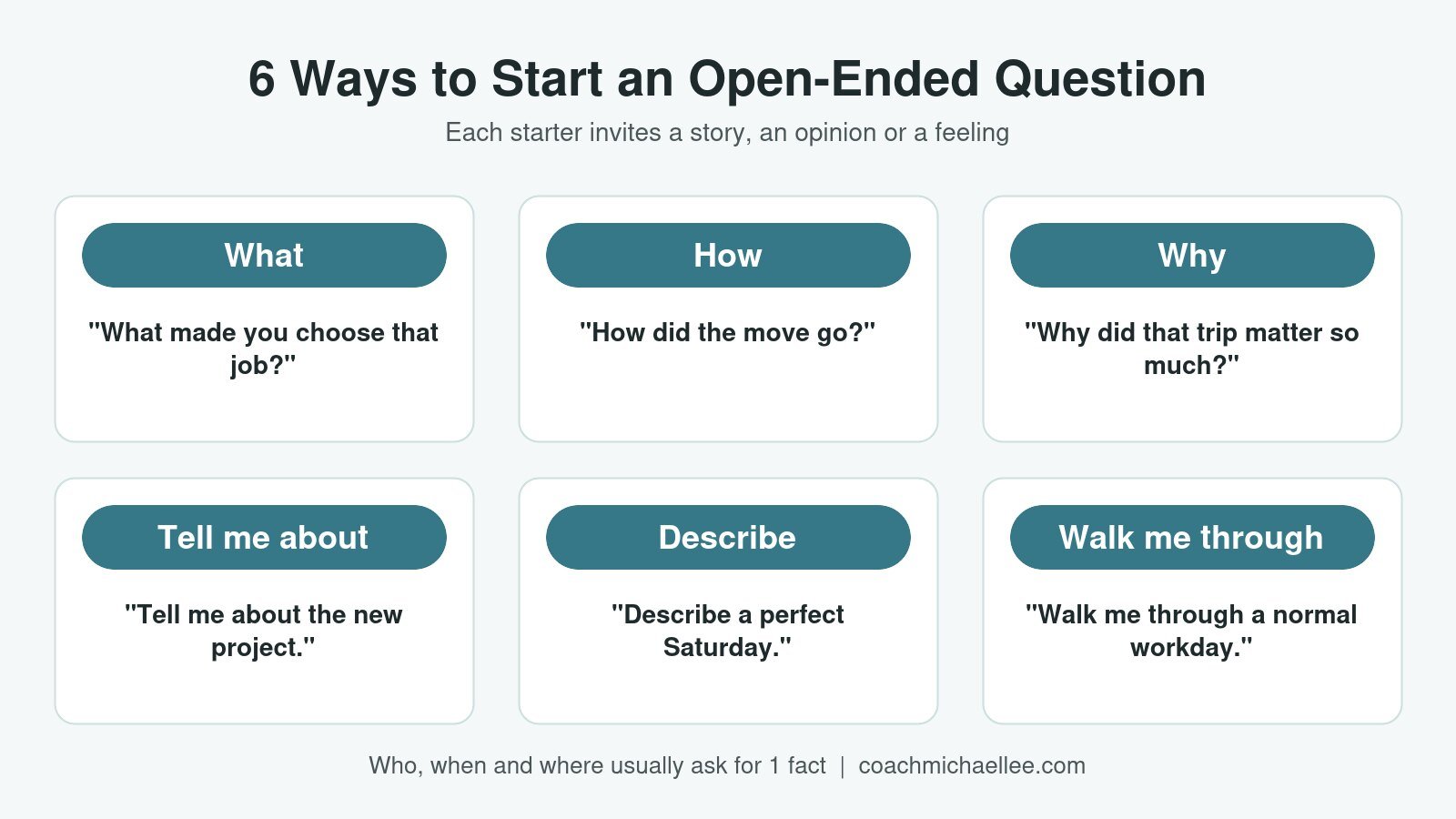
The starters who, when and where usually ask for 1 fact. An example of a who question is “Who was there?”. Questions with who, when and where work best as follow-ups inside a longer exchange.
What Is the Difference Between Open-Ended and Closed-Ended Questions?
The difference between open-ended and closed-ended questions is the range of possible answers. A closed-ended question invites yes, no or one fact from a small set. An open-ended question invites any answer in the speaker’s own words. The closed-ended question is the opposite of the open-ended question.
Closed-ended questions often start with do, did, is, are, can or have. Open-ended questions often start with what, how or why. The table below shows 8 closed-ended questions and their open-ended versions.
| Closed-ended | Open-ended | What changes |
|---|---|---|
| “Did you have a good weekend?” | “What was the best part of your weekend?” | A rating becomes a story |
| “Do you like your job?” | “What do you enjoy most about your job?” | Yes or no becomes a reason |
| “Was the movie good?” | “What did you think of the movie?” | A verdict becomes an opinion |
| “Are you nervous about the move?” | “How are you feeling about the move?” | One feeling becomes any feeling |
| “Did you grow up here?” | “What was it like growing up where you did?” | A fact becomes a memory |
| “Is the project going well?” | “How is the project going so far?” | A status becomes a progress report |
| “Did you enjoy the trip?” | “What was the highlight of the trip?” | A rating becomes a moment |
| “Do you have plans tonight?” | “What are you up to tonight?” | Yes or no becomes a plan |
When Is a Closed-Ended Question Better?
A closed-ended question is better in 4 situations: confirming a fact, making a decision, wrapping up a conversation and helping a nervous person start talking.
- Confirming a fact. An example of a confirming question is “Is the meeting at 3?”.
- Making a decision. An example of a decision question is “Pizza or tacos tonight?”.
- Wrapping up. An example of a wrap-up question is “Shall we pick this up next week?”.
- Helping a nervous person start. An easy closed question lowers the pressure of a first answer. An example of an easy start is “Is this your first time here?”.
A good conversation mixes both types. Motivational interviewing guidance by William Miller and Stephen Rollnick (2013) recommends more open questions than closed questions.
Why Do Open-Ended Questions Work?
Open-ended questions work by handing control of the answer to the other person. The speaker chooses which detail to share. The chosen detail reveals what matters to the speaker. Each answer also contains new hook points for the next question.
Interview research shows the size of the effect. Michael Lamb and colleagues studied investigative interviews with children in Britain in 2009. Mireille Cyr and Michael Lamb ran a matching study in Québec. Interviewers trained on the NICHD protocol used about 3 times more open invitations than other interviewers. Open invitations drew out about 4 times as many details as directive questions (Canadian Child Welfare Research Portal). The British study compared 50 interviews in each group. The Québec study compared 83 interviews in each group.
Everyday conversation follows the same pattern. An open-ended question gives the other person room to talk. Room to talk produces longer answers. Longer answers give both people more to connect over.
What Are the Benefits of Open-Ended Questions?
The 5 main benefits of open-ended questions are longer answers, more hook points, deeper connection, fewer assumptions and a sense of being heard.
- Longer answers. An open-ended question invites a story instead of a single word.
- More hook points. Each detail in a story gives the listener a topic for a follow-up question.
- Deeper connection. Stories reveal feelings, values and experiences.
- Fewer assumptions. The speaker explains a view in full instead of picking from the asker’s options.
- A sense of being heard. A person who gets room to talk feels respected.
How Do You Ask Open-Ended Questions?
Asking open-ended questions takes 5 steps: an open starter, a clear and specific topic, neutral wording, one question at a time and an active follow-up. Each step keeps the question easy to answer. The 5 steps work in person, on the phone and over text.
1. Start With What, How or "Tell Me About"
The starter word shapes the answer. A question that starts with what, how or “tell me about” invites a full answer. A question that starts with do, did, is or are invites yes or no. An example of a weak starter is “Do you like cooking?”. An example of a strong starter is “What do you like to cook?”. The verb at the front of the question decides the length of the answer.
2. Keep the Question Clear and Specific
A clear open-ended question names one topic. A broad question makes the other person do the hard work of choosing a topic. An example of a broad question is “Tell me about yourself.” An example of a specific question is “What got you into nursing?”. The specific version is easier to answer. The specific version also proves that the asker paid attention.
3. Avoid Leading Questions
A leading question pushes the other person toward an expected answer. Leading wording turns an open-ended question into a request for agreement. An example of a leading question is “Wasn’t the concert amazing?”. An example of the same question in neutral form is “What did you think of the concert?”. Neutral wording earns an honest answer.
4. Ask One Question and Wait
A good open-ended question stands alone. Stacked questions confuse the listener. An example of a stacked question is “How was the trip, where did you stay, and did you see the beach?”. The listener answers only the last part of a stacked question. A single question followed by a short pause gives the other person time to think. A thoughtful answer often starts after that pause.
5. Listen and Ask a Follow-Up
Listening turns an open-ended question into a conversation. Every answer contains at least one detail worth a second question. A follow-up question about that detail proves that the listener heard the answer. An example of an answer is “I spent the weekend repainting my kitchen.” A good follow-up to that answer is “What color did you pick?”. Follow-up questions make the asker more likable, according to Huang and colleagues at Harvard (2017).
How Do You Turn a Closed Question Into an Open-Ended Question?
A closed question turns into an open-ended question in 3 moves: swapping the starter, asking about the experience and dropping the yes-or-no verb. The starter swap replaces do, did, is or are with what or how. The experience move asks about the story behind a fact. The verb drop removes words such as “Do you” and “Is it” from the front of the question.
The 6 rewrites below show the 3 moves in action.
- “Do you like living here?” becomes “What do you like most about living here?”
- “Did the interview go well?” becomes “How did the interview go?”
- “Is your new boss nice?” becomes “What is your new boss like?”
- “Did you have fun at the wedding?” becomes “What was the best moment at the wedding?”
- “Are you a morning person?” becomes “What does a good morning look like for you?”
- “Was school okay today?” becomes “What was the best part of school today?”
Each rewrite keeps the same topic. Each rewrite invites a story instead of a verdict.
What Are Good Open-Ended Questions to Ask?
Good open-ended questions match the situation. The 7 lists below give 105 open-ended questions for getting to know someone, small talk, dating, couples, friends and family, work and kids. Each list holds 15 questions.
Open-Ended Questions for Getting to Know Someone
The 15 open-ended questions below help a new acquaintance move past the first line. The guide on how to start a conversation covers the opening line itself.
- “What do you do for fun when you’re not working?”
- “What’s the story behind how you ended up in this city?”
- “What are you most excited about right now?”
- “How did you get into your line of work?”
- “What does a perfect weekend look like for you?”
- “What’s a skill you’ve always wanted to learn?”
- “What’s the best trip you’ve ever taken?”
- “How would your closest friends describe you?”
- “What’s something most people don’t know about you?”
- “What book or show has stuck with you lately?”
- “What was your favorite part of growing up where you did?”
- “What’s a small thing that makes your day better?”
- “What are you working toward this year?”
- “What’s the best advice anyone has given you?”
- “How do you like to spend a free evening?”
Open-Ended Questions for Small Talk
The 15 open-ended questions below fit light small talk at parties, events and the office.
- “How do you know the host?”
- “What brought you to this event?”
- “What’s been the highlight of your week?”
- “What are you up to this weekend?”
- “What have you been watching lately?”
- “What’s the best place to eat around here?”
- “How has your day been so far?”
- “What kind of work keeps you busy?”
- “What’s new with you since we last talked?”
- “Where are you thinking of traveling next?”
- “What got you into that hobby?”
- “What do you like most about this neighborhood?”
- “How was the drive in?”
- “What’s the best thing you’ve eaten this week?”
- “What are you looking forward to this month?”
Open-Ended Questions for Dating
The 15 open-ended questions below suit a first or second date.
- “What does a great day look like for you?”
- “What are you passionate about outside of work?”
- “What’s the most spontaneous thing you’ve ever done?”
- “How did you get into your favorite hobby?”
- “What’s a place you’d love to visit?”
- “What’s something that always makes you laugh?”
- “What did you want to be when you were a kid?”
- “What’s a tradition you love from your family?”
- “What kind of music do you put on when you’re happy?”
- “What’s the best concert or show you’ve ever been to?”
- “What’s a goal you’re working on right now?”
- “How do you usually spend your Sundays?”
- “What’s a food you could eat every day?”
- “What’s a recent moment you felt proud of?”
- “What does a good relationship look like to you?”
Open-Ended Questions for Couples
The 15 open-ended questions below help long-term partners keep learning about each other. The guide to deep questions to ask lists questions for even deeper talks.
- “What was the best part of your day?”
- “What’s something you’re worried about right now?”
- “How can I support you better this week?”
- “What’s a memory of us that you love?”
- “What’s a dream you haven’t told me about?”
- “What do you need more of in our relationship?”
- “What made you feel loved recently?”
- “What’s a new thing you’d like us to try together?”
- “How have you changed since we met?”
- “What does a perfect day together look like to you?”
- “What’s been on your mind lately?”
- “What’s something I do that makes you happy?”
- “What are you most looking forward to next year?”
- “How do you feel about the way we handle disagreements?”
- “What’s a goal you’d like us to work on together?”
Open-Ended Questions for Friends and Family
The 15 open-ended questions below fit friends, parents, siblings and relatives.
- “What’s been taking up most of your time lately?”
- “What’s something good that happened this month?”
- “What was life like when you were my age?”
- “What’s your favorite memory from when we were kids?”
- “How are you really doing these days?”
- “What’s a family recipe you’d love to pass on?”
- “What’s something you’re looking forward to?”
- “What’s the hardest thing you’ve dealt with this year?”
- “What advice would you give your younger self?”
- “What’s a tradition you’d like us to start?”
- “How did you meet your best friend?”
- “What’s a decision you’re glad you made?”
- “What’s something new you’ve learned recently?”
- “What’s the best part of your job right now?”
- “What would make the next family get-together more fun?”
Open-Ended Questions for Work and Networking
The 15 open-ended questions below suit colleagues, managers, clients and networking events.
- “What projects are you most excited about right now?”
- “How did you get started in this field?”
- “What does a typical day look like in your role?”
- “What’s the biggest challenge your team is facing?”
- “What would make this process easier for you?”
- “How do you like to receive feedback?”
- “What’s the best career advice you’ve received?”
- “What skills are you building this year?”
- “What did you think of the meeting?”
- “How can I help your team hit its goal?”
- “What’s changed most in your industry lately?”
- “What do you enjoy most about your work?”
- “What would success look like for this project?”
- “What brought you to this event?”
- “What person has shaped your career the most?”
Open-Ended Questions for Kids and Teens
The 15 open-ended questions below invite kids and teens to say more than “fine”.
- “What was the best part of your day?”
- “What was something hard today?”
- “What made you laugh today?”
- “What did you learn that surprised you?”
- “What did you and your friends talk about at lunch?”
- “What would you do if you were the teacher for a day?”
- “What’s a game you’d like to play this weekend?”
- “How did you solve that problem?”
- “What are you looking forward to tomorrow?”
- “What’s something you’re proud of this week?”
- “What would make your room perfect?”
- “What song are you obsessed with right now?”
- “How did you feel when that happened?”
- “What do you think will happen next in the story?”
- “What’s something you wish adults understood?”
What Mistakes Should You Avoid With Open-Ended Questions?
The 5 mistakes to avoid with open-ended questions are questions that are too broad, disguised closed questions, an accusing “why”, stacked questions and interview mode.
- Too broad. “Tell me about yourself” leaves the other person with no clear starting point.
- Disguised closed questions. “Can you tell me about the trip?” invites a yes before the story. A direct “What was the trip like?” works better.
- An accusing “why”. “Why did you do that?” sounds like blame. “What led you to that choice?” sounds curious.
- Stacked questions. Three questions in one breath get one short answer.
- Interview mode. A string of questions with no personal shares feels like an interrogation.
A balanced conversation alternates open-ended questions with personal shares. The guide on how to keep a conversation going covers 12 techniques for balancing questions and shares.
Where Are Open-Ended Questions Used?
Open-ended questions are used in 4 main contexts beyond everyday conversation: job interviews, surveys and research, education, and coaching and therapy. Each context uses open-ended questions to gather richer answers.
Open-Ended Questions in Job Interviews
Job interviews use open-ended questions to reveal how a candidate thinks. Behavioral questions ask for a past example. An example of a behavioral question is “Tell me about a time you handled a difficult client.” The answer shows real behavior instead of a rehearsed claim.
Open-Ended Questions in Surveys and Research
Surveys use open-ended questions to collect answers in the respondent’s own words. An example of an open-ended survey question is “What could we improve about your visit?”. Free-text answers give richer detail than a rating scale. Free-text answers also take longer to analyze.
Open-Ended Questions in Education
Teachers use open-ended questions to make students think aloud. An open-ended classroom question has more than 1 good answer. An example of an open-ended classroom question is “Why do you think the character made that choice?”. Open-ended classroom questions build reasoning and confidence.
Open-Ended Questions in Coaching and Therapy
Coaches and therapists use open-ended questions to help clients explore their own thinking. Open questions are the O in OARS, the core skill set of motivational interviewing. OARS stands for open questions, affirmations, reflections and summaries. William Miller and Stephen Rollnick describe the method in Motivational Interviewing (2013).
How Do Open-Ended Questions Build Relationships and Communication Skills?
Open-ended questions build relationships by inviting people to be known. Each open question gives the other person room to share a story, a value or a feeling. Shared stories create closeness over time. The 6 related skills below connect open-ended questions to the wider topic of communication. The Roadmap Fundamentals session with Coach Michael Lee trains these skills in live practice.
How Do Open-Ended Questions Fit Into Conversation Skills?
Open-ended questions are one of the 8 core conversation skills. Open-ended questions move a conversation from the opening stage to the sustaining stage. Follow-up questions then carry the conversation deeper. The full guide to conversation skills explains all 8 skills and the 4 conversation stages.
What Role Do Open-Ended Questions Play in Interpersonal Communication?
Open-ended questions invite self-disclosure in interpersonal communication. Interpersonal communication is the exchange of messages between two people. Self-disclosure is the sharing of personal thoughts and feelings. An open-ended question is the clearest invitation to self-disclosure.
Which Interpersonal Skills Make Open-Ended Questions Work?
The 3 interpersonal skills that make open-ended questions work are active listening, empathy and curiosity. Curiosity produces the question. Active listening catches the answer. Empathy shapes the next question around the speaker’s feelings. The guide to interpersonal skills covers each skill in depth.
How Do Open-Ended Questions Make Communication More Effective?
Open-ended questions make communication more effective by replacing assumptions with real answers. Clarity and correctness are 2 of the 7 Cs of effective communication. An open-ended clarifying question checks meaning before a misunderstanding grows. An example of a clarifying question is “What would a good result look like to you?”.
Which Communication Exercises Train Open-Ended Questions?
The 3 communication exercises that train open-ended questions are Open Questions Role-Play, Question Chains and FORD Small Talk Practice. Open Questions Role-Play trains closed-to-open rewrites. Question Chains train a series of follow-ups on one topic. FORD Small Talk Practice trains topic choice. The full list of 47 communication exercises includes steps and timing for each exercise.
How Does a Communication Coach Help With Open-Ended Questions?
A communication coach helps with open-ended questions through live practice and direct feedback. A coach spots habits such as yes-or-no openers, stacked questions or an accusing “why”. A coach then replaces those habits with open starters and patient pauses. Communication coaching turns the 5 steps into automatic habits.