How to Improve Communication Skills: 12 Practical Ways
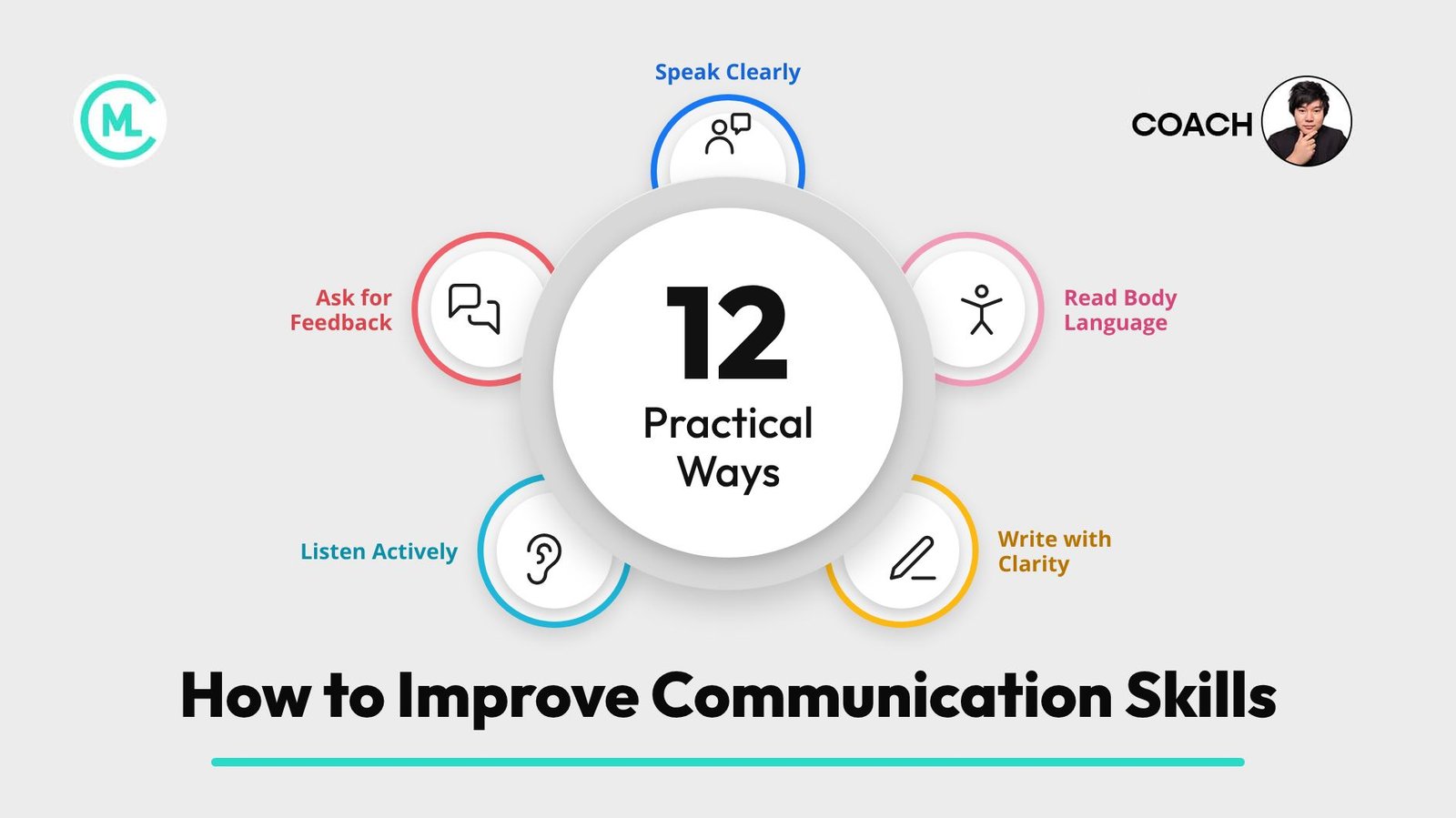
The 12 ways to improve communication skills are practicing active listening, asking open-ended questions, speaking clearly and concisely, preparing before important conversations, improving body language, managing tone of voice, managing emotions under stress, building empathy, asking for feedback, recording and reviewing practice, adapting to the audience, and practicing public speaking. Communication skills improve through deliberate practice, honest feedback, and daily repetition. The answer to how to improve communication skills is steady practice: small daily habits produce faster progress than rare big efforts. The sections below explain each method, the time that improvement takes, a 30-day plan, and practical steps for work, relationships, and school.
12 Ways to Improve Communication Skills
The 12 ways to improve communication skills are practicing active listening, asking open-ended questions, speaking clearly and concisely, preparing before important conversations, improving body language, managing tone of voice, managing emotions under stress, building empathy, asking for feedback, recording and reviewing practice, adapting to the audience, and practicing public speaking. The ways to improve communication skills follow a learning order: listening first, speaking second, emotions third, and feedback and audience last. The tips to improve communication skills below name the method, the reason the method works, 1 daily habit, and 1 example at work and in relationships. Effective communication skills grow fastest when a person practices 1 method at a time.
1. Practicing Active Listening
Practicing active listening improves communication skills, because full attention, paraphrasing, and clarifying questions prevent most misunderstandings. Active listening means hearing the full message before forming a reply. A 2014 study by Harry Weger and colleagues found that people who received active listening responses felt more understood than people who received advice or simple acknowledgments. Psychologist Michael P. Nichols describes listening as the core of every close relationship in the book The Lost Art of Listening. An active listener paraphrases at least once per conversation, such as “So the main problem is the deadline, right?” People who practice active listening for 1 week notice fewer repeated questions. A manager who paraphrases a team member’s concern before answering avoids a wrong solution. A partner who repeats the other person’s worry before offering advice makes the other person feel heard.
2. Asking Open-Ended Questions
Asking open-ended questions improves communication skills, because questions that start with “what” and “how” invite detailed answers and show interest. Closed questions end a topic with yes or no, while open-ended questions keep a conversation moving. A 2017 study by Karen Huang and colleagues at Harvard found that conversation partners rated people who asked more follow-up questions as more likable. The FORD method gives 4 easy topics for small talk: family, occupation, recreation, and dreams. A useful daily habit is 1 follow-up question after every answer. A team lead who asks “What slowed the project this week?” learns more than a team lead who asks “Is the project on track?” A person on a first date who asks “What got you into hiking?” turns a fact into a story.
3. Speaking Clearly and Concisely
Speaking clearly and concisely improves communication skills, because 1 main point in plain words is easier to understand and remember. Clear and concise communication states the main point first and adds only the necessary detail. Filler words, such as “um,” “like,” and “you know,” weaken a message and distract listeners. Jargon confuses listeners outside a field, so plain words reach a wider audience. A useful daily habit is a 1-sentence summary before every important message. An employee who says “The launch moves to Friday because the supplier is late” gives a manager the full picture in 1 sentence. A friend who says “I need a quiet night tonight” states a need without confusion.
4. Preparing Before Important Conversations
Preparing before important conversations improves communication skills, because a clear goal, 3 key points, and expected questions reduce rambling and stress. Preparation matters most for salary talks, performance reviews, presentations, and difficult conversations at home. The BRIEF framework organizes a short message into background, reason, information, end, and follow-up. Teams that prepare ahead of time hold shorter, more focused meetings. Writing the 3 key points on a note card keeps a speaker on track. A useful habit is 5 minutes of preparation before any conversation with high stakes. An employee who prepares 3 results and 1 request before a salary talk speaks with more confidence. A partner who plans a calm first sentence before a hard talk about money starts the conversation gently.
5. Improving Body Language
Improving body language improves communication skills, because eye contact, an open posture, and calm gestures confirm the spoken message. Nonverbal communication includes posture, gestures, facial expressions, eye contact, and personal space. Open body language includes uncrossed arms, relaxed shoulders, and a body turned toward the speaker. Positive body language, such as a smile and a nod, encourages the speaker to continue. Albert Mehrabian’s 1971 research found that listeners rely on tone of voice and facial expressions when a speaker’s words and feelings send inconsistent signals. Maintaining eye contact for a few seconds at a time signals attention without staring. A useful daily habit is a quick posture check at the start of every meeting or call. A job candidate who sits upright during an interview appears confident. A partner who puts the phone away and faces the speaker signals full attention.
6. Managing Tone of Voice
Managing tone of voice improves communication skills, because tone carries emotion and changes how listeners interpret the same words. The sentence “Fine, do it” sounds like agreement in a warm tone and like anger in a sharp tone. Pace and volume also shape tone: a slow, steady voice sounds calm, and a fast, loud voice sounds tense. Written messages carry tone too, so a short reply without a greeting often reads as cold. A useful daily habit is a second read of every important message for tone before sending. A support agent who lowers the voice with an upset customer calms the call. A partner who softens the tone during a disagreement keeps the conversation safe.
7. Managing Emotions Under Stress
Managing emotions under stress improves communication skills, because a calm speaker chooses words instead of reacting. Stress narrows attention and pushes people toward defensive or harsh replies. Daniel Goleman’s 1995 book Emotional Intelligence describes self-regulation as the control of impulsive reactions. People who develop emotional intelligence and manage emotions well notice stress signals, such as a tight jaw or a fast heartbeat, earlier. Quick stress relief, such as a slow breath or a short walk, helps keep stress in check before a hard talk. John Gottman’s research recommends a break of at least 20 minutes when a conflict becomes too heated, because the body needs time to calm down. An employee who waits 10 minutes before replying to a critical email writes a calmer answer. A partner who says “I need a short break, and then I want to finish this talk” protects the relationship during an argument.
8. Building Empathy
Building empathy improves communication skills, because understanding the other person’s feelings helps a speaker choose words that fit the listener. Empathy has 3 forms: cognitive empathy (understanding thoughts), emotional empathy (sharing feelings), and compassionate empathy (acting to help). Marshall Rosenberg’s book Nonviolent Communication teaches “I feel” statements that name a feeling and a need without blame. Daily curiosity about another person’s day, pressures, and goals helps people build empathy over time. A useful daily habit is 1 question about another person’s feelings, such as “How did that feel?” A team lead who notices a tired colleague and adjusts a deadline shows empathy at work. A partner who says “That sounds exhausting” before offering a solution shows empathy at home.
9. Asking for Feedback
Asking for feedback improves communication skills, because other people notice habits that a speaker misses, such as interrupting or a sharp tone. Specific questions produce useful feedback, while general questions produce polite answers. The question “What is 1 thing I could do better in meetings?” works better than “How am I doing?” Trusted colleagues, mentors, partners, and close friends give the most honest feedback. Constructive feedback names 1 behavior and 1 change, so the next step stays clear. Regular feedback creates feedback loops: practice, feedback, adjustment, and practice again. A useful habit is to ask for feedback once a week. An employee who asks a manager about presentation pace improves the next presentation. A partner who asks “Do I interrupt you often?” learns about a blind spot.
10. Recording and Reviewing Practice
Recording and reviewing practice improves communication skills, because a video or audio recording shows filler words, pace, and body language objectively. Most speakers talk faster and use more filler words than the speakers notice in the moment. A 2-minute phone recording of a practice answer reveals habits within minutes. A reflection journal adds the same benefit for real conversations: 1 note about what worked and 1 note about what to change. A useful habit is 1 short recording per week and 1 journal entry per day. A job seeker who records interview answers removes filler words before the real interview. A person who journals after a tense family dinner spots a repeated trigger.
11. Adapting to the Audience
Adapting to the audience improves communication skills, because each listener needs a different level of detail, tone, and channel. A technical team needs detail, a senior manager needs the bottom line, and a friend needs warmth. Knowing the audience means answering 3 questions before speaking: what the listener knows, what the listener needs, and what the listener feels. The channel matters as well: a quick chat message suits simple updates, and a call or meeting suits complex or emotional topics. A flexible communication style separates skilled communicators from average communicators. An engineer who explains a delay in plain language to a client adapts to the audience at work. A friend who switches from jokes to quiet support after bad news adapts to the moment.
12. Practicing Public Speaking
Practicing public speaking improves communication skills, because speaking to a group builds structure, confidence, and calm under attention. Public speaking practice transfers to meetings, interviews, and even first dates. Toastmasters International, founded in 1924 in Santa Ana, California, offers clubs where members give short speeches and receive structured feedback. Storytelling makes speeches memorable, because listeners follow a sequence of events more easily than a list of facts. A useful habit is to practice public speaking once a month, even with a 2-minute update at a team meeting. An analyst who presents results with 1 clear story gains attention at work. A best man who rehearses a wedding toast 5 times speaks calmly on the day.
Can Communication Skills Be Improved?
Yes, communication skills improve at any age, because communication skills are habits that change with practice and feedback. Communication skills are soft skills, not fixed talents, so a shy person and a confident person follow the same learning path. Research on active listening, emotional intelligence, and habit formation shows that deliberate practice changes communication behavior. Improvement in personal and professional life comes from small, repeated changes, such as 1 better question or 1 calmer reply each day. Age, personality, and past mistakes slow progress only when practice stops.
How Long Does It Take to Improve Communication Skills?
Noticeable improvement in communication skills takes about 2 to 3 months of daily practice, because new habits need repetition before the habits feel automatic. A 2010 study by Phillippa Lally and colleagues at University College London, published in the European Journal of Social Psychology, found that new daily habits took a median of 66 days to become automatic, with a range of 18 to 254 days. Simple habits, such as 1 paraphrase per conversation, form faster than complex habits, such as staying calm during conflict. Early progress appears within 2 to 4 weeks, when other people start to notice clearer messages and better listening. Consistency matters more than intensity, so 10 minutes of daily practice beats 2 hours of practice once a month.
What Is a 30-Day Plan to Improve Communication Skills?
A 30-day plan to improve communication skills focuses on 1 skill per week: listening, clarity, body language, and feedback. The plan shows how to improve communication skills step by step, and the weekly focus prevents overload, because each week builds on the week before. A personal communication plan works best with 1 measurable sign of progress per week. The table below shows the 4 weeks of the plan.
| Week | Focus skill | Daily practice | Sign of progress |
|---|---|---|---|
| Week 1 | Active listening | 1 paraphrase in every important conversation | Fewer repeated questions |
| Week 2 | Clarity | A 1-sentence summary before every message | Shorter emails and meetings |
| Week 3 | Body language and tone | A posture check and a tone check before each meeting | Calmer, more open conversations |
| Week 4 | Feedback | 1 feedback request and 1 journal entry per day | A clear list of strengths and next steps |
After 30 days, the plan repeats with the next weakest skill, such as empathy or public speaking.
How Do You Improve Communication Skills at Work?
Communication skills at work improve through clear emails, prepared meetings, regular feedback, and calm handling of disagreements. Workplace communication depends on the ability to communicate effectively with team members, managers, and customers. The National Association of Colleges and Employers (NACE) lists communication among the top attributes employers seek in the annual Job Outlook survey. A simple workplace communication strategy sets 3 rules: 1 channel for urgent issues, 1 channel for updates, and a written recap after every decision. Meetings improve with an agenda, a time limit, and named owners for each next step. Psychological safety, the belief that honest speech carries no punishment, keeps team members talking about problems early. Disagreements stay productive when each person describes the problem before proposing a solution. Strong communication skills in the workplace save time for every team and earn more trust from managers. The answer to how to improve communication skills at work starts with 1 clear email and 1 prepared meeting per day.
How Do You Improve Written Communication Skills?
Written communication skills improve through planning before writing, short sentences, a clear subject line, and proofreading before sending. Written communication carries most daily work messages, from emails to chat updates and reports. The 5 steps to improve written communication skills are below.
- Planning: A writer decides the goal and the 1 action for the reader.
- Main point first: The first 2 lines state the request, the deadline, or the decision.
- Short sentences: Sentences under 20 words keep emails and reports easy to scan.
- Clear subject lines: A subject line such as “Approval needed by Friday: Q4 budget” tells the reader what to do.
- Proofreading: A final read catches typos, wrong names, and a sharp tone before sending.
Spellcheck misses real words in the wrong place, such as “form” instead of “from,” so a human read stays essential.
How Do You Improve Communication in Remote Teams?
Communication in remote teams improves through agreed channels, short video calls for complex topics, written recaps, and quick acknowledgment of messages. Remote teams lose many nonverbal cues, so written messages need extra clarity and warmth. Asynchronous messages, such as email and chat, suit updates, while real-time calls suit decisions, conflicts, and brainstorming. Communication tools, such as Slack, Microsoft Teams, and Zoom, work best with clear rules for each channel. A written recap after every call keeps team members aligned across time zones. A short reply, such as “Got it, working on it today,” prevents a silence that colleagues read as neglect. Cameras on during short meetings help colleagues make eye contact and read facial expressions. A quick question at the end of a call helps the speaker check for understanding.
How Do You Improve Communication Skills in Relationships?
Communication skills in relationships improve through full attention, “I” statements, regular appreciation, and calm repair after arguments. Full attention means a silent phone, eye contact, and no multitasking during important talks. “I” statements, a core assertiveness tool, share a feeling without blame, such as “I feel worried when plans change late.” John Gottman’s research at the University of Washington found that stable couples maintain about 5 positive interactions for every 1 negative interaction during conflict. Appreciation, such as “Thank you for picking up the groceries,” adds positive interactions every day. Repair attempts, such as a joke, a gentle touch, or a simple “I’m sorry,” calm an argument before the argument escalates. Couples and friends who practice the habits above build stronger relationships over time.
How Do Couples Improve Communication?
Couples improve communication through a gentle start to hard topics, weekly check-ins, active listening without defensiveness, and short breaks when emotions run high. John Gottman calls a gentle opening a “soft startup,” such as “I feel stressed about money, and I want a plan together.” A harsh opening, such as “You always overspend,” predicts a harsh conversation. A weekly check-in of 20 minutes gives couples a calm space for small problems before small problems grow. Useful check-in questions include “What went well this week?” and “What does next week need from us?” Active listening without defensiveness means hearing a complaint fully before explaining. A break of at least 20 minutes helps when heart rates rise and clear thinking stops.
How Do You Improve Communication Skills for Dating?
Communication skills for dating improve through curious questions, clear plans, relaxed eye contact, and honest statements of interest. Curiosity creates connection on a first date, because good questions turn small talk into real conversation. A question such as “What’s something you’re looking forward to this month?” invites a story instead of a 1-word answer. Clear plans reduce anxiety: a text such as “Coffee at 4 on Saturday at Main Street Café?” leaves no confusion. Relaxed eye contact and a genuine smile signal warmth without words. An honest statement, such as “I had a great time, and I’d like to see you again,” shows confidence and respect. Follow-up messages that mention a detail from the date show active listening.
How Do You Improve Communication With Friends and Family?
Communication with friends and family improves through regular contact, patient listening, honest feedback, and sincere apologies. Regular contact keeps relationships close, even with a short message such as “Thinking of you. How did the interview go?” Patient listening matters most during hard weeks, when attention helps more than advice. Honest feedback, shared with care, prevents resentment from building over time. A sincere apology names the mistake, takes responsibility, and offers a change. Family conversations improve when parents model calm disagreement, because children copy the communication patterns at home.
How Can Students Improve Communication Skills?
Students improve communication skills through class discussions, group projects, presentations, and clear emails to teachers. Class discussions build the habit of sharing an opinion and responding to a classmate with respect. Group projects teach task division, deadlines, and conflict resolution in a shared chat. Presentations build public speaking skills and confidence in front of an audience. Clear emails to teachers, with a subject line and a polite request, build written communication skills. Debate clubs, student government, and volunteering offer extra practice outside class. Communication skills from school transfer directly to interviews, internships, and first jobs.
What Exercises Improve Communication Skills?
The 5 exercises that improve communication skills are paraphrase practice, the 1-minute summary, mirror practice, recorded conversations, and question chains. Exercises to improve communication skills turn communication tips into daily habits. The 5 exercises are below.
- Paraphrase practice: A partner speaks for 1 minute, and the listener restates the message before replying.
- The 1-minute summary: A speaker explains a news article or a work project in 60 seconds.
- Mirror practice: A speaker rehearses a short talk in front of a mirror to check facial expressions and posture.
- Recorded conversations: A speaker records a practice call and counts filler words afterward.
- Question chains: 2 people ask 5 follow-up questions in a row on 1 topic.
Role-play with a friend or a coach adds realistic pressure to every exercise. Communication skills training, such as workshops or coaching, adds structure to the same exercises.
What Mistakes Stop Communication Skills From Improving?
The mistakes that stop communication skills from improving include practicing without feedback, focusing only on speaking, avoiding difficult conversations, and trying to change every habit at once. The table below lists 6 common mistakes, the reason each mistake slows progress, and a better approach.
| Mistake | Why the mistake slows progress | Better approach |
|---|---|---|
| Practicing without feedback | Blind spots stay hidden | Asking 1 trusted person for weekly feedback |
| Focusing only on speaking | Listening drives most understanding | Starting with active listening |
| Avoiding difficult conversations | Difficult skills grow only under real pressure | Preparing and starting with a soft opening |
| Changing every habit at once | Too many goals cause overload | Practicing 1 skill per week |
| Reading tips without practice | Knowledge alone changes no behavior | Using 1 tip in a real conversation each day |
| Ignoring written messages | Most daily communication happens in writing | Rereading important messages for clarity and tone |
Each better approach turns 1 of the common communication mistakes into a habit that speeds up progress.
How Do You Know If Your Communication Skills Are Improving?
Improving communication skills show in fewer misunderstandings, calmer disagreements, shorter meetings, and more people who feel heard. The 6 signs of improving communication skills are below.
- Fewer misunderstandings: Colleagues and friends ask for fewer repeated explanations.
- Calmer disagreements: Arguments end with a plan instead of hurt feelings.
- Shorter meetings: Clear agendas and summaries cut meeting time.
- More honest conversations: Friends and partners share problems earlier.
- Better feedback: Managers and peers mention clarity and listening as strengths.
- Less stress: Difficult conversations feel manageable instead of frightening.
Strong communication skills show in the reactions of other people first, so feedback from others gives the most accurate measure.
Which Communication Skills Improve Fastest With Practice?
Active listening, clarity, and open-ended questions improve fastest, because each skill gives daily practice in every conversation. The 10 essential communication skills include active listening, clarity and conciseness, empathy, nonverbal awareness, confidence, emotional intelligence, open-ended questions, feedback, adaptability, and respect. Listening and questions improve within weeks, because every conversation offers a chance to practice. Practical communication exercises turn each method into a repeatable habit. Emotional intelligence and confidence take longer, because both skills depend on stress levels and self-belief. The guide on how to communicate with confidence breaks confidence into 35 practical ways. A communication coach speeds up every step of the plan with personal feedback and accountability. A focus on the fastest skills first builds momentum for the slower skills.
Which Communication Skills Examples Show Real Improvement?
Paraphrasing a message, writing a clear email, and staying calm in a difficult conversation show real improvement, because each example is visible to other people. The communication skills examples give concrete targets for practice at work and in relationships. A person who paraphrases once per conversation shows active listening. A person who writes a 3-line email with 1 clear request shows clarity. A person who pauses before replying in an argument shows emotional regulation. Visible examples turn private practice into public proof.
How Does Improvement Make Communication Effective?
Improvement makes communication effective when the receiver understands the message the way the sender intended. Effective communication follows the 7 Cs: clear, concise, concrete, correct, coherent, complete, and courteous. Speaking clearly and concisely applies the clear and concise Cs. Preparing before important conversations applies the complete and correct Cs. Managing tone of voice applies the courteous C. Each of the 12 ways moves a message closer to effective communication.
How Does Better Communication Overcome Barriers?
Better communication overcomes barriers by matching each barrier with a skill, such as emotional control for emotional barriers and plain language for language barriers. The barriers to communication include physical, emotional, language, cultural, and perceptual barriers. Managing emotions under stress removes emotional barriers. Adapting to the audience reduces cultural barriers. Active listening exposes perceptual barriers before a misunderstanding grows.
How Do Interpersonal Skills Grow With Communication Practice?
Interpersonal skills grow with communication practice, because teamwork, conflict resolution, and leadership depend on clear messages and attentive listening. Interpersonal skills include communication skills plus teamwork, patience, and leadership. Interpersonal communication is the exchange of messages between 2 or more people, and every method in the list improves that exchange. A person who practices active listening and empathy also becomes a better teammate, partner, and friend.
Why Does Improving Communication Matter at Every Level?
Improving communication matters at every level, because self-talk, conversations, meetings, and speeches all depend on the same core skills. The 5 levels of communication are intrapersonal, interpersonal, group, public, and mass communication. The importance of communication shows in trust, teamwork, career growth, and wellbeing at each level. The 12 practical ways to improve communication skills apply to every part of communication. More guides on communication are available in the Knowledge Hub.