
Elements of Communication: The 11 Key Components
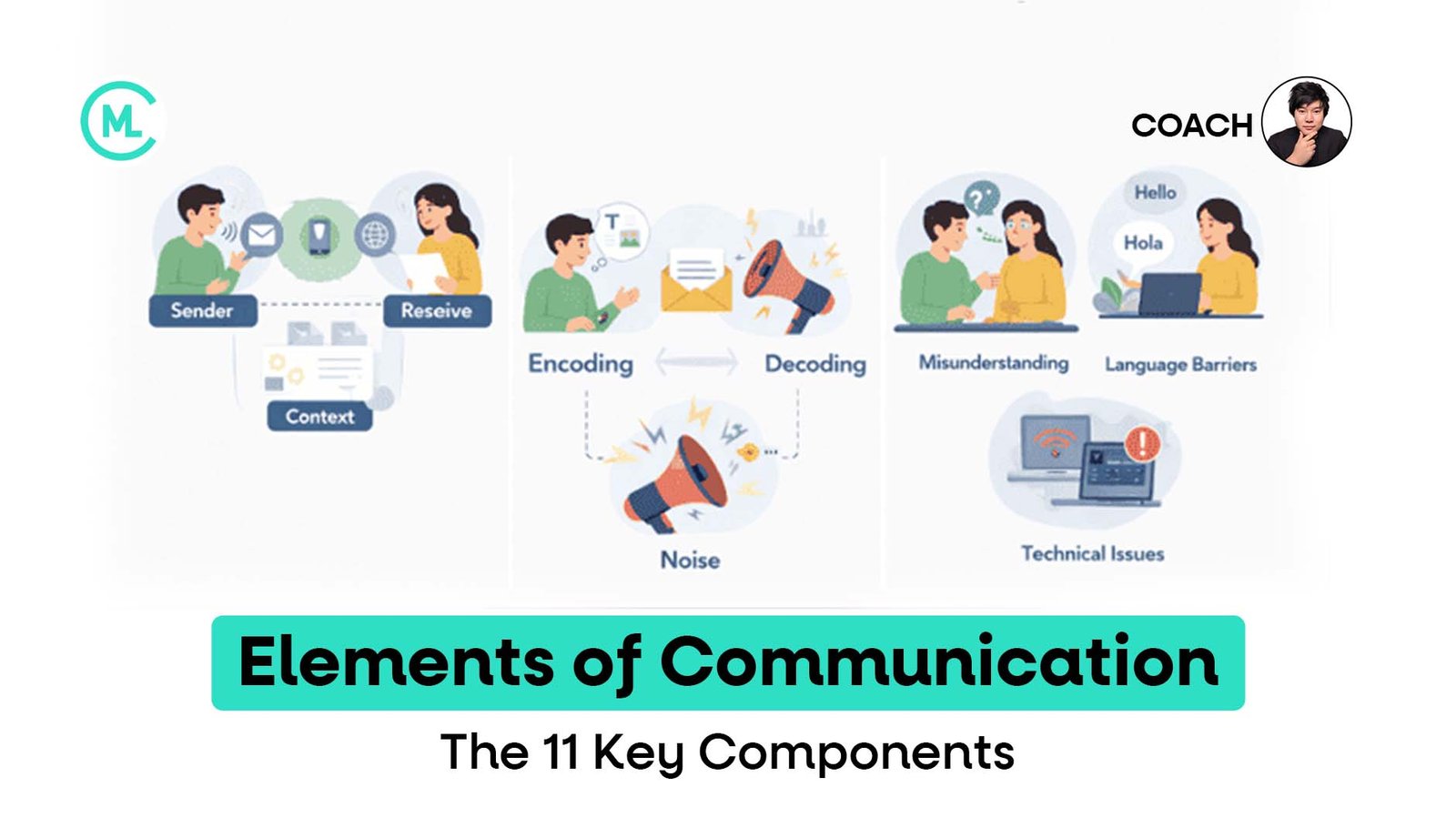
The elements of communication are the 11 key components that allow a message to travel from a sender to a receiver and create shared meaning. The 11 key components include 8 core elements: the sender, message, encoding, channel, receiver, decoding, feedback, and noise. The 11 key components also include 3 situational components: context, environment, and field of experience. Each element of communication plays a specific role, and a weakness in 1 element affects the whole exchange. Communication models, from Aristotle’s speaker-speech-audience model to Barnlund’s transactional model, include different combinations of the elements.
What Are the Elements of Communication?
The elements of communication are the individual components, such as the sender, message, channel, and receiver, that work together in every act of communication. The elements of communication are the parts of communication, while the communication process is the sequence in which the parts act. Every conversation, email, speech, and text message contains all 11 elements of communication, even when the people involved do not notice the elements.
The elements of communication explain why the same message succeeds in one situation and fails in another. A clear message fails when noise blocks the channel. A strong channel fails when the sender and receiver share little background. Each element of communication contributes to the final meaning that the receiver builds.
How Many Elements of Communication Are There?
The number of elements of communication ranges from 3 to 11, depending on the communication model. The 4 most common counts of the elements of communication are below.
- 3 basic elements: The sender, message, and receiver form the minimum structure of communication. Aristotle’s model and Wilbur Schramm’s “source, message, destination” describe the 3 basic elements.
- 8 core elements: The 8 core elements add encoding, channel, decoding, feedback, and noise to the 3 basic elements.
- 9 elements: The 9-element list adds context and is the most common list in communication textbooks and guides.
- 11 key components: The 11 key components add environment and field of experience to the 9-element list.
This guide uses 11 key components: 8 core elements and 3 situational components.
What Are the 11 Key Components of Communication?
The 11 key components of communication are the sender, message, encoding, channel, receiver, decoding, feedback, noise, context, environment, and field of experience. The 11 key components of communication are below.
- Sender: The sender is the person who creates and sends the message.
- Message: The message is the information, idea, or feeling that the sender shares.
- Encoding: Encoding converts thoughts into words, symbols, or gestures.
- Channel: The channel is the medium that carries the message.
- Receiver: The receiver is the person who receives and interprets the message.
- Decoding: Decoding is the receiver’s interpretation of the message.
- Feedback: Feedback is the receiver’s response to the message.
- Noise: Noise is any interference that distorts the message.
- Context: Context is the situation and relationship surrounding the exchange.
- Environment: The environment is the physical and psychological setting of the exchange.
- Field of experience: The field of experience is the background that each person brings to the exchange.
The first 8 components are core elements that appear in almost every communication model. The last 3 components are situational components that surround every exchange and shape the meaning of every message.
What Is the Sender in Communication?
The sender is the person or group who creates a message and starts the communication. Communication models also call the sender the source, the communicator, or the encoder. David Berlo’s SMCR model, published in 1960, identified 5 factors that shape the sender: communication skills, attitudes, knowledge, social system, and culture. The sender’s credibility and intent also affect how the receiver judges the message. A manager who gives instructions to a team and a friend who invites someone to dinner both act as senders.
What Is the Message in Communication?
The message is the information, idea, or feeling that the sender wants to share with the receiver. Every message contains 2 parts: a verbal part and a nonverbal part. The verbal part consists of spoken or written words. The nonverbal part consists of tone of voice, facial expressions, gestures, posture, and eye contact. Paul Watzlawick, Janet Beavin, and Don Jackson stated in 1967 that every message carries 2 levels of meaning: a content level, meaning the information, and a relationship level, meaning what the message signals about the relationship between sender and receiver. The request “Call me when you land” carries travel information and signals care at the same time.
What Is Encoding in Communication?
Encoding is the process of turning thoughts into words, symbols, gestures, or images that the receiver can understand. Encoding depends on the sender’s language, vocabulary, and knowledge of the receiver. Effective encoding uses words and symbols that the receiver already knows. A software engineer who tells a client “The server needs a patch” encodes the message in technical terms. The same engineer who says “The website needs a small repair” encodes the message in plain language that matches the client’s knowledge.
What Is the Channel in Communication?
The channel is the medium that carries the message from the sender to the receiver. The 4 main types of communication channels are below.
- Face-to-face channel: Face-to-face communication carries words, tone, facial expressions, and body language at the same time.
- Written channel: Written communication, such as letters, reports, and printed notices, carries words and creates a permanent record.
- Digital channel: Digital communication, such as email, text messages, chat apps, and video calls, carries messages instantly across distance.
- Broadcast channel: Broadcast and mass media, such as television, radio, and social media, carry 1 message to large audiences.
In face-to-face communication, the channel involves all the senses: sight, hearing, touch, and even smell. Richard Daft and Robert Lengel’s media richness theory, developed in the 1980s, ranks face-to-face communication as the richest channel, because face-to-face communication carries the most cues and allows immediate feedback.
What Is the Receiver in Communication?
The receiver is the person or group who receives the message and interprets the meaning of the message. Communication models also call the receiver the audience, the destination, or the decoder. Berlo’s 5 factors shape the receiver in the same way as the sender: communication skills, attitudes, knowledge, social system, and culture. The receiver’s emotional state and level of attention also affect how much of the message reaches understanding. A tired receiver at the end of a long day absorbs less information than a rested receiver in the morning.
What Is Decoding in Communication?
Decoding is the process in which the receiver interprets the sender’s words and signals to understand the intended meaning. Accurate decoding requires a shared language, awareness of context, and full attention. Encoding and decoding align when the receiver interprets the message the way the sender intended. Misunderstandings occur when encoding and decoding do not align. A text message that reads “Fine.” decodes as agreement to one receiver and as annoyance to another receiver.
What Is Feedback in Communication?
Feedback is the receiver’s response to a message, and feedback shows the sender whether the receiver received and understood the message. The 3 main pairs of feedback types are below.
- Verbal and nonverbal feedback: Verbal feedback uses words, such as a reply or a question. Nonverbal feedback uses signals, such as a nod, a smile, or a frown.
- Immediate and delayed feedback: Immediate feedback occurs during face-to-face conversations and phone calls. Delayed feedback occurs in emails, letters, and text messages.
- Positive and corrective feedback: Positive feedback confirms that the message worked. Corrective feedback shows that the message needs clarification.
Feedback turns one-way communication into two-way communication. Feedback also closes the communication loop, because the receiver’s response becomes a new message for the original sender.
What Is Noise in Communication?
Noise is anything that interferes with a message and distorts the meaning of the message between the sender and the receiver. Communication models also call noise interference or a barrier. Claude Shannon and Warren Weaver introduced noise as part of the communication model in 1948 and 1949. The 4 types of noise in communication are below.
- Physical noise: Physical noise is external interference, such as traffic sounds, loud music, or a weak phone signal.
- Physiological noise: Physiological noise is interference from the body, such as hunger, tiredness, illness, or hearing loss.
- Psychological noise: Psychological noise is interference from the mind, such as stress, bias, or assumptions about the sender.
- Semantic noise: Semantic noise is interference from language, such as jargon, ambiguous words, or unfamiliar terms.
Noise affects every element of communication, from the sender’s encoding to the receiver’s feedback.
What Is Context in Communication?
Context is the situation in which communication takes place, including the relationship, culture, timing, and purpose of the exchange. The 4 types of communication context are below.
- Social context: Social context is the set of social rules in a situation, such as a job interview or a birthday party.
- Relational context: Relational context is the relationship between the people, such as strangers, colleagues, friends, or partners.
- Cultural context: Cultural context is the shared norms, values, and language of each person’s culture.
- Temporal context: Temporal context is the timing of the message, such as right after an argument or late at night.
Context differs from environment. Context describes the situation and the relationships around a message, while environment describes the physical and psychological setting of the message.
What Is the Environment in Communication?
The environment is the physical and psychological setting where communication happens, such as a quiet office, a crowded café, or a tense meeting room. The environment has 2 parts. The physical environment includes the location, noise level, seating arrangement, lighting, and temperature. The psychological environment includes the mood, the level of formality, and the sense of safety that people feel in the setting. The environment shapes which messages feel appropriate. A joke that fits a relaxed dinner feels out of place in a formal board meeting.
What Is the Field of Experience in Communication?
The field of experience is the background of knowledge, culture, language, beliefs, and past experiences that each person brings to communication. Wilbur Schramm introduced the field of experience in 1954 and stated that communication succeeds when the sender’s field of experience and the receiver’s field of experience overlap. A message outside the receiver’s field of experience fails, because the receiver cannot connect the message to the sender’s original idea. Communication scholars also describe the field of experience as a person’s worldview. A doctor who explains a diagnosis to a patient faces a small overlap in medical knowledge. Two old friends who share inside jokes enjoy a large overlap in experience.
How Do the Elements of Communication Work Together?
The elements of communication work together in a loop: the sender encodes a message, the channel carries the message, the receiver decodes the message, and feedback returns to the sender. Noise enters the loop at any point and distorts the message. Context, environment, and field of experience surround the whole loop and shape how both people send and interpret each message.
The elements of communication depend on one another. A clear message fails through the wrong channel. A rich channel fails when noise fills the environment. A strong encoding fails when the receiver’s field of experience does not overlap with the sender’s field of experience. A weakness in 1 element of communication affects the whole exchange, and a strength in 1 element supports the others.
What Is an Example of the Elements of Communication?
A first-date dinner conversation is an example that shows all 11 elements of communication at once. The table below shows the role of each element of communication in a first-date conversation.
| Component | Role | Example |
|---|---|---|
| Sender | Starts the message | Alex asks Sam about a recent trip |
| Message | Carries the idea | “What was the best part of your trip to Japan?” |
| Encoding | Turns the idea into words and signals | A curious question, a smile, and a relaxed tone |
| Channel | Carries the message | Face-to-face conversation across the table |
| Receiver | Receives the message | Sam hears the question and sees Alex’s expression |
| Decoding | Interprets the meaning | Sam reads genuine interest in the question |
| Feedback | Returns a response | Sam describes a food market and leans forward |
| Noise | Distorts the message | Loud music from the next table |
| Context | Frames the situation | A first date between 2 people who met online |
| Environment | Sets the scene | A busy Italian restaurant on a Friday night |
| Field of experience | Shapes the meaning | Both people enjoy travel, so the topic connects quickly |
The first-date example shows that all 11 elements of communication operate together, even in a short exchange.
Which Communication Models Include Which Elements?
Each communication model includes a different set of elements, from Aristotle’s 3 elements to Barnlund’s transactional model. The table below lists the elements included in 6 major communication models.
| Model | Year | Elements included |
|---|---|---|
| Aristotle’s model | 4th century BC | Speaker, speech, audience |
| Lasswell’s model | 1948 | Communicator, message, medium, receiver, effect |
| Shannon-Weaver model | 1948–1949 | Source, transmitter, channel, noise, receiver, destination |
| Osgood-Schramm model | 1954 | Encoder, decoder, message, feedback, field of experience |
| Berlo’s SMCR model | 1960 | Source, message, channel, receiver |
| Barnlund’s transactional model | 1970 | Communicators as simultaneous senders and receivers, cues, context |
Communication models added more elements over time, from a one-way speaker model to a model of shared meaning.
Why Are the Elements of Communication Important?
The elements of communication are important because knowing each element shows exactly where a message succeeds or fails. The 4 main reasons the elements of communication are important are below.
- Diagnosing misunderstandings: Knowledge of the elements identifies the exact point of failure, such as noise, poor encoding, or a missing feedback loop.
- Choosing better channels: Knowledge of channel richness matches sensitive messages with face-to-face conversation.
- Adapting messages to the receiver: Awareness of the receiver’s field of experience produces messages that the receiver understands.
- Improving relationships and teamwork: Accurate communication builds trust between partners, friends, family members, and colleagues.
How Can You Strengthen Each Element of Communication?
Each element of communication becomes stronger through a specific habit, such as a clear purpose for the sender and full attention from the receiver. The table below lists a common problem and a strengthening habit for each of the 11 elements of communication.
| Element | Common problem | How to strengthen the element |
|---|---|---|
| Sender | Unclear purpose | A defined goal before the message |
| Message | Mixed verbal and nonverbal signals | Words, tone, and body language that match |
| Encoding | Jargon or vague words | Plain language matched to the receiver |
| Channel | Wrong medium for the message | Face-to-face conversation for sensitive topics |
| Receiver | Divided attention | Full attention without phones or multitasking |
| Decoding | Assumptions about meaning | Clarifying questions before a response |
| Feedback | Silence or unclear responses | Specific replies that confirm understanding |
| Noise | Distractions and interference | A quiet setting and simple wording |
| Context | Poor timing | Messages timed for calm moments |
| Environment | Tense or noisy setting | A private, comfortable space for important talks |
| Field of experience | Little shared background | Examples drawn from the receiver’s world |
Small improvements in each element of communication add up to clearer, more accurate communication.
How Do the Elements of Communication Apply to Interpersonal Communication?
In interpersonal communication, all 11 elements of communication operate at once, because both people send and receive messages at the same time. Interpersonal communication is 1 of the 5 levels of communication, alongside intrapersonal, group, public, and mass communication. In interpersonal communication, the relationship between the people becomes part of the context. Trust, history, and shared experiences change how each person encodes and decodes every message. A comment from a close friend and the same comment from a stranger produce different meanings, because the relational context differs.
What Is the Difference Between the Elements and the Steps of Communication?
The elements of communication are the parts involved in communication, while the steps of communication are the order in which the parts act. The 5 steps of the communication process are idea formation, encoding, transmission, decoding, and feedback. The elements describe what communication contains, and the steps describe how a message moves through the elements. Encoding, decoding, and feedback appear in both lists, because encoding, decoding, and feedback act as elements and as steps at the same time. The sender, receiver, channel, and noise stay present during all 5 steps.
How Do Nonverbal Cues Affect the Elements of Interpersonal Communication?
Nonverbal cues affect the elements of interpersonal communication by adding meaning to the message, the channel, and the feedback. Tone of voice changes the meaning of the same words. Facial expressions show emotion while the other person is speaking. Eye contact signals attention and interest. Nonverbal cues either support or contradict spoken words. Albert Mehrabian’s 1971 research found that listeners rely on tone of voice and facial expressions when a speaker’s words and feelings send inconsistent signals. A partner who says “I’m fine” with a flat tone and crossed arms sends a verbal message and a contradicting nonverbal message at the same time.
Which Interpersonal Skills Strengthen the Elements of Communication?
Interpersonal skills strengthen the elements of communication, including clarity for the message, active listening for decoding, and empathy for the field of experience. 4 interpersonal skills and the elements the skills strengthen are below.
- Clarity: Clarity strengthens the message and the encoding.
- Active listening: Active listening strengthens decoding.
- Constructive feedback: Constructive feedback strengthens the feedback loop.
- Empathy and cultural awareness: Empathy and cultural awareness widen the overlap between fields of experience.
How Does the Field of Experience Shape Interpersonal Relationships?
The field of experience shapes interpersonal relationships because people with overlapping backgrounds understand each other’s messages faster and with fewer misunderstandings. Shared experiences, such as inside jokes, common history, and shared values, increase the overlap between fields of experience over time. Long friendships and romantic relationships build a large overlap, so short messages carry rich meaning between close partners. New relationships start with a small overlap, so new acquaintances rely on common topics, such as work, hobbies, and hometowns, to build shared ground. Couples from different cultures build overlap through open questions about family traditions, values, and expectations. A small overlap between fields of experience is 1 of the most common barriers to communication.
How Do the Elements of Communication Change in Digital Communication?
The elements of communication change in digital communication because text-based channels remove tone of voice and body language, and feedback often arrives with a delay. Emojis, punctuation, and response time act as partial substitutes for nonverbal cues in text messages and chat apps. Video calls restore facial expressions and tone but add technical noise, such as lag and poor audio. The 11 key components remain the same across every channel, and the elements of communication explain why the same message works in person and fails in a text. More guides on communication are available in the Knowledge Hub.